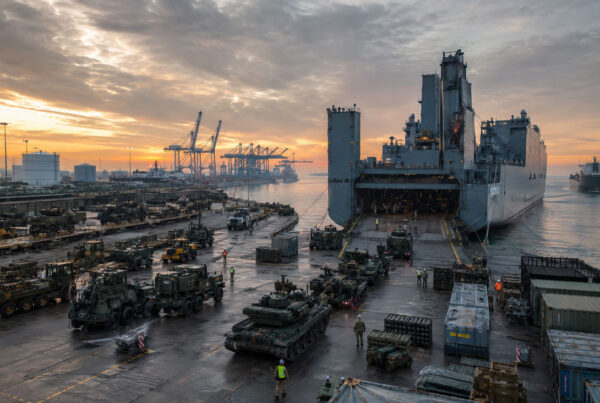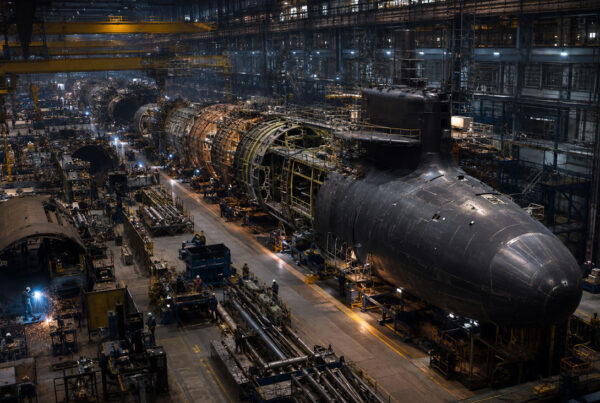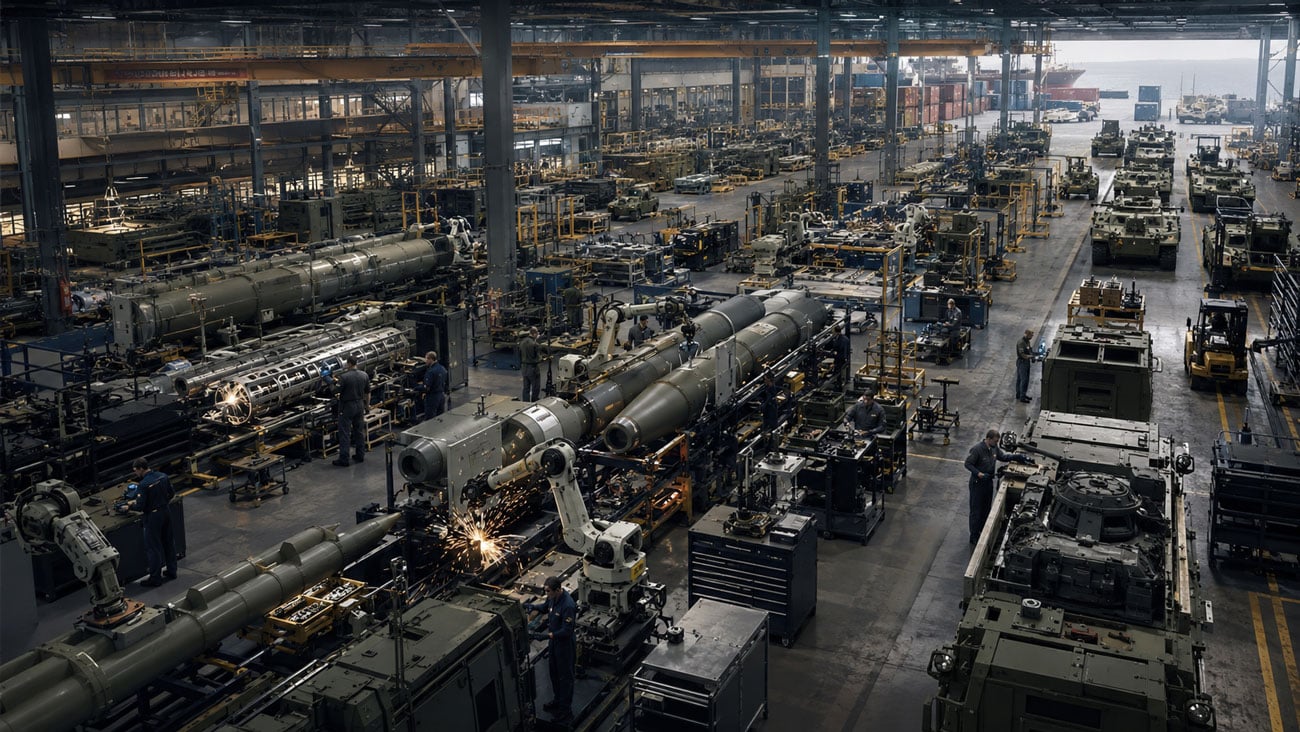
NATO has largely moved beyond the question of whether Allies will spend more. European Allies and Canada increased core defense spending by nearly 20 percent in 2025, the Alliance is implementing a 5 percent investment framework, and more than $50 billion in new procurements were announced at the 2026 Ankara Summit. The harder problem is conversion: turning money into contracts, contracts into industrial capacity, capacity into production, and production into interoperable military capability before the strategic need becomes urgent.
Bottom line: NATO’s next defense challenge is industrial conversion.
The Alliance has more money, more political commitment, and more demand than it did only a few years ago. What it does not automatically have is the factory capacity, skilled labor, supplier depth, standardization, tooling, energy, materials, and production time required to transform those commitments into usable military capability.
The strategic chain now looks like this:
money → contracts → capacity → production → fielded capability → replenishment.
Every arrow introduces friction.
The Spending Debate Is Giving Way to a Production Debate
For years, NATO burden-sharing conversations revolved around one number: 2 percent of GDP.
The debate has changed dramatically.
At the 2025 Hague Summit, Allies committed to invest 5 percent of GDP annually by 2035. At least 3.5 percent is intended for core defense requirements and NATO Capability Targets, while up to 1.5 percent can support defense- and security-related investments including critical infrastructure, networks, resilience, innovation, and the defense industrial base.
By the 2026 Ankara Summit, NATO reported that European Allies and Canada had increased core defense spending by nearly 20 percent in real terms in 2025 compared with 2024. NATO also announced more than $50 billion in new procurements around the Ankara Summit.
The political signal is clear.
The industrial question is harder:
Can the Alliance manufacture what its defense plans now require?
Money Moves Faster Than Manufacturing
A government can change a budget in one fiscal cycle.
A production system operates on physical timelines.
Capacity may require:
- new facilities;
- machine tools;
- specialized materials;
- qualified suppliers;
- skilled workers;
- quality systems;
- test infrastructure;
- permits;
- working capital;
- and predictable demand.
Those dependencies create an unavoidable delay between financial commitment and military output.
German defense supplier Renk illustrates the difference. In August 2026, the company reported record quarterly orders, first-half order intake of approximately €1.2 billion, and an order backlog of roughly €7.4 billion—while maintaining its full-year guidance.
A backlog is evidence of demand.
It is not the same thing as throughput.
NATO’s New Constraint Is Conversion
The Alliance increasingly faces a conversion problem:
- Can budgets become executable contracts?
- Can contracts justify capacity investment?
- Can capacity become qualified production?
- Can production become interoperable equipment?
- Can equipment become fielded readiness?
- Can wartime consumption be replenished?
A prime contractor can add final-assembly capacity while remaining constrained by one propulsion supplier. A factory can install new machines and still lack qualified operators. Multiple nations can order similar systems but reduce scale by demanding different configurations.
The meaningful metric is therefore not how much NATO spends.
It is how quickly spending becomes usable military capability.
That is fundamentally a strategic planning and capability-portfolio problem.
The ATACMS Example Shows Why Scaling Takes Time
One of the agreements highlighted around Ankara involves Lockheed Martin and Rheinmetall pursuing ATACMS production in Germany.
The strategic logic is straightforward. Additional European production could expand missile capacity, geographically distribute manufacturing, and strengthen replenishment.
But the effort also demonstrates the time required to build qualified industrial output.
Rheinmetall Chief Executive Armin Papperger said in August that revenue from the planned German production effort is expected beginning around 2028 and warned that rebuilding depleted missile inventories would take more than two years.
The lesson is larger than ATACMS.
A weapon needed during the opening phase of a conflict cannot depend on industrial capacity that begins expanding after the conflict starts.
Deterrence Requires Capacity Before the Surge
Commercial manufacturing rewards utilization.
Unused factory space, idle tooling, excess workers, and large inventories all carry cost.
Defense production has a different requirement: the industrial system may need to generate output far above normal peacetime demand during crisis.
A line already operating at its practical maximum has little room to surge.
Industrial resilience may therefore require intentionally maintaining some combination of:
- expandable facilities;
- reserve tooling;
- qualified second sources;
- supplier redundancy;
- strategic inventories;
- trained workforce pipelines;
- and contracts that sustain capacity before it is urgently needed.
From a narrow commercial perspective, some of that capacity may appear inefficient.
From a deterrence perspective, it is insurance.
Long-Term Demand Signals Matter More Than One-Year Orders
Industry faces a rational question before investing hundreds of millions of dollars:
Will the demand still exist when the new capacity comes online?
Facilities have to be financed. Equipment ordered. Workers recruited. Suppliers qualified. Production lines certified.
If governments provide only short-term or fragmented orders, firms have less incentive to build permanent capacity around uncertain demand.
NATO’s Industrial Capacity Expansion Pledge addresses this directly by emphasizing firm orders, contracts, multiyear procurement, aggregated requirements, and long-term investment.
The Alliance is not merely asking industry to manufacture more.
It is trying to create enough confidence for industry to build the ability to manufacture more.
Thirty-Two Customers Can Create Scale—or Fragmentation
NATO’s greatest industrial advantage is also one of its hardest coordination problems.
Thirty-two Allies can aggregate enormous demand.
They can also generate thirty-two sets of requirements, budget cycles, procurement laws, preferred suppliers, export restrictions, technical standards, and industrial policies.
If every country buys a slightly different version of the same capability, industrial complexity increases.
Factories manage more configurations. Spare parts diverge. Training diverges. Maintenance diverges. Supply chains fragment.
What appears politically as customization can become industrial inefficiency.
Standardization Is Industrial Policy
Interoperability is normally discussed in operational terms: can Allied systems communicate, exchange information, share ammunition, and support one another?
It also matters on the factory floor.
Common standards can enable:
- larger production runs;
- shared components;
- interchangeable munitions;
- simpler maintenance;
- larger supplier markets;
- and more flexible stockpiles.
NATO’s Industrial Capacity Expansion Pledge explicitly emphasizes common standards, multinational procurement, interoperability, and interchangeability where appropriate.
Standardization is therefore not simply doctrine.
It is a mechanism for converting 32 national markets into something closer to one industrial market.
Co-Production Is Changing the Transatlantic Defense Model
The traditional export relationship is straightforward: one country manufactures a weapon and another buys it.
The emerging model increasingly includes:
co-design → co-development → co-production → co-sustainment.
Distributed production can strengthen Alliance capacity by creating more manufacturing locations, maintenance options, skilled workforces, and supplier relationships.
It also creates technical and contractual demands:
- Who owns technical data?
- How is configuration controlled?
- Which components can be localized?
- How is quality verified across factories?
- How are export restrictions handled?
- Can output be redirected during crisis?
Co-production is therefore a systems-integration and transition challenge as much as an industrial policy.
European Capacity Does Not Have to Mean American Displacement
European rearmament is sometimes framed as a competition between U.S. and European contractors.
For Alliance readiness, the more useful objective is total trusted capacity.
Additional European manufacturing can supplement American output, create redundancy, shorten portions of supply chains, and place maintenance or replenishment capacity closer to European forces.
The strategic question should be:
Does the Alliance possess enough trusted, interoperable, geographically distributed capacity to sustain the fight?
That is a more useful definition of industrial sovereignty than requiring every capability to be produced entirely within one country.
National Industrial Policy Will Still Create Friction
Defense factories create jobs, intellectual property, tax revenue, strategic technology, and political constituencies.
Governments therefore have understandable incentives to direct spending toward domestic industry.
Those incentives can conflict with Alliance-wide efficiency.
Local-content requirements, export controls, national certification, preferred suppliers, and technology-sharing restrictions can make multinational production slower or more expensive.
NATO’s 2026 Ankara declaration explicitly commits Allies to reducing barriers to defense trade and strengthening transatlantic industrial cooperation.
The challenge will be translating that political commitment into rules that manufacturers can actually operate under.
NATO Is Building a Marketplace for Manufacturing Capacity
One of the most strategically interesting initiatives launched around Ankara is the NATO Engine.
The concept addresses a specific scaling problem: innovative companies may have mature products but not enough factory capacity to manufacture them in meaningful quantities.
NATO’s Innovation Scale-Up Package describes the Engine as a network connecting companies—particularly nontraditional suppliers and small and medium-sized enterprises—with manufacturers and factories that have flexible production capacity.
In practical terms, it is a form of factory-for-hire infrastructure.
The NATO Support and Procurement Agency launched the pilot on July 16, 2026. NSPA says the network will initially focus on additive manufacturing, engineering services, and manufacturing-as-a-service.
The model could shorten the path from successful prototype to industrial output without requiring every defense startup to finance a factory first.
The NATO Engine Expands the Definition of the Defense Industrial Base
The initiative also recognizes that useful defense manufacturing capacity exists outside traditional primes.
Relevant capabilities may sit inside:
- automotive manufacturers;
- commercial aerospace suppliers;
- electronics firms;
- precision machine shops;
- industrial automation companies;
- additive manufacturers;
- and contract manufacturers.
NATO’s own language explicitly contemplates civilian factories participating in the Engine.
That matters for newer categories of defense technology built around shorter production cycles and more commercial components.
The Alliance’s industrial base may ultimately be much larger than the companies historically labeled “defense contractors.”
Small Companies Need Production Paths, Not Just Innovation Programs
Western defense institutions have become much better at discovering technology.
Accelerators, prototype contracts, innovation funds, challenges, and venture investment can identify promising products.
The hard question arrives after the demonstration:
How does a 70-person company manufacture 20,000 units?
Scaling requires working capital, component sourcing, cybersecurity, quality systems, workers, production engineering, supplier management, maintenance planning, and facilities.
NATO’s 2026 Innovation Scale-Up Package explicitly recognizes manufacturing capacity as a major barrier for nontraditional firms.
The innovation problem has become a scaling problem.
Supplier Depth Determines Whether New Factories Create Real Capacity
A prime contractor can announce a new factory and still fail to increase final output proportionally.
Complex weapons depend on layers of suppliers producing propulsion, electronics, energetic materials, seekers, actuators, castings, precision components, navigation systems, and specialized materials.
If final assembly expands but one critical sub-tier supplier does not, the bottleneck moves rather than disappears.
Industrial-base planning therefore has to look below Tier 1:
- Which component has the longest lead time?
- Which supplier serves several weapons programs?
- Which material has limited sources?
- Which process requires unique equipment?
- Where should a second source be qualified?
- Which supplier lacks capital to expand?
Industrial capacity is defined by the weakest critical dependency in the production chain.
This is where supplier, resource, workforce, and capacity planning becomes readiness planning.
The Hypersonics Problem Is the Same Industrial Problem at a Smaller Scale
The industrial dynamics visible across NATO rearmament are also visible inside individual advanced weapons programs.
Low production rates, specialized suppliers, test bottlenecks, manufacturability, quality, workforce, and demand signaling all determine whether a technically successful weapon becomes a usable inventory.
Diamondback’s analysis of why hypersonics now face an industrialization challenge examines the same conversion problem at the weapon-system level.
The scale differs.
The industrial logic does not.
Workforce Is the Capacity That Takes Longest to Surge
Factories need more than machines.
They need qualified machinists, welders, engineers, energetic-material specialists, software developers, metallurgists, electronics technicians, inspectors, production managers, and maintainers.
Some skills can be developed quickly.
Others require years.
That makes workforce a leading indicator of future capacity rather than an HR issue that can be solved after construction is complete.
Capital investment and workforce planning have to occur together.
The same dynamic is explored in Diamondback’s analysis of why defense workforce capacity is becoming a readiness constraint.
Advanced Manufacturing Is Attracting Strategic Capital
One encouraging sign is that private capital is increasingly moving beyond defense software and weapons startups into the manufacturing infrastructure supporting them.
On August 6, U.S. advanced-manufacturing company Hadrian announced a $1.37 billion financing round, bringing its valuation to nearly $8 billion. The company builds software- and automation-heavy manufacturing infrastructure for aerospace and defense customers.
The significance is broader than one financing event.
Investors increasingly recognize that defense technology cannot scale if the factory ecosystem behind it does not scale as well.
NATO’s Innovation Scale-Up Package makes the same point from the public-sector side by explicitly calling for additional private capital to support production expansion.
Industrial Software Is Becoming Part of Rearmament
Expanding output is not only about constructing more buildings.
Software can increase utilization and quality inside existing capacity through:
- production scheduling;
- digital work instructions;
- automated inspection;
- predictive maintenance;
- supply-chain analytics;
- digital twins;
- robotics;
- inventory visibility;
- and AI-assisted process optimization.
The strongest rearmament strategy combines:
new physical capacity + better use of existing capacity.
That makes industrial data, software, and technology enablement part of defense production strategy.
Industrial Cybersecurity Becomes Alliance Security
Factories and suppliers hold weapons designs, production schedules, technical data, software, engineering information, and supplier relationships.
A cyberattack can therefore reduce military production without physically destroying a plant.
Ransomware can interrupt manufacturing. Espionage can compromise intellectual property. Supply-chain attacks can insert vulnerabilities. Attacks on utilities or connected operational technology can halt production.
As more commercial manufacturers and smaller companies enter the defense ecosystem, the cyber boundary expands.
The Alliance needs participation requirements that are secure enough to protect the mission but scalable enough that they do not prevent capable smaller manufacturers from entering.
Production Geography Is Part of Resilience
Concentrating critical manufacturing in a small number of locations creates efficient scale.
It also creates vulnerability.
Physical attack, infrastructure failure, natural disaster, energy shortages, transportation disruption, or cyber incidents can reduce regional output.
Distributed production creates another form of resilience.
Different Allies can manufacture components, maintain systems, and replenish stockpiles from multiple locations.
Redundancy can cost more during peacetime.
So can losing access to production during conflict.
Readiness Should Include Industrial Mobilization Time
Military readiness is usually described through forces, training, equipment availability, and stockpiles.
Another metric deserves equal attention:
How long does it take the industrial base to increase output after demand changes?
Call it industrial mobilization time.
If missile production requires four years to double, war planners need to understand that. If a drone manufacturer can multiply output in six months, that matters too. If one machine has a 30-month lead time, that dependency should be visible before the factory becomes the constraint.
Industrial capacity has timelines just as deployment and logistics do.
Orders Should Be Designed With the Factory in Mind
Procurement decisions can either increase or reduce industrial efficiency.
Governments can:
- aggregate demand;
- use multiyear commitments;
- standardize configurations where practical;
- use common components;
- qualify second sources;
- fund tooling and capacity expansion;
- and provide suppliers better visibility into future requirements.
These are purchasing decisions.
They are also production-design decisions.
A modern weapon system should increasingly be designed not only for battlefield performance but for production performance.
Alliance Strategy Has to Reach the Factory Floor
The 2026 Ankara Summit made industry more explicit inside NATO strategy.
The Alliance endorsed a new Strategy for Industry-NATO Cooperation focused on better communication with industry, interoperability, innovation, and strengthening, scaling, and sustaining production.
NATO also launched the Front Door for Industry and announced plans for a consolidated unclassified demand signal to give companies better visibility into future capability needs.
This is a significant shift.
Industry is no longer simply a vendor engaged after governments decide what to buy.
Industrial capacity itself is becoming an input to defense planning.
That requires enterprise governance and execution discipline connecting plans, procurement, production, suppliers, and delivery.
The Alliance Does Not Need Thirty-Two Separate Arsenals
Every NATO nation does not need to manufacture every category of military capability.
The more efficient objective is a distributed Alliance industrial network with complementary strengths.
One country may specialize in artillery. Another in armored vehicles. Another in missiles. Another in aerospace. Another in naval systems, electronics, or autonomy.
The strategic value lies in making those industrial bases work collectively.
That requires interoperability not only among militaries.
It requires interoperability among industrial bases.
Spending Is Input. Capability Is Output.
The growth in NATO defense spending is strategically significant.
So are the $50 billion-plus in procurements announced at Ankara, the new production partnerships, new investment mechanisms, and new factories.
But none is the final objective.
A contract is not a missile.
A factory announcement is not throughput.
A budget is not readiness.
The strategic work occurs in the conversion between those stages.
NATO has begun attacking that problem through clearer demand signals, longer-term procurement, standardization, transatlantic industrial cooperation, manufacturing networks, private capital, and initiatives such as the NATO Engine.
The next test of Alliance defense investment will therefore not occur primarily in a summit hall.
It will occur across machine shops, missile lines, electronics plants, chemical facilities, shipyards, test centers, training pipelines, and supplier networks throughout Europe and North America.
NATO increasingly has the money.
The harder transformation is turning that financial commitment into industrial power—and industrial power into military capability that exists before the Alliance needs to use it.
Primary Sources
- NATO — 2025 Hague Summit and 5 percent defense-investment framework
- NATO — 2026 Ankara Summit Declaration
- NATO — 2026 defense investment update for Europe and Canada
- NATO — Innovation Scale-Up Package and NATO Engine
- NATO Support and Procurement Agency — NATO Engine pilot launch
- NATO — Strategy for Industry-NATO Cooperation
- NATO — Industrial Capacity Expansion Pledge
- Reuters — Renk 2026 orders and backlog
- Reuters — Rheinmetall and ATACMS production timeline