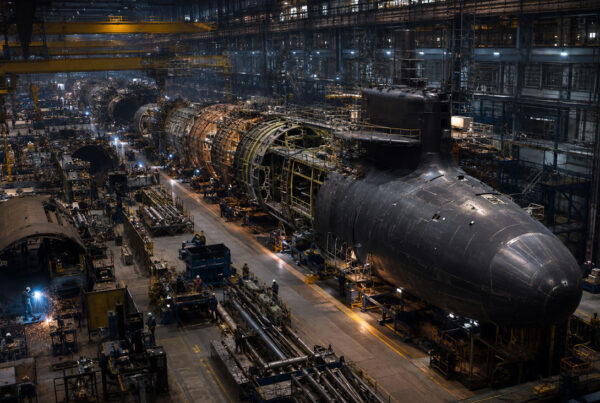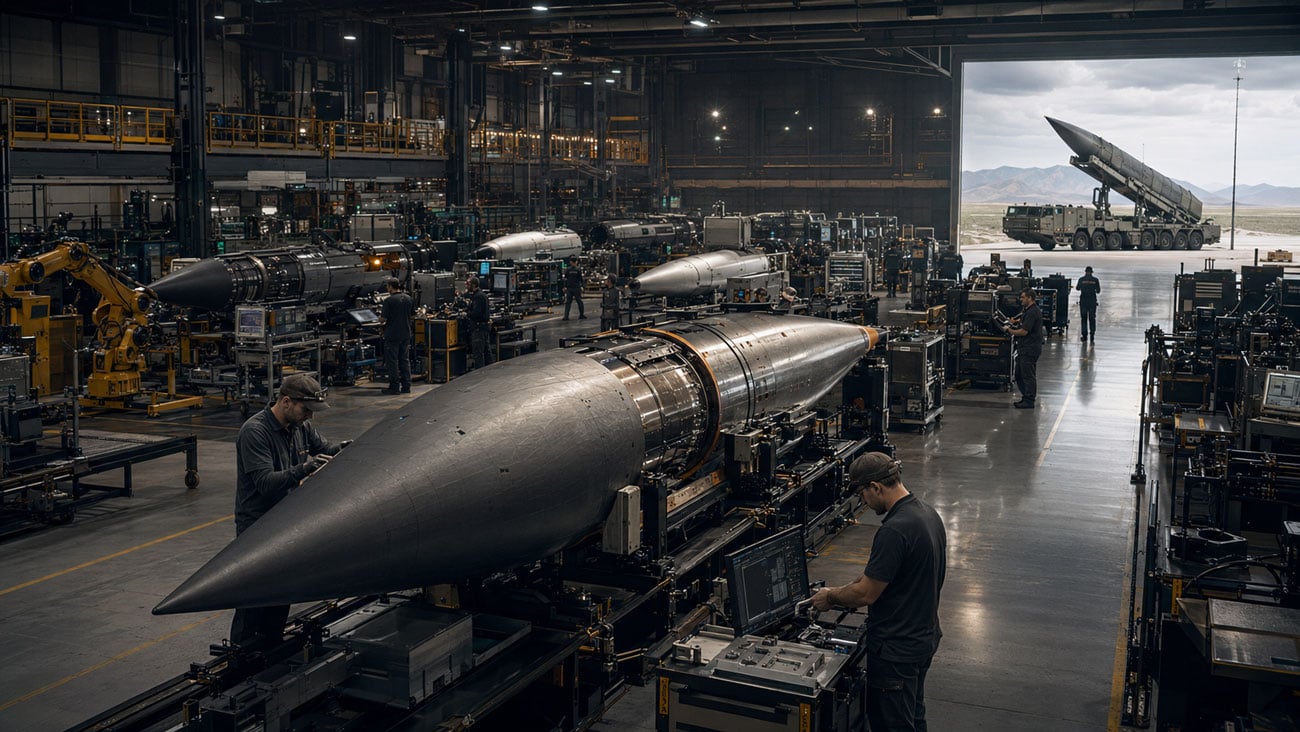
Hypersonic weapons are crossing from demonstration into operational use, but the harder problem is now industrial. The Army is training with Dark Eagle, the Army and Navy have continued testing a common missile, and billions of dollars are committed to the capability. Yet GAO says production remains well below a goal of only 12 rounds per year. The next hypersonic race will be determined by whether the United States can turn an exquisite prototype into a repeatable, affordable, supportable inventory.
Bottom line: the United States has largely moved beyond proving that hypersonic weapons can work. The next challenge is proving that the defense enterprise can manufacture, integrate, test, field, sustain, and replenish them at a rate that changes military behavior.
A successful flight test demonstrates technical performance. An operational arsenal requires something harder: repeatable production, stable suppliers, acceptable quality, common governance, platform integration, trained units, test capacity, logistics, and enough inventory that commanders are willing to use the weapon when it matters.
That is the transition now confronting Dark Eagle and Conventional Prompt Strike.
The Hypersonic Problem Is Changing
For much of the past two decades, America’s hypersonic weapons challenge could be summarized with one question: Can it work?
Can a glide body survive extreme thermal loads? Can it maneuver predictably above Mach 5? Can guidance remain accurate enough for a conventionally armed weapon? Can boosters, structures, materials, navigation, and launch equipment survive the complete mission profile?
Those questions still matter. But by 2026 another question has become just as consequential:
Can America build the weapon repeatedly, at predictable quality and cost, in numbers large enough to matter?
The Army’s Long-Range Hypersonic Weapon, Dark Eagle, is no longer confined to developmental events. Soldiers trained with the system during Valiant Shield 2026 in the Indo-Pacific. On March 26, 2026, the Army and Navy successfully launched their common hypersonic missile from Cape Canaveral. Five days later, Army Contracting Command awarded a $2.7 billion contract supporting Dark Eagle development, testing, and production.
The capability is entering the operational world.
Now comes production engineering.
A Successful Flight Test Is One Weapon
Hypersonic flight tests compress years of engineering into minutes. A booster ignites, the missile accelerates, the glide body separates, and the system attempts to survive an extreme flight environment while reaching the required target area.
That is a major technical achievement.
It does not prove that a production system can build the same weapon over and over again with consistent quality, predictable schedule, and controlled cost.
Prototype development asks whether engineers can build an object capable of extraordinary performance.
Production asks whether an industrial enterprise can reproduce it:
- with stable drawings;
- repeatable processes;
- qualified suppliers;
- controlled configuration;
- predictable inspection;
- and sufficiently low defect rates.
That difference is fundamental. A weapon does not become militarily mature when one article flies. It becomes mature when the industrial system can keep producing acceptable rounds after the early articles have been consumed.
GAO’s 12-Round Production Goal Shows the Scale of the Challenge
GAO’s July 17, 2026 review of Navy hypersonic integration provides one of the clearest indicators of where the program now stands.
The Navy is installing Conventional Prompt Strike (CPS) aboard all three Zumwalt-class destroyers and plans future integration aboard some Virginia-class submarines. The Army is acquiring the same common missile architecture for Dark Eagle.
Across the connected programs, GAO says the Department plans to invest at least $50 billion in developing, testing, producing, and fielding the capability.
Yet CPS has encountered quality and production problems that have pushed output well below the production goal of 12 missile rounds per year.
Twelve rounds annually is not a mass-production objective. It is a low-rate objective.
If the industrial base cannot reliably achieve that rate, the challenge is no longer primarily whether hypersonics are technically possible. It is whether the program can escape prototype economics.
Production Quantity Changes Military Behavior
A military behaves differently when it has ten weapons than when it has hundreds.
A scarce missile is preserved. Target approval becomes more restrictive. Every expenditure creates a larger opportunity cost. Inventory becomes part of operational planning.
A deeper inventory changes that equation. Commanders can support more targets, sustain pressure, replace expended rounds, distribute weapons across theaters, and absorb losses or maintenance interruptions.
That means production quantity is not merely an industrial metric.
Inventory depth changes the operational utility of the weapon.
Production is therefore part of deterrence. An adversary sees something different in one experimental battery than in multiple operational batteries backed by a production system capable of continuous replenishment.
Hypersonics Need to Fit Inside a Larger Strike Portfolio
Hypersonic weapons are valuable because they can combine speed, maneuverability, range, and survivability against time-sensitive or heavily defended targets.
But not every target requires that combination.
A mature long-range strike portfolio needs tiers:
- lower-cost weapons for volume;
- cruise missiles;
- ballistic systems;
- air-launched weapons;
- hypersonic weapons;
- and increasingly autonomous long-range effects.
The important question is not which weapon is most advanced. It is which weapon produces the required effect at acceptable cost, risk, and inventory burden.
This is a portfolio and force-design problem. Hypersonics should be preserved for missions in which speed and survivability materially change the outcome.
Manufacturability Has to Become a Design Requirement
The industry is beginning to reflect this change in priorities.
In June 2026, Lockheed Martin announced a next-generation hypersonic glide-body concept built around what the company called a manufacturing-first approach, emphasizing affordability, rapid producibility, and scalability.
The terminology matters.
Breakthrough weapons programs traditionally focus first on performance: achieve the speed, range, maneuverability, thermal tolerance, and accuracy. Manufacturing problems are addressed later.
That sequence becomes dangerous when the nation ultimately needs inventory.
Manufacturability belongs inside the original engineering trade space:
- How many unique materials are required?
- How many specialized machining steps?
- How much hand finishing?
- How long does inspection take?
- Which component controls production rate?
- Can multiple suppliers manufacture it?
- Can the design tolerate normal production variation?
- Can automation reduce labor or cycle time?
That is where transformational engineering meets industrial engineering.
The Best Military Design Is Not Always the Maximum-Performance Design
Imagine two hypersonic weapons.
One achieves slightly better theoretical performance but depends on a single specialized material, extensive hand processing, and a long inspection cycle.
The other gives up a modest amount of performance but can be produced several times faster by a broader supplier base.
Which is the better military weapon?
The answer depends on the mission. But in sustained conflict, manufacturability can become part of combat performance.
A weapon’s military value includes the probability that another round can replace it after launch.
The Army-Navy Common Missile Should Create Scale
The partnership between Dark Eagle and Conventional Prompt Strike provides an important industrial opportunity.
The Army and Navy share a common hypersonic missile while employing it from different platforms. Commonality should create advantages through shared components, suppliers, test data, manufacturing learning, and aggregate demand.
The March 26, 2026 joint flight test demonstrated the continued Army-Navy common-missile approach. The concept should help the Department avoid building two entirely independent industrial bases for similar weapons.
But common hardware does not automatically create common enterprise management.
GAO Found Common Hardware but Fragmented Governance
GAO found that Army and Navy personnel coordinate on day-to-day program activity but continue to make many larger investment decisions separately.
That includes decisions affecting the shared production line.
GAO concluded that the Department lacks a comprehensive strategy for coordinating investments across the common hypersonic capability and warned that fragmented decision-making contributes to inefficiency and delay.
This is a classic enterprise-governance problem.
A supplier constraint affects both services. A production-line investment can benefit both services. A quality problem can delay both services. A decision about capacity should therefore be evaluated against the combined national requirement rather than one program’s annual budget in isolation.
The production line is effectively part of the joint weapon system.
The Production Line Needs an Enterprise Operating Model
Treating production as a joint capability means answering questions above the program level:
- What annual output does the nation ultimately require?
- How should Army and Navy demand be sequenced?
- Which investment increases total throughput most?
- Which supplier is the controlling constraint?
- Who funds supplier expansion?
- What inventory should be maintained?
- What surge rate is required?
- How quickly can capacity be increased during conflict?
Those are operations-management and production-governance questions as much as acquisition questions.
Platform Integration Can Cancel Out Production Progress
Manufacturing the missile is only one part of fielding it.
GAO reported that the Navy’s effort to modernize its three Zumwalt-class destroyers for CPS is currently 24 months behind schedule. Flight testing from the ship, originally planned for 2025, is now planned for 2027.
That delay demonstrates another important truth: a missile is never just a missile.
The complete operational system includes:
- launchers;
- platform modifications;
- fire control;
- mission planning;
- communications;
- targeting;
- software;
- maintenance;
- training;
- and logistics.
A larger missile inventory does not become combat power if ships, submarines, launchers, targeting systems, or units cannot employ it.
That is why systems architecture and integration must mature alongside production.
Testing Is Part of the Industrial Base
Hypersonic systems depend on specialized test infrastructure: wind tunnels, propulsion facilities, materials laboratories, telemetry, high-speed tracks, instrumented ranges, and flight corridors.
Those resources are limited.
As more programs mature, test capacity can become a production and schedule constraint in its own right.
A flight article can be ready while a test window is not. A production change can require validation that competes with other programs for the same infrastructure.
Test capacity therefore belongs inside industrial-base planning rather than being treated as a separate developmental activity.
Flight Testing Cannot Be the Factory’s Primary Quality System
Flight tests are indispensable, but they are too expensive and infrequent to function as the main manufacturing feedback loop.
Scaled production requires confidence from lower-cost and earlier forms of verification:
- digital engineering;
- hardware-in-the-loop testing;
- materials characterization;
- component testing;
- nondestructive inspection;
- simulation;
- automated quality systems;
- and high-fidelity ground testing.
The factory needs to detect defects before they consume an assembled missile or an expensive flight article.
That makes manufacturing data strategically important. Configuration history, supplier data, inspection results, test outcomes, and quality trends should allow engineers to see systemic problems before they become schedule failures.
This is a natural application for AI-augmented analytics and decision support, provided the underlying production data are trustworthy and well governed.
Quality Problems Are Throughput Problems
In advanced weapons manufacturing, quality and production speed are not opposing goals.
A defective component that reaches final assembly consumes technician time, inspection capacity, schedule margin, replacement material, and test resources. A defect discovered even later can destroy an entire flight article.
The fastest production line is therefore not the one moving the most material.
It is the one producing the greatest number of accepted, reliable weapons per unit of time.
First-pass quality is throughput.
The Real Production Ceiling May Be Several Tiers Down
Final assembly gets the attention, but the true capacity limit may sit inside a small supplier producing one specialized component.
Hypersonic weapons can depend on advanced thermal materials, propulsion components, energetics, guidance electronics, actuators, high-temperature structures, specialized machining, and other difficult manufacturing processes.
A prime contractor can expand final assembly and still produce no additional rounds if a constrained supplier cannot increase output.
Scaling production therefore requires visibility beneath Tier 1:
- Which parts have only one qualified supplier?
- Which materials have long lead times?
- Which machines or processes cannot be duplicated quickly?
- Where are workforce constraints concentrated?
- Which suppliers lack the capital to expand?
- Where should second sources be qualified?
That is where supply-chain and resource planning become weapons-readiness issues.
Second Sources Can Matter More Than a Second Final-Assembly Line
Industrial redundancy does not always require another complete missile factory.
In many cases the more valuable investment is a second source for the component that can halt the entire production system: another materials supplier, machining source, electronics provider, energetics producer, or thermal-protection process.
The difficulty is economic. Very low annual quantities can make multiple suppliers difficult to sustain.
This creates a paradox:
Low production makes redundancy expensive, but insufficient redundancy makes future high production difficult.
The government may therefore need to invest in capacity before normal procurement economics would justify it.
Workforce Learning Is Part of Production Capacity
Hypersonic manufacturing depends on specialized engineers, machinists, quality professionals, test specialists, propulsion experts, materials scientists, and systems engineers.
Production learning accumulates over time. Workers become faster. Processes stabilize. Tooling improves. Defects fall. Suppliers learn which tolerances create problems and which processes can be simplified.
A production line that repeatedly stops and restarts loses more than output. It can lose experience.
Stable demand matters because industrial knowledge is embodied partly in people and repeated practice.
Industry Needs a Credible Demand Signal
Manufacturers cannot rationally size capacity without understanding the government’s long-term requirement.
A supplier will invest differently for 12 missiles per year than for 120. Facilities, tooling, automation, supplier agreements, hiring, and raw-material commitments all depend on expected demand.
The Department eventually needs more than a requirement to “field hypersonics.”
It needs clarity around:
- desired inventory;
- annual production rate;
- platform demand;
- minimum stockpile;
- wartime consumption assumptions;
- and surge requirements.
Without that signal, companies have an incentive to avoid building capacity that may sit unused.
The FY2026 Budget Shows Hypersonics Remain a Major Commitment
CRS reports that the Department’s FY2026 budget submission requested approximately $13.4 billion in procurement and research-and-development funding across offensive and defensive hypersonic warfare programs.
That level of investment shows hypersonics remain a major defense priority.
But spending is not the end-state metric.
The meaningful measures are increasingly operational:
- How many rounds were accepted?
- How many launch platforms can employ them?
- How many trained units exist?
- What is the replenishment rate?
- How resilient is the supplier base?
- How quickly can production surge?
Those are inventory and readiness questions.
Dark Eagle Is Entering the Operational World
Valiant Shield 2026 illustrates how far the Army has moved from early prototyping. Soldiers are now training with Dark Eagle in an Indo-Pacific exercise environment where long-range land-based fires have direct operational relevance.
That is a major milestone—but it is also the beginning of the next phase.
Operational batteries need ammunition, maintenance, training, spare parts, communications, targeting, movement concepts, reload procedures, and access to the theater infrastructure required to employ the system.
A launcher without sufficient rounds eventually becomes transportation equipment.
The Next Hypersonic Breakthrough May Happen Inside a Factory
For years, the defining images of hypersonic development came from test ranges: ignition, acceleration, flight, and impact.
The next decisive breakthroughs may be less dramatic:
- a component redesigned for fewer production steps;
- a new automated inspection process;
- a second qualified supplier;
- a better thermal material;
- a digital quality system that identifies defects earlier;
- a machining process that cuts cycle time;
- or a production line that consistently delivers more accepted rounds each year.
None produces a spectacular launch video.
Collectively, those improvements determine whether the technology becomes an arsenal.
GAO’s finding that current CPS production remains well below a goal of only 12 rounds per year should focus attention on that transition.
The United States has demonstrated that it can build hypersonic weapons capable of extraordinary performance.
Now it has to demonstrate something different:
that the weapons can become ordinary enough to manufacture reliably, repeatedly, and in numbers that matter.
America’s next hypersonic race will still be fought above Mach 5.
But it may be won at the speed of the production line.
Primary Sources
- U.S. GAO — Navy Ship Modernization: DOD Needs Comprehensive Strategy to Field Hypersonic Missile Capability
- U.S. Army — Army and Navy Continue Tests of Hypersonic Missile
- U.S. Army — Behind Dark Eagle: Contracting at the Speed of Hypersonic
- U.S. Army — Dark Eagle at Valiant Shield 26
- Congressional Research Service — FY2026 Defense Budget: Funding for Selected Weapon Systems
- Lockheed Martin — Affordable, Scalable Hypersonic Glide Body