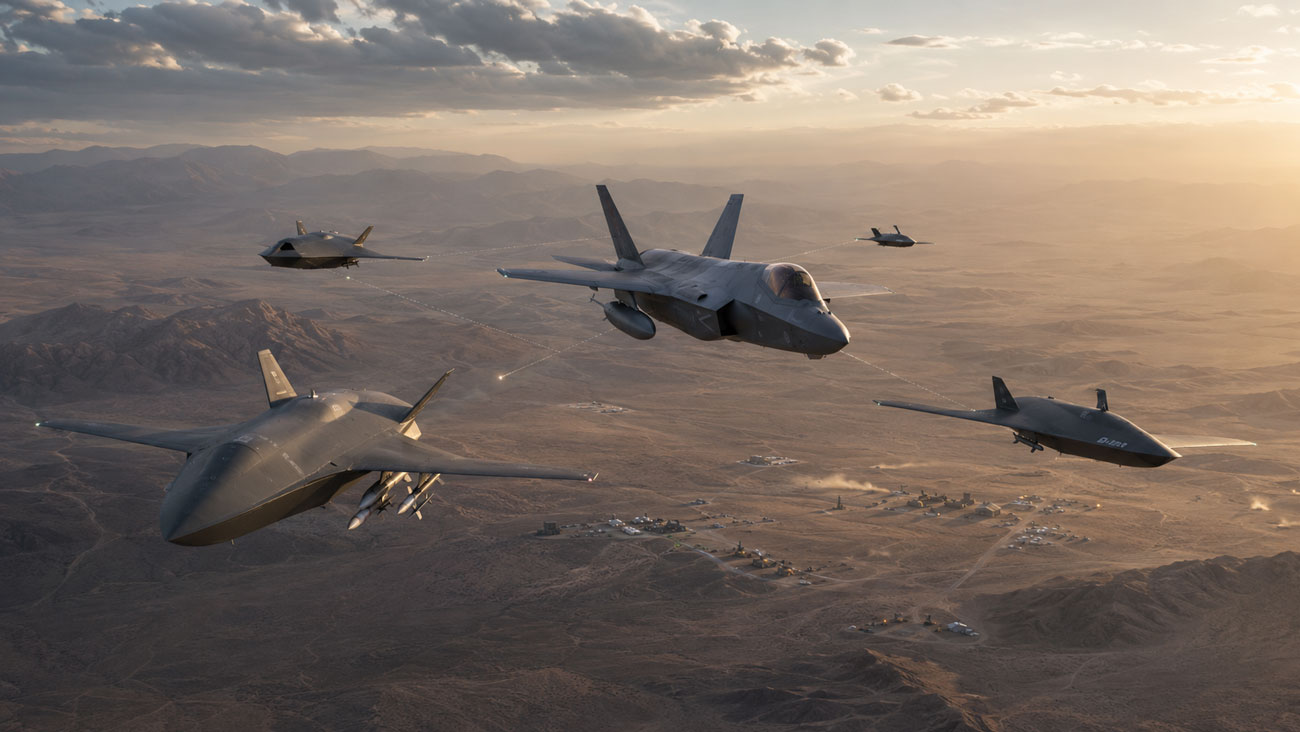
The Air Force is turning Collaborative Combat Aircraft into more than a new class of uncrewed fighter. By procuring competing airframes, mission-autonomy software, and open interfaces separately, the service is testing a different model of military acquisition—one in which hardware, software, payloads, and operational concepts can evolve at different speeds while remaining part of the same combat system.
Bottom line: the most important feature of the Air Force’s Collaborative Combat Aircraft program may not be the aircraft themselves. It may be the decision to separate the air vehicle from the mission-autonomy software that makes it useful—and to preserve competition across both.
In June 2026, the Air Force selected General Atomics’ FQ-42 and Anduril’s FQ-44 for engineering, manufacturing development, and production. At the same time, it created a six-vendor marketplace for mission autonomy and awarded initial production options to Anduril, RTX Collins Aerospace, and Shield AI.
The deeper change is architectural.
Compete the airframe. Compete the autonomy. Maintain the interfaces. Upgrade each layer on its own timeline.
That is not simply a new way to buy an aircraft. It is an experiment in how future military capability may be assembled.
The Fighter Is Becoming a System of Systems
For most of aviation history, military capability has been organized around the aircraft.
The airframe, engine, radar, electronic warfare, weapons, software, mission computer, and pilot are integrated into a single platform. That platform becomes a major acquisition program and then receives upgrades over decades.
Collaborative Combat Aircraft challenge that model.
The Air Force awarded production contracts for both the FQ-42 and FQ-44 on June 17, 2026, four months ahead of its planned decision point. The service says it intends to procure more than 150 combat-capable CCA by the end of the decade and ultimately field approximately 1,000.
Those aircraft are important. But the Air Force made another decision that may prove more consequential: it did not make one aircraft manufacturer the permanent owner of the autonomy layer.
Instead, mission autonomy is being procured through a separate competitive structure.
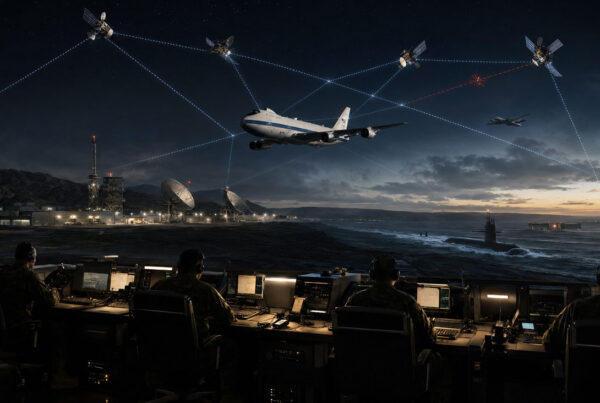
The aircraft is becoming one component inside a larger combat architecture.
The FQ-42 and FQ-44 Have Moved Beyond Prototype Status
The CCA program has progressed quickly.
General Atomics and Anduril were selected in 2024 to build production-representative test aircraft. Flight testing followed. By February 2026, the Air Force had entered weapons-integration and captive-carry testing with inert munitions.
On July 15, the service announced that a YFQ-44A had fired an AIM-120 air-to-air missile at a digital target over the Mojave Desert. The event followed earlier evaluations of aircraft handling, weapon carriage, and data-link integration.
Later that month, both CCA types were operating at Creech Air Force Base during an Agile Combat Employment exercise. The Experimental Operations Unit used the event to study the practical questions that determine whether a promising aircraft becomes an operational capability:
- How should CCAs be armed?
- How small can the support footprint become?
- How should crews service and relaunch them?
- How do they integrate with crewed aircraft?
- What tactics, techniques, and procedures are required?
- How well do they operate from dispersed locations?
This is the transition from technology demonstration to operational integration and force generation.
The Objective Is Not an Uncrewed F-35
CCA are often described as “drone wingmen.” That description is useful, but incomplete.
The objective is not simply to remove the pilot from a traditional fighter.
A crewed fighter concentrates extraordinary capability inside one expensive, scarce aircraft. It also places a trained aviator at risk and creates a significant maintenance and sustainment burden.
A lower-cost uncrewed aircraft changes the commander’s decision space. It can carry weapons, extend sensing, perform electronic attack, relay communications, act as a decoy, operate farther forward, or accept risks that would be inappropriate for a crewed platform.
The concept therefore increases the combat influence of the crewed force rather than merely replacing it.
Instead of asking how much capability can fit inside one fighter, the Air Force can ask:
How much capability can one human command across a formation?
Affordable Mass Changes the Geometry of Air Combat
Consider a formation of crewed fighters joined by a larger number of semi-autonomous aircraft.
Some CCAs may carry weapons. Others may collect sensor data, perform electronic warfare, extend communications, or create decoys. The adversary has to determine which aircraft are most important, which are armed, which are sensing, and which are shaping the battlespace for another platform.
The number of tactical problems confronting the adversary grows faster than the number of American pilots placed at risk.
That is the logic behind “affordable mass.”
But the concept works only if affordable eventually becomes producible at scale. A tiny fleet of exquisite uncrewed aircraft would simply recreate the scarcity problem.
The Air Force Is Separating Software From Hardware
This is where the CCA program becomes especially important from an acquisition perspective.
The Air Force has established a government-owned Autonomy Government Reference Architecture (A-GRA). In February 2026, the service demonstrated that the architecture could support autonomy from different vendors on different CCA aircraft.
The Air Force’s stated objective is explicit: decouple mission software from vehicle hardware, reduce vendor lock, and create a competitive ecosystem.
That is a major departure from the traditional vertically integrated defense platform.
Under the emerging model:
- the airframe can compete;
- the autonomy can compete;
- payloads can change;
- software can iterate faster than hardware;
- and the government retains control of the architectural rules that connect them.
This is a direct example of open systems architecture as technology enablement.
“Software Sold Separately” Changes the Acquisition Model
The Air Force itself describes the mission-autonomy strategy as “software sold separately.”
The June production decision created a six-vendor baseline pool consisting of:
- Anduril;
- General Atomics;
- Lockheed Martin;
- Northrop Grumman;
- RTX Collins Aerospace;
- and Shield AI.
The service also awarded initial production options to Anduril, RTX Collins, and Shield AI for the first of two six-month competitive phases. A primary Increment 1 mission-autonomy provider is planned to be selected by summer 2027.
The important feature is that the competition does not end with the first aircraft award.
The Air Force can continue evaluating autonomy providers, licensing software, introducing new capabilities, and rewarding performance as the technology evolves.
That is acquisition reform embedded in the system design.
Architecture Determines Market Structure
Defense acquisition reform is often discussed in terms of contracting authorities, paperwork, and decision speed.
CCA demonstrates something more fundamental:
technology architecture can determine whether future competition is practical.
A proprietary interface makes changing vendors expensive. A government-controlled interface creates a pathway for another supplier to enter.
A software layer permanently tied to one airframe makes future competition difficult. Portable software allows the government to compare autonomy independently from the aircraft.
That means modular open systems are not merely an engineering preference. They are a way to preserve government optionality.
This is where systems engineering and acquisition transformation converge.
The Air Force Is Trying to Prevent Vendor Lock Before It Forms
Vendor lock does not require bad intent. It often emerges naturally from complexity.
A contractor develops proprietary software. Custom interfaces evolve. Government personnel learn one ecosystem. Other systems integrate around it. Sustainment processes mature. Eventually, another company may theoretically be able to compete, but switching becomes prohibitively difficult.
CCA offers the Air Force an opportunity to confront that problem before the ecosystem hardens.
By owning A-GRA and requiring continuing compliance, the government preserves the rules by which software connects to the aircraft.
That creates strategic optionality:
- a better autonomy provider can enter;
- a weaker provider can lose market share;
- a new company can compete without building an entire aircraft;
- and a future airframe can potentially inherit an existing software ecosystem.
The Air Force Has Built Continuous Competition Into the Program
The June decision preserved two competing airframes rather than consolidating Increment 1 around a single production line.
The autonomy marketplace is even broader.
Competition therefore continues after award.
That creates market pressure, but also resilience. If one airframe experiences a technical problem, another production line exists. If one autonomy provider advances faster, the Air Force can compare performance. If a new entrant develops a breakthrough, the architecture is intended to provide an integration path.
This is a portfolio strategy rather than a winner-take-all platform strategy.
Human Control Remains Central to Weapons Employment
The July live-fire test also clarified an important boundary.
The Air Force said CCA will not autonomously employ weapons. Weapon release remains a human decision.
That does not mean the aircraft must be manually flown in the traditional sense.
A semi-autonomous system can execute complex behavior within human-defined mission parameters. The human can command intent while the aircraft handles lower-level execution.
The difference is significant.
The operator does not need to dictate every maneuver. The system may navigate, maintain formation, manage fuel, position itself, avoid conflicts, or perform assigned tasks autonomously while human authority remains over mission objectives and lethal employment.
One Pilot Cannot Become a Drone Traffic Controller
Human-machine teaming fails if autonomy simply transfers more workload onto the human.
A fighter pilot already manages sensors, weapons, communications, navigation, threats, formation responsibilities, and a rapidly changing tactical picture.
If the pilot also has to manually control several CCAs, the architecture has created burden rather than combat power.
Mission autonomy must therefore operate at a high enough level that humans can command objectives rather than micromanage movement.
This is one reason autonomy software may ultimately be more consequential than any single CCA airframe.
Trust Is an Operational Performance Metric
Autonomy can work technically and still fail operationally if users do not trust it.
If pilots expect unpredictable behavior, they will spend cognitive capacity monitoring the system. If maintainers do not understand degraded modes, support becomes cautious. If commanders cannot predict how the aircraft will interpret instructions, they may restrict employment.
Trust has to be earned through:
- predictable behavior;
- clear system status;
- realistic testing;
- human override;
- transparent degraded modes;
- repeatable failure handling;
- and operational exercises.
This is where AI and autonomy need governance, testing, and human oversight rather than simply more sophisticated algorithms.
Contested Communications Make Local Autonomy Essential
CCA cannot assume continuous connectivity.
A sophisticated adversary will attempt to disrupt data links, satellite communications, GPS, radar, and other parts of the electromagnetic environment.
That creates a paradox: CCAs must collaborate with humans, but they must remain useful when communications become intermittent.
Depending on the mission and policy constraints, a CCA that loses connectivity may still need to:
- fly safely;
- maintain an assigned area;
- manage fuel;
- avoid friendly aircraft;
- return to a rendezvous point;
- follow previously authorized mission logic;
- or recover autonomously.
The more contested the communications environment becomes, the more valuable competent local autonomy becomes.
Open Architecture Has to Survive Degraded Conditions
Software portability is easiest to demonstrate under ideal conditions.
The harder test is whether different combinations of airframes, autonomy, sensors, and communications systems behave predictably when information becomes incomplete or contradictory.
What happens when GPS disappears? When bandwidth collapses? When an aircraft leaves the network? When a sensor becomes unreliable? When the human changes the mission while communications are intermittent?
Those are not edge cases. They are combat conditions.
The reference architecture therefore has to support not only technical interoperability but predictable operational behavior across heterogeneous systems.
Mission Autonomy May Outlive the First Aircraft
If the Air Force succeeds in creating portable mission autonomy, the software ecosystem may become strategically more durable than the first CCA airframes.
Airframes change. Autonomy can potentially migrate.
The concepts developed for collaborative air combat may influence future reconnaissance aircraft, electronic-warfare platforms, logistics systems, maritime autonomy, or aircraft that do not yet exist.
The long-term strategic asset could therefore be the government-owned architecture and the vendor ecosystem developing against it.
That resembles successful commercial technology platforms: the most important layer is sometimes not the device, but the environment that allows new applications and hardware to connect.
Production Is as Important as Autonomy
The CCA concept is also an industrial-base experiment.
The Air Force wants approximately 1,000 combat-capable CCAs over time. That requires a manufacturing model different from one optimized for extremely small fleets of exquisite aircraft.
The question becomes:
How quickly can industry build another combat-capable aircraft?
Design decisions affect production rate. Specialized materials, handcrafted processes, single-source components, difficult inspection, and bespoke tooling can all constrain affordable mass.
Manufacturability therefore becomes a combat requirement.
That connects CCA directly to industrial-base, supply-chain, and resource planning.
Attritable Does Not Mean Disposable
CCA are frequently discussed through the concept of attritability.
Attritable does not mean an aircraft is casually expendable. It means commanders may be more willing to accept its loss than the loss of a crewed and exceptionally expensive platform.
CCA occupies a space between expendable munitions and multidecade crewed aircraft:
capable enough to contribute repeatedly, affordable enough to employ more aggressively, and manufacturable enough that losses can be replaced.
The balance among capability, cost, survivability, and replacement rate will determine whether the concept delivers affordable mass in practice.
Logistics Could Become the Hidden Constraint
Autonomous aircraft still need fuel, weapons, maintenance, spare parts, software, ground equipment, transportation, and operating locations.
A fleet of 150 aircraft creates one support problem. A future force approaching 1,000 creates another.
The July Creech exercise is important partly because the Air Force used it to examine real weapon-loading, servicing, relaunch, and distributed-operating requirements. The service explicitly said the exercise helped validate the reduced logistics footprint needed for remote and forward locations.
The cost to buy the aircraft is only part of affordability.
The cost and complexity of operating the fleet matter too.
Agile Combat Employment Should Shape the Aircraft
The Air Force is simultaneously designing around Agile Combat Employment: dispersing forces across more locations so an adversary has fewer lucrative fixed targets.
CCA should fit naturally into that model, but only if the support architecture remains lean.
A platform that requires specialized facilities, large contractor teams, or unique ground equipment can undermine its own operational flexibility.
Distributed CCA operations favor:
- small support teams;
- rapid turnaround;
- common weapons;
- modular replacement;
- resilient communications;
- and limited specialized infrastructure.
The aircraft can be advanced. Its support model should be deliberately uncomplicated.
The CCA Marketplace May Matter More Than Increment 1
The words Increment 1 are strategically important.
They imply that the FQ-42 and FQ-44 are not intended to become permanent end-state designs.
Future increments can introduce new airframes, mission sets, payloads, manufacturing approaches, and autonomy. The procurement mechanism itself becomes part of the capability because it provides a recurring path for better technology to enter the force.
The ideal outcome is not a CCA program that eventually becomes “finished.”
It is an ecosystem capable of repeated modernization.
The Wrong Outcome Would Be Another Closed 30-Year Monolith
Every successful weapon system develops institutional gravity.
Training organizations form. Maintenance infrastructure grows. Contracts expand. Suppliers invest. Users become accustomed to the system. Interfaces harden.
CCA’s long-term challenge will be preserving the flexibility it currently possesses.
Will new airframe companies receive meaningful opportunities? Will software remain portable? Will A-GRA stay government-controlled? Will autonomy competition remain real? Will payload providers be able to enter without depending on one prime?
Those questions matter because open architecture creates value only if the government continues to use it as an open architecture.
Contractors Will Compete at More Than the Platform Level
A modular CCA ecosystem changes opportunities across the defense industry.
A company may never build the aircraft and still compete to provide:
- mission autonomy;
- sensors;
- electronic warfare;
- communications;
- weapons integration;
- edge computing;
- mission software;
- simulation and test;
- or sustainment technology.
That broadens the industrial base, but it also raises the standard.
Products must integrate with architectures the supplier does not own. Interoperability becomes part of competitive performance.
The Air Force Is Testing an Operating Model for Future Weapons
CCA is usually described as an aviation program.
It may ultimately be just as important as an acquisition, software, and industrial-base experiment.
The Air Force has:
- moved competing prototype aircraft into full-scale manufacturing;
- preserved two airframe providers;
- separated mission autonomy from the aircraft;
- validated a government-owned autonomy architecture across vendors;
- created a six-company software marketplace;
- begun live-fire weapons testing;
- and established an Experimental Operations Unit to develop tactics and support concepts alongside the technology.
Taken together, those choices amount to something larger than another aircraft program.
They represent a new approach to assembling and evolving military capability.
The Future Fighter May Be a Formation
For generations, airpower has concentrated extraordinary capability inside individual aircraft.
CCA introduces another path.
One aircraft may see. Another may carry weapons. Another may perform electronic attack. Another may extend communications. Another may operate farther forward.
Software coordinates the formation. A human commander provides intent.
The individual aircraft becomes one node inside a larger combat system.
That is why the title “Collaborative Combat Aircraft” is more important than “uncrewed fighter.”
The Most Important CCA May Not Have Been Designed Yet
The FQ-42 and FQ-44 matter because they are turning the concept into real production aircraft.
But the larger promise of CCA is that the architecture should allow the force to improve without waiting for one platform to complete a decades-long upgrade cycle.
Future autonomy can improve independently. New airframes can compete. Payloads can change. New suppliers can enter. Operational lessons can shape the next increment.
If that model works, the decisive future CCA may be an aircraft that does not exist today—running autonomy that has not been written, carrying a payload that has not been designed, but able to enter the force rapidly because the interfaces, competitive marketplace, test infrastructure, and operational model were built to accept change.
That is the deeper promise of Collaborative Combat Aircraft: not simply an autonomous wingman, but a combat-aircraft ecosystem designed to evolve.
Primary Sources
- U.S. Air Force — CCA air vehicle and mission-autonomy production contracts, June 17, 2026
- U.S. Air Force — A-GRA open architecture validation, February 12, 2026
- U.S. Air Force — CCA weapons integration and captive-carry testing
- U.S. Air Force — YFQ-44A AIM-120 live-fire test, July 15, 2026
- U.S. Air Force — CCA Agile Combat Employment exercise at Creech AFB, July 28, 2026
- Air Force Life Cycle Management Center — Release of foundational open architecture standards, July 28, 2026