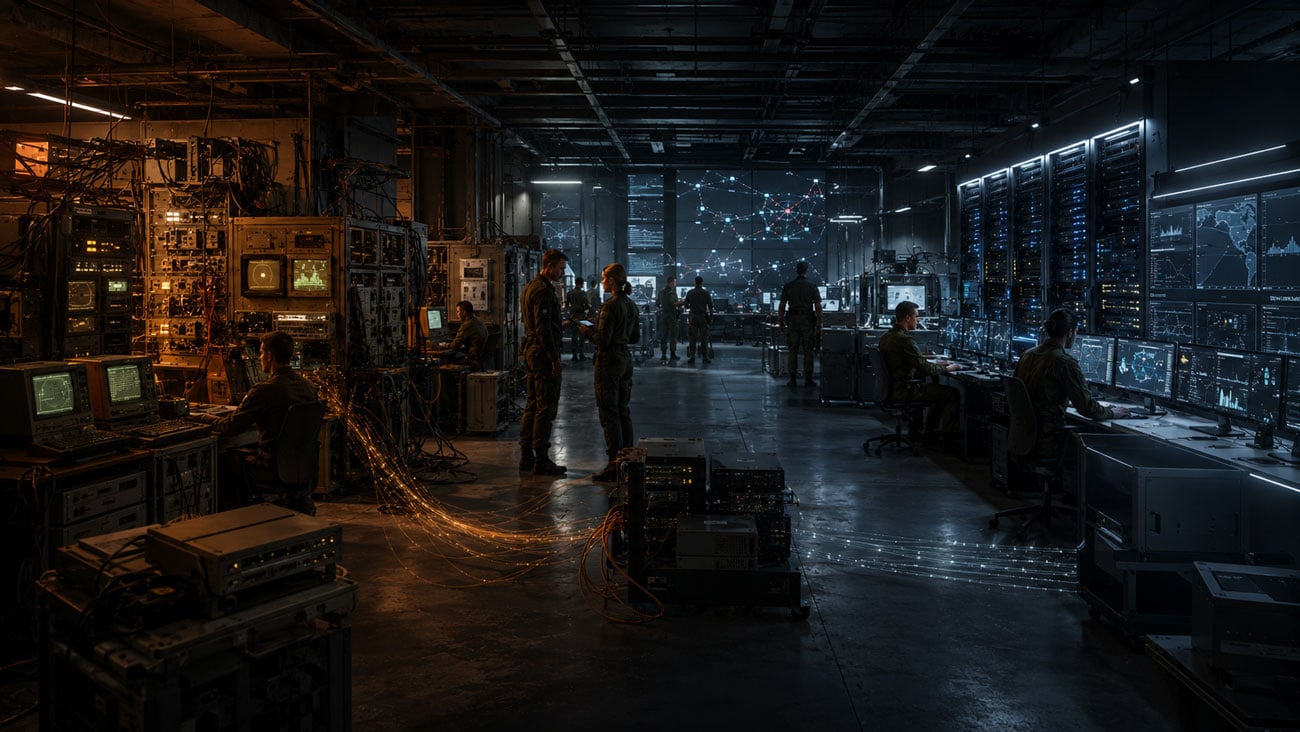
The Pentagon’s modernization challenge is increasingly about subtraction as much as addition. The Army has cut its business-system environment from roughly 1,300 systems to about 200, DoD has identified 89 outdated systems for retirement, and the Navy reports more than $100 million in savings from shutting down legacy platforms. The lesson is larger than audit compliance: modernization is incomplete until redundant applications, conflicting data, obsolete processes, interfaces, contracts, and institutional dependencies actually disappear.
Bottom line: federal modernization fails when agencies deploy new technology but continue operating everything the new technology was supposed to replace. The result is not transformation. It is accumulation.
True modernization therefore needs two milestones: go live and turn off.
The first introduces the future environment. The second removes the technical debt, duplicate data, maintenance burden, cyber exposure, contracts, interfaces, and organizational dependencies attached to the past.
The Pentagon’s current audit and business-system reforms are making that distinction increasingly visible.
The Pentagon Has a Modernization Problem New Technology Alone Cannot Solve
One of the most revealing defense-modernization stories of 2026 did not involve hypersonic missiles, artificial intelligence, autonomy, or a new cloud platform.
It involved property records.
Reuters reported in July that Army audit-remediation work uncovered cases in which data-entry errors caused systems to represent the same vehicle as separate assets—for example, when the letter “O” was entered instead of the numeral zero in a serial number. Other records contained additional zeros that distorted facility data.
The errors appear trivial until they influence maintenance, inventory, infrastructure planning, readiness reporting, or resource allocation.
The underlying problem is architectural: when different systems contain different versions of the same reality, leaders spend time reconciling information before they can act on it.
The Army has made a major reduction in that complexity. Reuters reported that the service has reduced its business-system environment from roughly 1,300 systems to about 200. The Army is also deploying Army Fiscal Frontline, which the service describes as a “single pane of glass” for fiscal visibility and a replacement for siloed legacy approaches.
That points to a larger lesson:
Modernization is not simply the process of adding better systems. It is also the discipline of deciding what can finally disappear.
Every Legacy System Had a Reason to Exist
Legacy technology is easy to criticize after the fact.
But most old systems were not created because someone wanted a fragmented enterprise. They solved real problems.
A command needed an application. A logistics organization needed inventory data. A program required a workflow. A financial office needed a database. An enterprise platform could not satisfy a local requirement, so another tool appeared.
Individually, many of those decisions were rational.
Over decades, the accumulated result can become an environment of overlapping applications, custom interfaces, local databases, spreadsheets, duplicated data, and manual reconciliation.
At that point, the organization is no longer merely operating software.
It is operating layers of historical decisions.
Technical Debt Eventually Becomes Organizational Debt
Technical debt is usually described as the future engineering cost created by short-term technical decisions.
Inside a large federal organization, the debt extends much farther.
A legacy application may have:
- a program office;
- a contract;
- a support workforce;
- training material;
- interfaces;
- cybersecurity documentation;
- budget lines;
- data feeds;
- users;
- and operational processes built around it.
Retiring the application therefore does not mean simply shutting down a server. It means unwinding an ecosystem.
That is why technical-debt remediation and technology modernization have to account for organizational dependencies as well as code and infrastructure.
The Cost of Keeping Everything Is Enormous
DoD is increasingly quantifying the cost of legacy technology.
GAO reported that fiscal 2024 audit-remediation plans included retirement of 89 outdated information systems, with projected savings of at least $760 million annually through fiscal 2029.
The Navy provides another example. After acknowledging in 2020 that it had spent billions sustaining redundant and obsolete IT systems, the service launched a broader consolidation and retirement effort.
GAO reported in April 2026 that the Navy had terminated at least 11 legacy systems and reported more than $100 million in savings. The Navy also completed migration of remaining commands to Navy Enterprise Resource Planning as its financial system of record in January 2026.
Legacy retirement can therefore finance modernization.
Every system eliminated can remove some combination of hosting, licensing, contract support, patching, testing, integration, administration, infrastructure, cyber authorization, and maintenance cost.
Modernization Without Retirement Is Just Accumulation
Consider an organization operating ten legacy applications.
It deploys a modern enterprise platform intended to replace six of them. The new platform launches successfully—but the six old systems remain because historical data was not migrated, one interface still depends on them, users resist the replacement, or nobody owns the final retirement decision.
The organization now operates eleven systems.
Modernization occurred technically.
Complexity increased operationally.
The workforce supports both old and new environments. Cyber attack surface expands. Costs overlap. Conflicting sources of truth survive.
That is why every modernization program needs an explicit retirement outcome.
A New System Should Come With a Decommissioning Plan
At program initiation, leaders should be able to answer:
- What does the new capability replace?
- Which applications will retire?
- Which databases will migrate or archive?
- Which contracts will end?
- Which interfaces become unnecessary?
- Which manual workflows should disappear?
- Who owns the retirement decision?
- When does the legacy funding stop?
Without those answers, the modernization business case may describe the benefits of the new system without demonstrating that the enterprise becomes simpler.
This is where technology portfolio rationalization and modernization roadmaps need to begin with the future-state environment and work backward to what must be removed.
The Audit Is Exposing Architecture Problems
DoD’s financial audit is often framed as an accounting challenge.
It is also a data and systems-architecture challenge.
Financial statements depend on reliable information about property, inventory, weapons, facilities, contracts, personnel, maintenance, funding, and logistics.
If two systems report different versions of an asset, auditors have a problem.
So do commanders.
DoD leaders have repeatedly emphasized that audit remediation improves more than financial compliance. Better asset visibility and authoritative data improve readiness and decision-making.
The audit forces questions that every modernization program should ask:
- Which system is authoritative?
- Who owns the data?
- Can the transaction be traced?
- Why do two databases disagree?
- Does the physical asset match the digital record?
Those are questions about institutional truth.
A Dashboard Cannot Create a Single Source of Truth
Army Fiscal Frontline is designed to provide users from operational formations through senior leadership access to a common fiscal picture.
But a “single pane of glass” is valuable only when the information behind the glass is trustworthy.
Data definitions have to align. Duplicates have to be identified. Authoritative sources have to be established. Errors have to be corrected. Interfaces have to propagate changes consistently.
A modern dashboard over inconsistent data simply provides faster access to inconsistency.
That distinction becomes even more important as agencies adopt AI.
Artificial Intelligence Makes Legacy Cleanup More Urgent
DoD’s FY2026 budget included approximately $1.8 billion for audit-related activities, including $200 million for automation and AI and $150 million for business-system replacement as the Department works toward an unmodified audit opinion by December 31, 2028.
Automation and machine learning can identify anomalies, reconcile transactions, surface duplicates, and prioritize records for human review.
But AI does not remove the need for sound data governance.
If two legacy databases disagree about the same asset, an algorithm does not automatically know which record reflects reality. If inventory data are stale, predictive analytics inherit that staleness.
AI therefore increases the cost of unresolved legacy architecture.
This is where AI-augmented decision support depends first on reliable data, traceable processes, and clear governance.
The Authoritative-Data Question Has to Be Answered
One of the hardest modernization questions is deceptively simple:
Which system is right?
A maintenance application may know the current condition of a vehicle. A property system may contain the official accountability record. A logistics system may show location. Another database may hold acquisition history.
Each can be accurate within its own domain while still conflicting with another system.
Modernization therefore requires explicit data governance:
- Who owns each data domain?
- Which system creates the authoritative record?
- Which systems may modify it?
- Which systems consume it?
- How are corrections propagated?
- How are duplicate records resolved?
Without that discipline, integration can connect conflicting truths more efficiently.
Application Rationalization Should Begin With the Mission
Application portfolios are often classified through technical actions: modernize, migrate, maintain, consolidate, or retire.
The stronger analysis begins with mission capability.
What function does the application provide? Who depends on it? What happens if it disappears? Is another system already providing the same capability? Which workflow exists only because the old application requires it?
Most importantly:
Should the process itself still exist?
Organizations sometimes digitize inefficient workflows without challenging them. A 15-step paper process becomes a 15-step digital process. The interface improves; the bureaucracy remains.
Effective diagnostic-driven modernization examines the mission, process, data, technology, and governance together rather than treating the application inventory as the problem by itself.
Modernization Has to Remove Process Debt Too
Legacy processes can survive long after the conditions that created them disappear.
A signature once required paper. A reconciliation was manual because two systems could not communicate. A recurring report existed because leaders lacked access to underlying data.
New technology can remove those constraints—but only if the workflow is redesigned.
Modernization should therefore address four connected layers:
- systems;
- data;
- processes;
- governance.
Changing only one produces limited transformation.
Cybersecurity Is Another Argument for Retirement
Every application adds attack surface.
It requires accounts, authentication, patching, dependencies, monitoring, backups, network access, incident response, cyber authorization, and administrative support.
Legacy systems can be especially difficult to protect because they may depend on unsupported operating systems, deprecated libraries, custom code, obsolete hardware, limited logging, or interfaces created before modern zero-trust principles.
One of the simplest ways to reduce cyber risk is therefore also one of the least glamorous:
have fewer systems to defend.
Simplicity Is a Resilience Strategy
Every integration creates another dependency.
System A sends data to System B. System B transforms it. System C consumes it. System D pushes another update downstream.
Large legacy environments can contain chains that few individuals understand completely.
Retirement removes nodes from those chains:
fewer interfaces, fewer credentials, fewer patches, fewer failure modes, fewer contracts, and fewer places for data to diverge.
Simplicity is not merely aesthetic.
It reduces operational fragility.
The Hardest Legacy System May Be the Spreadsheet
Not every mission-critical legacy environment appears in an official application inventory.
Spreadsheets, Access databases, email workflows, locally maintained trackers, and macros often emerge because enterprise tools do not fully meet user needs.
Over time, these unofficial tools can accumulate business logic and data that the formal system does not contain.
That creates a serious retirement risk. Leadership may believe an application has been replaced while users quietly recreate the old capability outside the governed environment.
Successful rationalization therefore requires understanding what people actually do—not only what the official system inventory says they do.
User Adoption Is Part of Decommissioning
Legacy retirement is not exclusively an IT activity.
Users need confidence that the replacement supports the mission. Historical data have to remain accessible where required. Training, performance, workflow design, and transition support all matter.
If the replacement makes work materially harder, users will build workarounds.
If leadership allows old and new environments to coexist indefinitely, organizations will naturally keep using whichever one is easier.
This is why change management and transition planning are part of system retirement, not activities that happen after the technical migration.
Retirement Needs Exit Criteria
Modernization programs usually define go-live criteria.
Legacy retirement deserves an equally explicit checklist:
- required data migrated or archived;
- interfaces redirected;
- users transitioned;
- records retained appropriately;
- contracts modified or closed;
- cyber authorities terminated;
- infrastructure removed;
- funding stopped;
- system access disabled.
Without formal exit criteria, an application can remain “almost retired” for years.
That is where execution governance and accountability determine whether the retirement actually occurs.
Portfolio Owners Need the Authority to Say No
Technology rationalization is ultimately a governance problem.
Six applications may perform nearly identical functions, but each belongs to a different command or program. Everyone agrees duplication is inefficient. Nobody wants their system to be eliminated.
Portfolio leadership therefore needs authority to make enterprise tradeoffs.
Which capability becomes standard? Which exception is truly mission-essential? Which local requirement justifies duplication? Which system receives another year of funding—and which one does not?
Modernization eventually requires saying no:
no duplicate application, no indefinite extension, no unnecessary custom interface, and no new local solution when an enterprise capability already satisfies the requirement.
Open Architecture Can Keep Today’s Modernization From Becoming Tomorrow’s Legacy
System retirement should influence what government buys today.
A modern platform can become tomorrow’s legacy problem if it depends on proprietary interfaces, closed data formats, vendor-controlled infrastructure, undocumented integrations, or architecture that makes replacement prohibitively expensive.
Well-defined interfaces, modularity, government access to data, and portable components make future change easier.
The same principle is visible outside business systems. The Air Force’s Collaborative Combat Aircraft program is deliberately separating airframes from mission-autonomy software so competition can continue as technology changes. That open-architecture strategy is designed to prevent today’s platform choice from permanently defining tomorrow’s ecosystem.
The lesson applies directly to enterprise IT.
A system designed to be replaced eventually is often more resilient than one designed as though it will remain forever.
Every New System Should Have an Exit Strategy
Before government becomes dependent on a new platform, decision-makers should ask:
- How do we export our data?
- Who owns the interfaces?
- Can individual components be replaced?
- What documentation does government retain?
- Can another provider operate the environment?
- What happens if the vendor changes?
The best time to negotiate exit rights is before dependency forms.
Modern acquisition should account for the full lifecycle:
enter → operate → evolve → exit.
A Clean Audit Is Not the Same as a Modern Enterprise
DoD is under a statutory mandate to achieve a clean audit opinion by the end of 2028.
GAO reported in May 2026 that the Department has revised its strategy toward greater centralized coordination, technology investment, and prioritization of material financial balances. GAO also raised questions about whether the approach will fully resolve underlying internal-control and systems weaknesses or sustain improvements beyond the deadline.
That distinction matters.
A clean audit is an important milestone. It should not become the definition of modernization.
The deeper objective is reliable financial and operational information as a normal condition of management.
The audit should validate that environment—not substitute for it.
The Real Value Is Better Decisions
Business-system modernization matters to the mission because resources determine readiness.
Leaders need trustworthy answers to basic questions:
- What equipment exists?
- Where is it?
- What condition is it in?
- What does it cost?
- Where is inventory available?
- Which facilities require investment?
- What has been obligated?
- Which contracts are performing?
- Where should resources move next?
Poor data introduces friction into every one of those decisions.
Business systems may operate behind the battlefield. Their information shapes what reaches it.
Application Rationalization Is Changing the Contractor Market
Legacy environments historically generated large volumes of support work: application maintenance, database administration, custom integration, reconciliation, hosting, cyber remediation, help desks, and technical upgrades.
As agencies simplify portfolios, some of that work will decline.
Another category grows:
- current-state assessments;
- application inventories;
- dependency mapping;
- technical-debt analysis;
- enterprise architecture;
- portfolio rationalization;
- data migration and governance;
- business-process redesign;
- change management;
- transition planning;
- and system retirement.
The contractor of the future may increasingly create value not by helping government operate another application forever, but by helping agencies determine which systems they no longer need to operate at all.
Successful Modernization Should Usually Make the Enterprise Simpler
One useful measure deserves more attention.
After modernization, does the organization operate fewer:
- systems;
- interfaces;
- duplicate databases;
- manual reconciliations;
- redundant processes;
- conflicting sources of truth;
- and unnecessary contracts?
Not every modernization initiative should reduce application counts. New missions legitimately require new capabilities.
But an organization that continuously adds technology without removing anything eventually becomes harder to secure, integrate, operate, and change.
Modernization Is Also Deletion
The Pentagon’s 2028 audit deadline is forcing the Department to confront decades of accumulated systems, inconsistent data, duplicate workflows, and unclear ownership.
The Army’s reduction from roughly 1,300 business systems to about 200 demonstrates the scale of rationalization that can occur when simplification becomes an enterprise priority. The Navy’s system retirements demonstrate that deletion can generate measurable savings. DoD’s broader plan to retire dozens of outdated systems shows that decommissioning is increasingly being treated as a modernization strategy rather than an administrative afterthought.
The lesson applies far beyond financial management.
Modernization is often visualized as addition:
a new cloud platform, a new AI capability, a new application, a new dashboard, a new data environment.
Mature transformation also requires subtraction:
retire the duplicate, close the obsolete database, eliminate the manual reconciliation, remove the unnecessary interface, simplify the workflow, end the old contract, and establish one authoritative source.
The ultimate measure of modernization is not how much new technology an organization acquires. It is whether the enterprise becomes simpler, faster, more reliable, more secure, and better able to execute its mission after the transformation is complete.
Sometimes progress means building something new.
Sometimes the most transformational thing an enterprise can do is finally turn something off.
Primary Sources
- Reuters — Army audit drive, business-system reduction, and Fiscal Frontline
- U.S. Army — Army financial transformation and Fiscal Frontline
- U.S. GAO — DoD remediation efforts and planned retirement of 89 outdated systems
- U.S. GAO — Navy financial-management systems modernization and legacy-system retirement
- U.S. GAO — Questions associated with DoD’s new financial-audit approach
- U.S. Department of Defense — FY2026 audit, automation, AI, and business-system replacement funding