America’s nuclear deterrent is usually described as a triad of submarines, intercontinental ballistic missiles, and bombers. But those platforms depend on a less visible system: the warning sensors, satellites, airborne command posts, ground stations, software, networks, procedures, and people that allow national leadership to understand an attack, make a decision, communicate authenticated orders, and retain control of strategic forces. Modernizing that Nuclear Command, Control, and Communications network may be the hardest part of modernizing the deterrent itself.
Bottom line: nuclear deterrence is not only a portfolio of weapons. It is a survivable decision-and-communications architecture.
Ballistic missile submarines, intercontinental ballistic missiles, and strategic bombers create the visible nuclear triad. But none can perform its strategic mission independently. National leaders need warning. They need trusted information. They need secure and survivable communications. Strategic forces need authenticated orders. And the entire system has to remain usable during the exact conditions an adversary would create to prevent it from functioning.
That less visible architecture is Nuclear Command, Control, and Communications (NC3).
The FY2027 defense budget request underscores its scale, proposing approximately $20.2 billion for NC3 architecture in addition to the investments associated with the nuclear delivery systems themselves.
The modernization challenge is therefore larger than replacing missiles, submarines, bombers, or satellites.
The United States has to modernize the network connecting national decisions to strategic forces without ever allowing that network to stop being credible.
The Nuclear Triad Has a Fourth Element
The traditional triad remains fundamental:
- ballistic missile submarines;
- land-based intercontinental ballistic missiles;
- strategic bombers.
But the platforms require a connective layer.
A submarine needs authenticated communications. An ICBM force needs warning, command authority, and secure connectivity. A bomber force needs mission information and survivable communications. National leadership needs confidence that the information driving a decision is accurate and that orders will reach the intended forces.
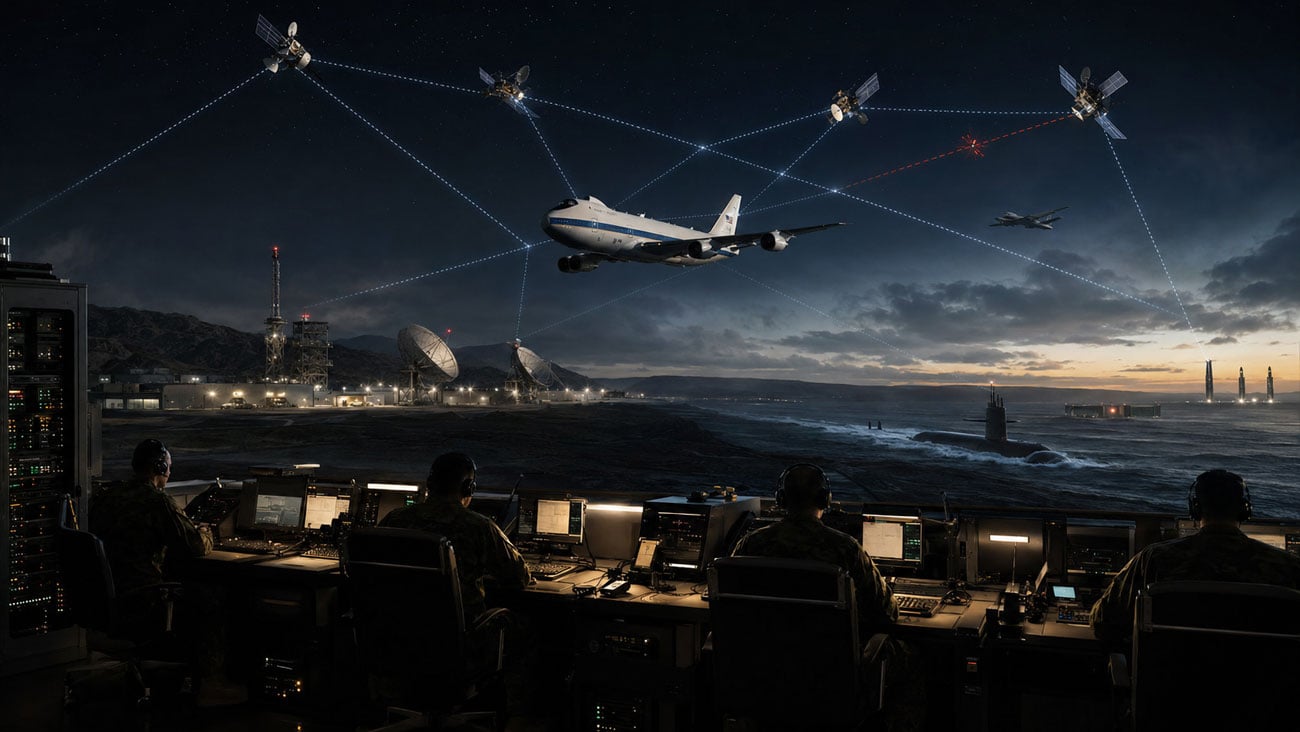
NC3 provides that connective tissue through a system of systems that includes satellites, aircraft, ground stations, warning sensors, command posts, communications terminals, software, networks, procedures, and personnel.
The weapon is therefore only one part of the deterrent.
The network that allows leaders to understand, decide, communicate, and execute is part of the weapon system too.
The Most Important Message Has to Get Through
Most enterprise technology is designed to maintain high availability under relatively normal operating conditions.
NC3 has to remain functional while an adversary is actively trying to make communications fail.
The architecture has to account for:
- cyberattack;
- electronic warfare;
- space disruption;
- physical attack;
- loss of ground infrastructure;
- electromagnetic effects;
- communications congestion;
- and simultaneous failures across multiple domains.
That requirement drives redundancy, hardening, distribution, alternate pathways, protected satellites, airborne command posts, mobile systems, and resilient networks.
But availability alone is not enough.
The system also has to preserve trust.
A message that arrives but cannot be authenticated is not useful. Warning information that may have been altered can create uncertainty rather than decision advantage. A system that is technically online but no longer trusted has already lost much of its strategic value.
NC3 Is a Trust Architecture as Much as a Communications Architecture
Strategic command and control requires several qualities simultaneously:
- availability — information and communications remain accessible;
- integrity — data have not been altered;
- authentication — participants know who sent a message;
- confidentiality — sensitive information remains protected;
- provenance — decision-makers can understand where information originated;
- resilience — the mission continues despite component loss.
That makes NC3 simultaneously a communications, cybersecurity, warning, decision-support, and command architecture.
It is also why modernization cannot be managed as a collection of independent technology programs.
Modernization Has to Occur While the Deterrent Remains on Alert
The central modernization problem is continuity.
Many components of today’s NC3 enterprise evolved over decades. Individual systems have been upgraded, replaced, extended, or integrated as threats and technology changed.
That produces a familiar modernization pattern: new systems connect to old ones, multiple generations coexist, different services own different portions of the architecture, and replacement programs move on different schedules.
But NC3 cannot pause for migration.
Existing capability has to remain operational while the replacement is introduced. Interfaces have to support the transition. Personnel may have to operate both generations. Legacy systems can retire only after the new capability has demonstrated sufficient trust and resilience.
This is where transition architecture and transformational engineering become central to strategic deterrence.
The Transition Period Can Be More Dangerous Than Either End State
A mature legacy system may be expensive and difficult to sustain, but its behavior is understood.
A new system may offer better capability but still be moving through integration, testing, training, and operational acceptance.
During transition, the enterprise may have to support both.
That means:
- more interfaces;
- more configuration states;
- more training;
- multiple sustainment environments;
- temporary dependencies;
- and increased risk that one modernization schedule affects another.
The Sentinel ICBM transition demonstrates the broader problem. GAO reported in February 2026 that Sentinel’s first flight had slipped about four years to March 2028 and that the Air Force estimated the program would cost at least $141 billion. Delays require the Air Force to operate the aging Minuteman III system longer than planned.
Modernization programs do not exist independently from the systems they replace.
Delay in the future architecture creates sustainment requirements in the legacy architecture.
This is the same principle explored in Diamondback’s analysis of why modernization is incomplete until legacy systems can actually retire.
Evolved Strategic SATCOM Shows the Network Modernizing in Layers
The Space Force’s Evolved Strategic Satellite Communications (ESS) program provides a useful example of how NC3 modernization works as a system rather than a single procurement.
In July 2025, Space Systems Command awarded Boeing $2.8 billion to build the first two ESS satellites, with options for two additional spacecraft. ESS is intended to replace the strategic NC3 capability currently provided through Advanced Extremely High Frequency and provide resilient global strategic communications.
But the satellite is only one segment.
Space Systems Command describes ESS as a system of systems consisting of cryptographic, ground, space, and user-terminal segments.
That distinction is critical.
A protected satellite in orbit does not create end-to-end strategic communications unless the ground systems, terminals, software, operators, security, and mission-planning architecture work with it.
The July 2026 ESS Award Shows Why Software Is Strategic Infrastructure
On July 27, 2026, Space Systems Command awarded $287 million to Sphinx Defense to complete prototyping for the ESS Mission Planning application.
The contract is fundamentally for software.
The mission is strategic nuclear command and control.
The application is intended to support global mission planning for resilient strategic communications—helping the architecture determine how communications resources are planned and employed as conditions change.
This illustrates a broader transformation in defense capability:
software increasingly determines how physical strategic infrastructure is used.
The satellite may provide communications capacity. Mission software helps turn that capacity into an operational network.
That is a direct example of technology enablement through integrated software, infrastructure, and mission architecture.
The Ground Segment Can Be as Important as the Satellite
Space programs naturally focus attention on orbit.
Many of the dependencies that determine mission success remain on Earth:
- mission-planning applications;
- ground terminals;
- operations centers;
- fiber and terrestrial networks;
- cybersecurity infrastructure;
- data environments;
- command facilities;
- and trained operators.
A highly survivable satellite connected to an unavailable or compromised ground architecture provides limited strategic value.
NC3 therefore has to be designed and tested end to end.
Project Enigma Makes Digital Engineering Part of Strategic SATCOM
One day after announcing the ESS mission-planning award, Space Systems Command highlighted Project Enigma, a government-hosted digital environment supporting ESS development.
The initiative connects contractor development environments into a shared government platform and uses model-based systems-engineering tools to improve development workflows, security, and model deployment.
The significance goes beyond collaboration software.
NC3 programs require hardware, software, cryptography, ground systems, satellites, user terminals, and networks to converge into an operational capability.
Digital engineering can surface integration problems before they become physical-fielding problems.
That makes shared technical baselines and model-based engineering part of enterprise technology modernization, not simply internal development tools.
The Airborne Command Post Is Another Node in the Network
NC3 resilience also depends on command capability that can survive when fixed ground infrastructure cannot.
The Air Force’s E-4B National Airborne Operations Center has served that role for decades. The service is now developing its replacement through the Survivable Airborne Operations Center (SAOC) program.
The FY2026 Air Force RDT&E request included more than $2.2 billion for SAOC development.
The replacement is intended to preserve highly survivable airborne command-and-control capability through extreme national emergencies.
The strategic point is not the aircraft alone.
The aircraft is one mobile command node inside a network designed to continue functioning when other nodes disappear.
Resilience Does Not Mean Building One Indestructible System
Hardening remains essential.
But no modern architecture should assume every component can be made invulnerable to every threat.
The stronger model combines:
hardening + redundancy + distribution + alternate pathways.
One satellite can be lost while another path remains. One command location can become unavailable while an airborne or mobile node assumes the mission. One network can degrade while traffic moves through another communications path.
The objective changes from ensuring that every component survives to ensuring that the mission survives component loss.
That is the more useful definition of resilience.
Cyberattack Can Target Confidence Without Taking the Network Offline
NC3 presents one of the most demanding cybersecurity missions in government because an adversary does not necessarily need to destroy the network to create strategic risk.
Uncertainty can be an effect.
Was the warning authentic? Has data been modified? Is the system behaving normally? Did an order originate from the expected authority? Can leadership trust the picture being presented?
The security problem is therefore not simply preventing outages.
It is protecting the confidence required for consequential decisions.
Cybersecurity becomes part of strategic stability because the credibility of the deterrent depends on the integrity of the command architecture.
Artificial Intelligence Can Help—But Human Authority Matters More Here Than Almost Anywhere
AI and automation can support portions of the NC3 enterprise without becoming the authority over nuclear employment.
Potential applications include:
- anomaly detection;
- network diagnostics;
- communications-resource management;
- cyber defense;
- sensor correlation;
- maintenance analytics;
- and decision-support functions.
Those applications may improve speed and clarity.
They also introduce risk. Models can be wrong. Inputs can be manipulated. Software supply chains can be compromised. Behavior can change under conditions not represented in development or testing.
The design principle should therefore be clear:
use automation to improve the information available to authorized human decision-makers, not to transfer consequential nuclear authority to automation.
This is where AI-augmented decision support requires unusually rigorous governance, traceability, testing, and human oversight.
Decision Advantage Has a Different Meaning When Minutes Matter
In many military missions, better information creates tactical advantage.
In strategic command and control, information can shape national decisions under extreme time pressure.
Warning sensors generate observations. Other systems contribute context. Information has to be correlated, assessed, transmitted, and presented. National leaders need enough confidence to understand what is occurring while communications pathways remain available.
This creates a difficult optimization problem:
fast enough to matter; trusted enough to act upon.
Information that arrives too late may be operationally equivalent to information that never arrived.
Information that arrives quickly but cannot be trusted can be worse.
The Government Has to Own the Mission Architecture
Industry will build enormous portions of the modern NC3 enterprise.
Satellite manufacturers, aircraft integrators, software companies, network providers, cyber firms, terminal manufacturers, and systems integrators all contribute critical expertise.
But no contractor owns the national deterrence mission.
The government does.
That means government has to retain sufficient technical authority to manage:
- requirements;
- interfaces;
- data;
- configuration;
- security;
- testing;
- dependencies;
- transition sequencing;
- and long-term system evolution.
Without that authority, programs can optimize locally while degrading the enterprise globally.
This is a strategic architecture and governance problem as much as a technology problem.
Governance Is a Technical Requirement
NC3 spans military services, combatant commands, agencies, acquisition programs, and industry partners.
That distribution creates a governance challenge because the mission is integrated even when program authorities are not.
Governance determines technical outcomes:
- Who establishes interfaces?
- Who arbitrates cross-program requirements?
- Who owns enterprise-level risk?
- Who decides when a legacy system can retire?
- Who determines whether one program’s design creates unacceptable dependency elsewhere?
- Who owns the authoritative technical baseline?
If interoperability is everyone’s responsibility but no one has sufficient authority to enforce it, integration problems become structural.
Testing Has to Assume Multiple Parts of the Architecture Are Failing
Ordinary technology testing asks whether a system works.
NC3 testing has to ask whether the mission continues while systems are being denied, degraded, or destroyed.
Testing should force questions such as:
- Can leadership communicate if a satellite path disappears?
- Can traffic transition to an alternate route?
- What happens when a ground node is unavailable?
- Can new and legacy systems interoperate during transition?
- How quickly does the architecture detect compromised or degraded information?
- Can mobile or airborne command nodes assume the mission?
- What happens when bandwidth is constrained?
- Can operators distinguish system failure from adversary manipulation?
Redundancy shown on an architecture diagram is not enough.
The enterprise has to prove that the mission can actually move onto the alternate path.
This is where operational testing, readiness, and execution governance determine whether architectural resilience is real.
Legacy Retirement Is Part of NC3 Modernization Too
Modernization programs naturally focus on fielding new capability.
Retiring old capability is often harder.
Legacy systems remain because users depend on them, interfaces still require them, replacements slip, technical knowledge becomes scarce, or leaders are unwilling to assume the risk of shutdown.
But indefinite coexistence creates cost, cyber exposure, training burden, configuration complexity, and additional failure modes.
NC3 therefore needs explicit transition architecture:
- What replaces what?
- When can the legacy system retire?
- Which interfaces are temporary?
- Which older capabilities remain intentionally as redundancy?
- Which dependencies have to disappear first?
Without those decisions, modernization becomes accumulation.
Open Architecture Matters Even When the Mission Requires Exceptional Security
NC3 cannot simply apply commercial notions of openness.
Classification, authentication, security, survivability, and nuclear surety impose constraints that do not exist in ordinary enterprise systems.
Not every interface should be widely exposed.
But the architectural principle still matters: government should avoid unnecessary dependencies that prevent future modernization.
Where security permits, useful practices include:
- well-defined interfaces;
- government-controlled technical baselines;
- appropriate data rights;
- modularity;
- portable components;
- and configuration discipline.
The architecture has to make future technology insertion possible without destabilizing the deterrent mission.
The Architecture Has to Outlive the Technology
Individual technologies will change.
Satellites, processors, networks, encryption, software, sensors, aircraft, artificial intelligence, and cyber threats will all evolve.
The underlying mission remains remarkably stable.
National leadership must retain the ability to:
- understand a strategic attack;
- make an authorized decision;
- communicate that decision;
- and maintain control of strategic forces.
The architecture therefore has to accommodate technology that does not yet exist.
That is why modularity, governance, and government technical ownership matter so much.
Nuclear Modernization Is Enterprise Modernization
Public discussion understandably centers on the most visible nuclear programs: Columbia-class submarines, Sentinel, the B-21 Raider, and long-range weapons.
But deterrence also depends on strategic SATCOM, warning, airborne command posts, ground networks, terminals, software, cyber defense, mission-planning systems, and the personnel operating them.
The FY2027 request’s approximately $20.2 billion for NC3 architecture makes that connective layer impossible to treat as secondary.
The complete system has to evolve coherently.
That requires mission support, workforce, sustainment, and resource coordination alongside engineering and acquisition.
Deterrence Depends on What an Adversary Believes Will Still Work
Nuclear deterrence is ultimately about influencing an adversary’s expectations.
A survivable submarine contributes less deterrent value if an adversary believes national leadership cannot communicate with it. A missile force contributes less if command systems cannot authenticate orders. A bomber force contributes less if strategic communications can be severed.
For the deterrent to remain credible, an adversary has to assume that destroying one node will not break the decision-and-command system.
That uncertainty is part of deterrence.
The Network Behind the Triad May Be the Hardest System to Modernize
America’s nuclear modernization effort is often described as a once-in-a-generation recapitalization.
The deepest challenge may be that many major components are being replaced at roughly the same time while the command architecture connecting them cannot be allowed to fail.
The July 2026 ESS mission-planning award is only one software effort inside a far larger enterprise, but it captures the nature of the problem.
Modern deterrence depends on software managing resilient communications. It depends on satellites, terminals, airborne command posts, cyber defenses, digital engineering, ground infrastructure, and government technical authority. It depends on old and new systems coexisting safely until transition is complete.
Most importantly, it depends on those pieces functioning as one mission architecture.
The nuclear triad remains central to American deterrence. But in the twenty-first century, deterrence cannot be understood through platforms alone.
Behind every submarine, bomber, and missile is a network that must survive, remain trusted, and continue connecting an authorized national decision to the strategic forces expected to carry it out.
Deterrence is only as credible as that network.
Primary Sources
- Space Systems Command — ESS Mission Planning Phase 3 award to Sphinx Defense, July 27, 2026
- Space Systems Command — Project Enigma digital engineering environment, July 28, 2026
- Space Systems Command — $2.8 billion ESS satellite award to Boeing, July 3, 2025
- U.S. GAO — Sentinel modernization risks, schedule, cost, and Minuteman III transition
- U.S. Air Force — FY2026 RDT&E budget justification, including Survivable Airborne Operations Center
- U.S. Department of War — FY2027 defense budget request and $20.2 billion NC3 investment