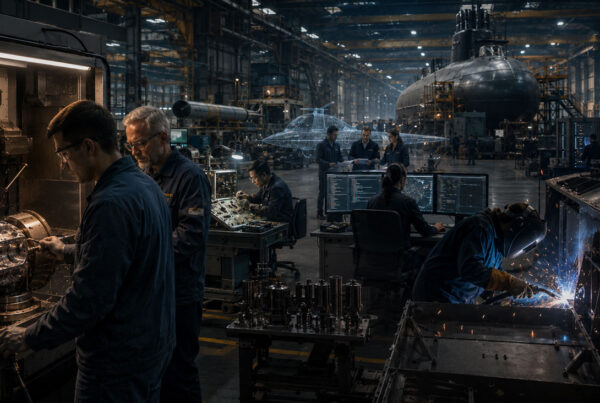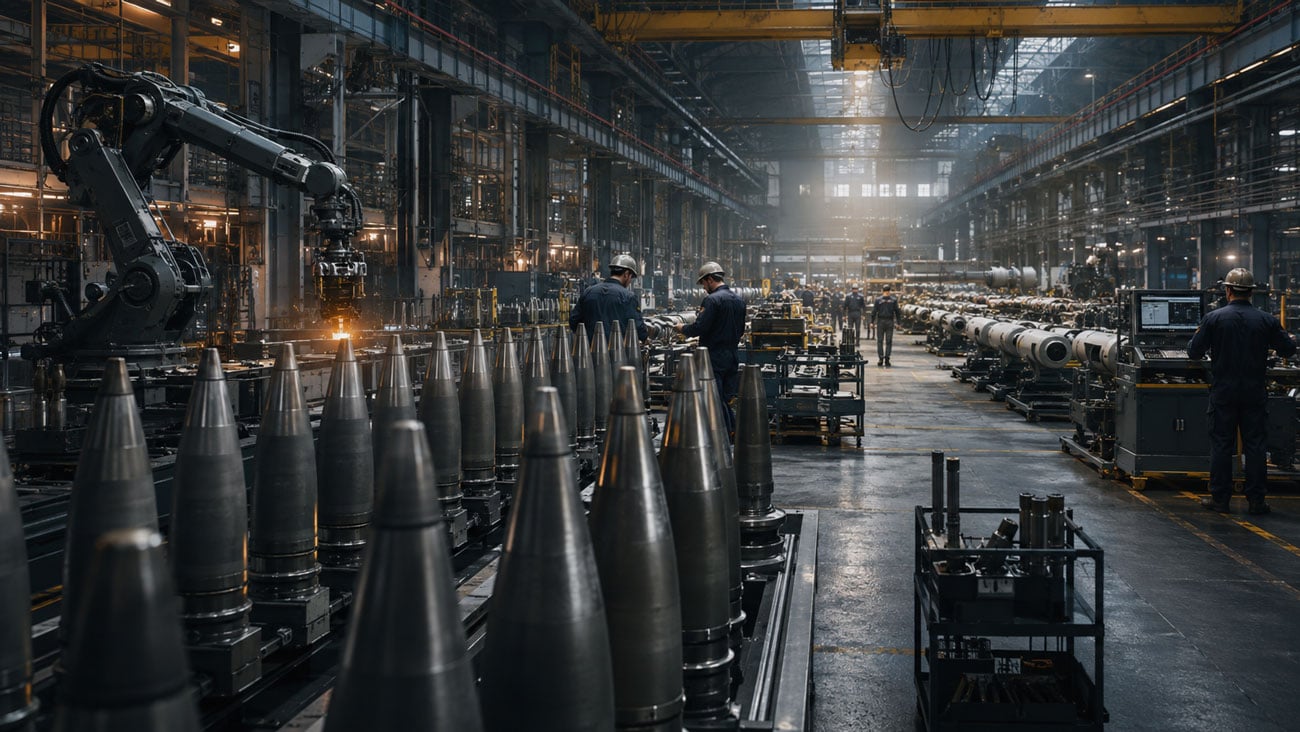
The United States is investing heavily in ammunition plants, energetics, missile components, and industrial modernization. But a July 2026 Pentagon watchdog review found finished 155mm artillery output at roughly 36,000 rounds per month—well below the Army’s 100,000-round target—and highlighted how one failed metal-parts expansion could constrain the entire production chain. The lesson is larger than artillery: deterrence depends on throughput, not capacity that exists only on paper.
Bottom line: America does not simply need more munitions factories. It needs an industrial system that can convert investment into sustained, qualified output at wartime speed.
The distinction matters because defense production has several different measures:
funded capacity → installed capacity → qualified capacity → sustained throughput.
Those are not the same thing.
A facility can be funded without being finished. It can be finished without producing. It can produce without meeting specifications. It can meet specifications without reaching rate. And a final assembly line can have capacity while one upstream supplier prevents it from using that capacity.
The July 2026 Inspector General review of 155mm artillery production makes that problem unusually visible.
The Arsenal Problem Is No Longer Primarily About Demand
The United States understands that munitions inventories and production capacity matter.
Recent conflicts have made the consumption problem impossible to ignore. Artillery, air defense interceptors, precision missiles, drones, rocket motors, propellants, explosives, guidance systems, and other expendable capabilities can be consumed far faster than peacetime industrial bases were designed to replenish them.
Washington has responded with billions of dollars in plant modernization, new factories, Defense Production Act investments, supplier agreements, and long-term procurement.
The harder question is now:
Does that investment create weapons at the rate military plans assume?
The 155mm Ramp Shows the Difference Between Capacity and Throughput
The Army set out to increase 155mm artillery production dramatically from a pre-expansion baseline of roughly 14,000 finished rounds per month.
The target was 100,000 rounds per month.
By March 2026, the Department’s Inspector General found that output had increased to approximately 36,000 finished rounds per month.
That is real progress.
It is also only about 36 percent of the target.
The shortfall illustrates why headline factory announcements can be misleading.
Production is only as high as the lowest functioning rate across the chain.
One Failed Metal-Parts Facility Became a System-Level Constraint
A complete 155mm round requires more than loading explosive into a shell.
Projectile metal bodies have to be manufactured first. Fuzes, primers, propelling charges, explosives, packaging, and load-assemble-pack capacity all have to arrive in the correct sequence.
The Inspector General found that the new Mesquite, Texas facility—intended to contribute 30,000 projectile metal parts per month—had produced no parts meeting contract specifications as of March 2026 despite approximately $469 million invested in establishing the capability.
That failure mattered far beyond one facility.
Without the expected metal bodies, other portions of the production system could not convert their available capacity into finished rounds.
The bottleneck moved upstream.
The Slowest Critical Step Sets the Production Rate
This is the central rule of munitions industrialization:
final output cannot exceed the slowest critical input.
A missile line may be able to assemble 1,000 weapons while receiving only 600 rocket motors.
An artillery loading plant may be able to handle more rounds than metal-parts suppliers can deliver.
A prime contractor may have labor and floor space while waiting for one actuator, energetic material, seeker, casting, forging, or guidance component.
That makes production-rate management an enterprise throughput and execution-governance problem, not merely a factory problem.
Throughput Is a Chain, Not a Building
A useful munitions-production model looks like:
raw material → energetics → components → subassemblies → metal parts → load/assemble/pack → inspection → acceptance → storage → delivery.
Each stage has its own:
- equipment;
- workers;
- suppliers;
- technical data;
- quality requirements;
- production rates;
- maintenance needs;
- and failure modes.
The industrial system succeeds only when those rates are balanced.
Increasing one node dramatically can create little final benefit if another node remains constrained.
The Army Is Still Adding 155mm Capacity
The current shortfall does not mean the expansion effort has stopped.
In April 2026, the Army and Day & Zimmermann opened a new 155mm load, assemble, and pack facility in Parsons, Kansas.
The Army says the plant will eventually be capable of producing 12,000 M795 projectiles per month at full operational capacity following a $36 million Army investment in production establishment and engineering.
In July, the Army also broke ground on the Future Artillery Complex at the Iowa Army Ammunition Plant.
The project will replace an aging World War II-era M795 production line with an advanced facility designed for multiple 155mm variants, digital integration, automation, and scalable production.
Those investments are necessary.
The challenge is ensuring they produce usable throughput when integrated with the rest of the chain.
Factories Need to Be Designed for Rate, Not Just Capability
There is an important difference between proving that a facility can make a product and proving that it can make the product repeatedly at scale.
A production line has to demonstrate:
- cycle time;
- equipment reliability;
- first-pass yield;
- material availability;
- maintenance intervals;
- worker productivity;
- quality consistency;
- and sustained output across shifts.
A machine capable of producing one acceptable part does not automatically create industrial capacity.
Industrial capacity exists when the system can produce acceptable parts continuously at the required rate.
This is a manufacturing-engineering and production-system design challenge.
Quality Is Part of Throughput
Speed and quality are sometimes framed as competing objectives.
In munitions manufacturing, poor quality is itself a production-rate problem.
A defective projectile body does not increase inventory.
It creates inspection, rework, scrap, investigation, schedule disruption, and potentially additional testing.
As production accelerates, the objective cannot be loosening standards.
It has to be improving the system so more product passes those standards the first time.
Useful measures therefore include:
- first-pass yield;
- scrap rate;
- rework hours;
- equipment downtime;
- inspection cycle time;
- and defects by supplier or process.
Quality is throughput.
The Army’s Organic Industrial Base Is Being Rebuilt as a Production System
The ammunition ramp sits inside a much larger Army modernization effort.
The Army is transforming 23 depots, arsenals, and ammunition plants through a long-term Organic Industrial Base modernization program involving facilities, tooling, workforce, networks, cybersecurity, energy, automation, and advanced manufacturing.
Army Materiel Command now describes the OIB as a strategic weapon system that has to be modernized, integrated, resourced, and kept ready.
That framing is important.
The industrial base is not simply infrastructure supporting the force.
It is part of the force’s ability to sustain combat.
Digital Factories Can Make Bottlenecks Visible Earlier
Modernization is not only concrete and machinery.
The Army’s OIB effort is also building a digital backbone for industrial operations.
Modern plants increasingly depend on:
- industrial-control networks;
- production telemetry;
- real-time equipment monitoring;
- digital work instructions;
- automated inspection;
- maintenance analytics;
- inventory visibility;
- and production scheduling.
The objective is not technology for its own sake.
It is earlier detection of rate loss.
Which machine is becoming unreliable? Which operation is creating scrap? Which supplier is slipping? Which work center is accumulating queue? Which line has unused capacity?
This is where industrial data architecture and technology enablement can turn production information into management action.
A Throughput Dashboard Needs to Measure the Whole Chain
Management becomes harder when production is distributed across government-owned plants, contractor-operated facilities, prime contractors, and multiple supplier tiers.
A useful industrial operating picture should not simply report money obligated or construction milestones.
It should show:
- qualified monthly output;
- actual versus planned rate;
- supplier delivery performance;
- first-pass yield;
- equipment availability;
- workforce vacancy and retention;
- lead times;
- inventory of critical inputs;
- maintenance downtime;
- and emerging single points of failure.
The objective is to understand where final output will be constrained before the constraint reaches final assembly.
Energetics Are the Industrial Base Beneath the Industrial Base
Many munitions depend on a category of inputs that receives less attention than the finished weapon:
energetics.
Propellants, explosives, initiators, pyrotechnics, energetic materials, and solid rocket motors underpin artillery rounds, missiles, rockets, air-defense interceptors, and other weapons.
Production of the final weapon cannot outpace those inputs.
In May 2026, the Department announced that nine Defense Production Act investments since December 2024 had committed approximately $191 million to expand the solid rocket motor industrial base.
Those investments span nozzles, insulation materials, energetic components, and other production constraints.
The policy recognizes that missile production rates can be determined far below the prime contractor.
Missile Production Is Also a Supplier-Throughput Problem
The same logic appears in the Department’s March 2026 agreement with Honeywell Aerospace.
The Department provided a long-term demand framework covering critical munitions components, including navigation systems and actuators, which Honeywell says will support a $500 million multiyear private investment in expanded manufacturing capacity.
The significance is the demand signal.
Suppliers are more likely to purchase equipment, expand factories, and hire workers when they can see enough future demand to justify permanent capacity.
This converts procurement visibility into industrial-capacity planning.
Long-Term Demand Signals Unlock Private Capital
Industrial expansion requires confidence.
A supplier considering a new production line has to know whether demand will persist long enough to recover the investment.
Short-term surge orders can increase output temporarily.
Long-term agreements can change the underlying industrial structure.
They allow firms to:
- add machinery;
- expand plants;
- hire and train workers;
- qualify second sources;
- automate processes;
- and carry more inventory.
That is why sustained demand is part of munitions strategy.
The Munitions Campus Is Testing Shared Industrial Infrastructure
Another 2026 effort attacks a different scaling problem.
In February, the Department broke ground on the Munitions Campus in Bloomfield, Indiana, a public-private manufacturing ecosystem supported by an earlier $75 million Defense Production Act investment.
The campus is designed to provide shared infrastructure and specialized manufacturing resources for multiple defense suppliers, with Prometheus Energetics as an anchor tenant.
The broader National Security Industrial Hub is projected to attract more than $600 million in private investment.
The model could reduce a barrier facing smaller suppliers:
every company does not need to finance an entire specialized industrial ecosystem before it can increase defense production.
Shared infrastructure can accelerate entry and scaling.
Second Sources Matter Before the Primary Source Fails
Single-source suppliers create efficient peacetime production.
They also create concentrated operational risk.
A fire, cyberattack, machine failure, workforce disruption, quality problem, or financial issue at one supplier can reduce national munitions output.
The right time to qualify a second source is before that occurs.
Dual sourcing can increase peacetime cost.
It also creates:
- surge options;
- competitive pressure;
- geographic dispersion;
- and a fallback when one supplier stops.
The logic mirrors Diamondback’s analysis of why defense supply-chain crises often begin several tiers before final assembly.
Critical Materials Can Set the Rate Before Energetics Do
Energetics are not the earliest dependency.
Munitions production also depends on metals, chemicals, rare-earth materials, electronic components, semiconductors, castings, forgings, and other inputs.
If a critical material is unavailable, the factory cannot manufacture its way around the shortage.
This means munitions planning has to understand material provenance, processing concentration, alternative suppliers, substitution options, and inventory several tiers upstream.
Final assembly is only the visible end of the chain.
The Workforce Is a Production Constraint That Machines Cannot Fully Replace
Automation can reduce labor requirements and improve repeatability.
Munitions plants still need skilled people.
Machinists. Electricians. Chemical operators. Engineers. Maintenance technicians. Quality inspectors. Controls specialists. Welders. Production planners. Safety professionals.
A new facility without a qualified workforce is installed capacity without usable throughput.
The workforce problem is especially difficult because experienced workers cannot be delivered on the same schedule as new equipment.
Diamondback’s analysis of the defense workforce as a readiness constraint examines that industrial dependency more broadly.
This is where workforce, supplier, sustainment, and resource coordination become production strategy.
Maintenance Is Part of Factory Capacity
A production line rated for a certain output only achieves that rate when the equipment is available.
Machine failures, spare-parts shortages, control-system issues, calibration problems, and deferred maintenance all reduce throughput.
That makes equipment availability a strategic metric.
Industrial maintenance teams need the same planning discipline applied to operational weapon systems:
- condition monitoring;
- preventive maintenance;
- critical spares;
- obsolescence management;
- and rapid repair.
The factory itself is a production weapon system.
Energy and Utilities Are Hidden Production Dependencies
Energetics plants, foundries, machining centers, environmental controls, automated inspection systems, robotics, and digital factories all depend on reliable power and other utilities.
A facility with extraordinary machinery but fragile electrical, water, steam, or communications infrastructure remains vulnerable.
This is why the Army’s broader OIB modernization includes energy and environmental infrastructure alongside tooling, facilities, networks, and workforce.
Production resilience begins below the manufacturing process itself.
Surge Capacity Has to Exist Before the Surge
Commercial factories are rewarded for high utilization.
Defense manufacturing also has to preserve the ability to increase output during crisis.
If every line is already operating at its practical ceiling during peacetime, there is little room to respond when demand doubles.
Industrial resilience may therefore require:
- reserve tooling;
- expandable facilities;
- qualified alternate suppliers;
- excess utility capacity;
- trained labor pipelines;
- and processes that can add shifts rapidly.
That capacity may look inefficient during normal demand.
It becomes invaluable when inventories begin falling faster than industry can replace them.
The NATO Problem Is the Same Throughput Problem at Alliance Scale
European rearmament creates the same distinction between money and output.
Budgets can increase quickly. Factory capacity, supplier qualification, workers, energetics, and manufacturing yield move more slowly.
Diamondback’s analysis of why NATO’s defense-spending surge still has to become industrial throughput examines the same conversion problem across the Alliance.
The unit of analysis changes.
The industrial logic does not.
Hypersonics Face the Same Industrialization Test
Advanced weapons can intensify the throughput challenge because they require specialized materials, manufacturing processes, test infrastructure, thermal protection, propulsion, and precision components.
A successful flight test proves technical capability.
It does not prove repeatable production.
Diamondback’s analysis of the production challenge now facing U.S. hypersonic weapons shows how the same industrial principles apply to a far more specialized weapon class.
The Right Metric Is Weapons Delivered per Unit of Time
Defense industrial policy naturally produces many intermediate metrics:
- dollars invested;
- facilities opened;
- contracts awarded;
- machines installed;
- square footage constructed;
- workers hired;
- and theoretical production capacity.
All matter.
None is the final metric.
The final measure is:
qualified weapons delivered per unit of time.
That number incorporates the entire system.
Materials.
Suppliers.
Workers.
Machines.
Quality.
Maintenance.
Energetics.
Assembly.
Inspection.
Acceptance.
Industrial Mobilization Time Should Be a Readiness Metric
Another useful measure is how quickly output can change.
If a missile line can increase production by 20 percent in six months, that matters.
If a new energetic-material plant requires four years, that matters too.
Military planners need to know how long it takes to:
- add a shift;
- qualify a supplier;
- install equipment;
- expand a building;
- train workers;
- increase material supply;
- and move a product from prototype into serial manufacturing.
Industrial timelines belong inside readiness planning because wars consume inventory on operational timelines, not construction timelines.
The Arsenal Has to Be Managed as a System
The United States is clearly rebuilding munitions capacity.
New artillery facilities are opening. Old plants are being replaced. The organic industrial base is being modernized. Solid rocket motor suppliers are receiving investment. Commercial capital is entering through long-term demand agreements and shared manufacturing infrastructure.
The 155mm shortfall does not prove those efforts are failing.
It proves something more useful:
production capacity cannot be managed one factory at a time.
The Arsenal of Freedom is a network of raw materials, suppliers, energetics, component makers, government plants, private factories, workers, machinery, data, utilities, inspectors, and logistics.
The output of that network is determined by how well the parts operate together.
Throughput Is Deterrence
Stockpiles create immediate combat power.
Factories create the ability to restore it.
A credible industrial base therefore changes an adversary’s calculation.
If U.S. inventories fall and cannot be replenished, a long conflict becomes increasingly difficult.
If the industrial base can replace losses, increase output, add suppliers, and sustain production, time works differently.
That is why throughput is more than a manufacturing metric.
It is part of deterrence.
The United States is spending heavily to rebuild the arsenal.
The next phase is making sure the money becomes machinery, the machinery becomes qualified production, qualified production becomes sustained rate, and sustained rate becomes weapons in inventory.
Capacity on paper does not deter an adversary. Throughput does.
Primary Sources
- Department Office of Inspector General — Evaluation of 155mm artillery production capability and capacity, July 2026
- U.S. Army — Parsons, Kansas 155mm load-assemble-pack facility
- U.S. Army CPE Ammunition & Energetics — Future Artillery Complex at Iowa Army Ammunition Plant
- U.S. Army — 2026 Organic Industrial Base Transformation Strategy
- Department — $191 million in solid rocket motor industrial-base investments
- Department — Honeywell munitions supplier framework and $500 million private investment
- Department — Indiana Munitions Campus and shared manufacturing infrastructure