The Pentagon is moving drone warfare from prototype culture toward industrial scale. The 2026 Drone Dominance program is buying tens of thousands of low-cost systems, testing vendors under repeated competitive gauntlets, and reorganizing unmanned capabilities under a single portfolio structure. The next advantage will not come from the most sophisticated drone alone. It will come from the military-industrial system that can manufacture, integrate, reprogram, replace, and improve autonomous systems faster than battlefield countermeasures evolve.
Bottom line: drone dominance is becoming an industrial and organizational capability, not simply a technology advantage.
The decisive question is no longer only:
How capable is the drone?
It is increasingly:
How quickly can the force buy it, build it, integrate it, update it, replace it, and adapt it after the enemy changes?
The operating loop is becoming:
observe → adapt → produce → field → employ → lose → learn → repeat.
The military that moves through that cycle fastest may possess the more important form of drone dominance.
The Drone Race Has Entered an Industrial Phase
For much of the past decade, defense conversations about unmanned systems centered on technical performance.
Range.
Payload.
Endurance.
Autonomy.
Sensor quality.
Precision.
Those measures still matter.
Recent warfare has added another set:
- unit cost;
- monthly production rate;
- supplier capacity;
- replacement speed;
- software-update cadence;
- and the time required to adapt after an adversary develops a countermeasure.
Those metrics move the drone competition beyond engineering.
They make it an industrial-system problem.
The Pentagon Is Reorganizing Around Scale
On July 1, 2026, the Department consolidated its unmanned and autonomous systems portfolio under a newly established direct-report structure to the deputy secretary.
The organization is intended to provide oversight and direction across service components and other major unmanned organizations, including Joint Interagency Task Force 401, the Defense Innovation Unit, and the Defense Autonomous Warfare Group.
The Department explicitly tied the reorganization to the need to accelerate:
- development;
- procurement;
- fielding;
- and autonomous capability at scale.
That matters because fragmentation can become an industrial constraint.
When every organization develops its own drone, controller, payload, data environment, and acquisition pathway, the Department can accumulate many successful prototypes without creating a coherent force.
Drone Dominance Is Being Run as a Production Competition
The Department’s current Drone Dominance Program makes the change visible.
The two-year, $1.1 billion effort is designed to field large numbers of low-cost, expendable one-way attack drones through repeated competitive gauntlets rather than a single traditional program cycle.
During the June 2026 qualifier event, 49 companies brought 79 unique unmanned aircraft systems into operationally relevant testing.
Each company brought 20 drones.
The program evaluates mission performance—but the competition is also fundamentally about whether vendors can deliver at production scale.
That is a different acquisition signal.
Manufacturability is becoming part of tactical performance.
The Production Curve Is Already Part of the Program
By mid-June, the Department said it had purchased 30,000 drones through the first phase of Drone Dominance.
Nearly 2,000 additional units had already been shipped to the services, with thousands more moving through fulfillment.
Program leaders said another 60,000 drones were expected to be ordered in September.
The competitive model is intended to scale production from tens of thousands toward much larger quantities while pushing unit prices lower as volume increases.
The Department’s stated goal is to field more than 200,000 lethal, AI-enabled drones by 2027.
The strategic significance is not the exact number alone.
It is the operating assumption:
autonomous systems will increasingly be consumed, replaced, and upgraded at rates closer to munitions than traditional aircraft.
Mass Changes the Economics of Warfare
A modern military can win an individual engagement and still lose the cost exchange.
If a low-cost drone forces the defender to use a dramatically more expensive interceptor, the tactical result may favor the defender while the economic logic favors the attacker.
At scale, that matters.
Hundreds or thousands of inexpensive systems can create:
- sensor saturation;
- magazine pressure;
- air-defense exhaustion;
- persistent reconnaissance;
- decoy effects;
- and distributed strike capacity.
This is why the Department is increasingly asking not simply:
Can we defeat the threat?
but:
Can we defeat it affordably enough to repeat the engagement thousands of times?
DIU Is Applying the Same Economics to Maritime Defense
The cost-exchange problem is not limited to airborne drones.
In 2026, the Defense Innovation Unit launched a maritime challenge seeking production-ready combinations of unmanned surface vessels and aerial drones to detect, track, and defeat low-cost asymmetric maritime threats.
DIU explicitly describes the current cost exchange as unfavorable when exquisite naval and aviation systems must respond to inexpensive unmanned surface vessels, Group 1–3 drones, small boats, and similar threats.
The challenge includes up to $100 million in available funding and emphasizes affordable, scalable, market-ready systems.
This is the same industrial logic:
operational effectiveness has to survive the economics of repeated use.
Attritable Systems Change the Design Equation
Traditional defense platforms are often designed for decades of service.
Attritable systems operate under a different economic model.
If a drone is expected to survive only a limited number of missions—or perhaps one—the optimum balance among:
- cost;
- performance;
- reliability;
- maintainability;
- and manufacturability
changes.
The objective is not low quality.
It is mission-appropriate quality.
A system designed to be rapidly replaced should not automatically inherit every engineering assumption associated with a thirty-year aircraft.
This is a systems-engineering and design-for-production challenge.
The Airframe Is Only One Layer
A military drone is better understood as a stack:
airframe + propulsion + sensor + payload + compute + communications + autonomy + software + data.
Those layers evolve at different speeds.
An airframe may remain useful for years.
A camera may be replaced in months.
Autonomy software may change in weeks.
An electronic-warfare library may need updating after one new enemy tactic.
A mission application may need revision immediately after operational feedback.
The architecture therefore has to permit change without forcing the entire system to be replaced.
Modularity Is What Allows Mass to Keep Evolving
Thousands of cheap drones are useful only if the fleet can continue adapting.
That requires:
- standardized interfaces;
- modular payloads;
- replaceable sensors;
- open software interfaces;
- portable mission applications;
- and clear data standards.
The objective is not one standardized drone.
It is standardized connection points around rapidly changing capability.
That model preserves competition without turning diversity into operational chaos.
Diamondback’s analysis of how the Air Force is separating mission autonomy from the Collaborative Combat Aircraft airframe shows the same architecture principle at a larger scale.
Quantity Without Integration Is Just Inventory
A force can own thousands of unmanned systems and still create enormous operational burden if each requires:
- a different controller;
- a different battery;
- a different communications link;
- a different data format;
- a different mission-planning application;
- a different training pipeline;
- and a different logistics architecture.
At some point, variety becomes friction.
The solution is not suppressing competition through complete standardization.
It is a common mission architecture that allows multiple vendors and platforms to operate within the larger force.
This is where data architecture, interoperability, and technology enablement become part of drone scaling.
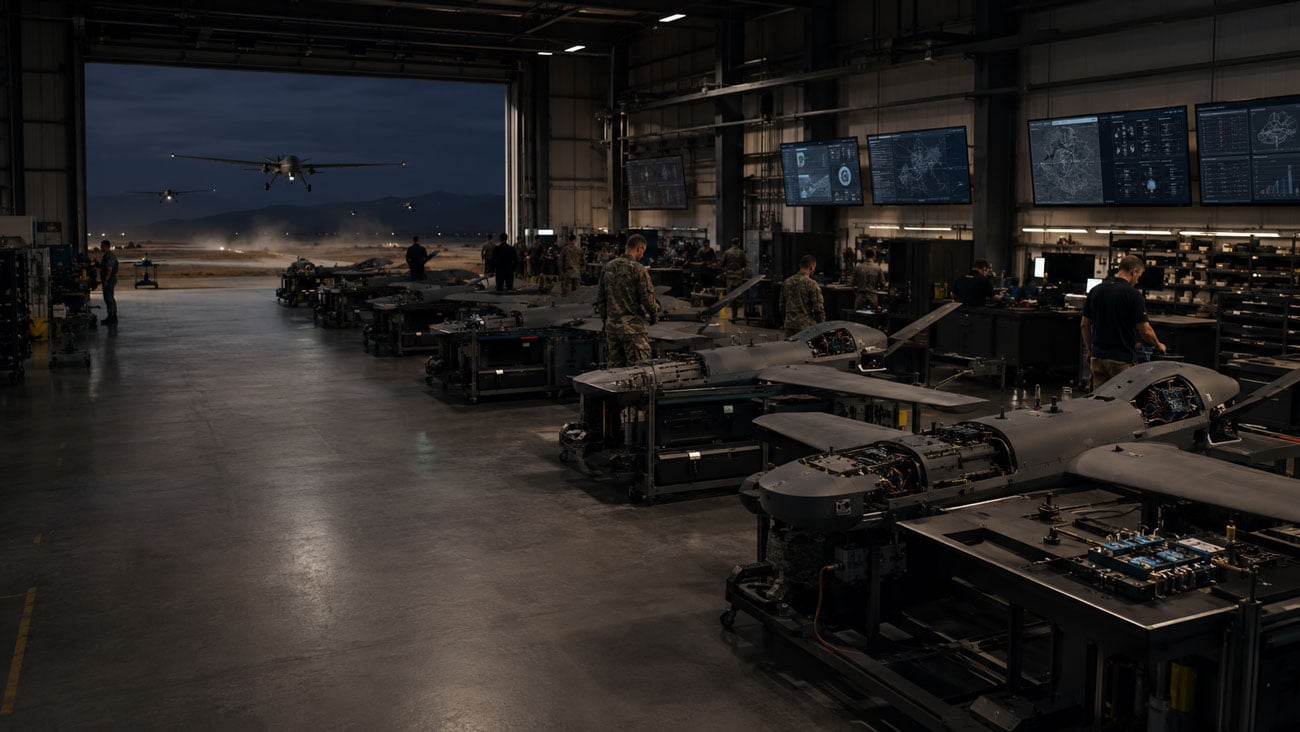
The Factory Has to Become Part of the Operational Loop
High-loss autonomous warfare creates a direct relationship between the battlefield and industrial base.
If drones are consumed continuously, the factories supplying them become part of force regeneration.
That ecosystem includes:
- electronics manufacturers;
- airframe producers;
- battery suppliers;
- motors and propulsion;
- optics;
- semiconductors;
- software teams;
- test organizations;
- assembly plants;
- and logistics networks.
Mass cannot be created at final assembly if one upstream component remains constrained.
That is the same industrial principle explored in Diamondback’s analysis of why America’s arsenal bottleneck is ultimately throughput.
Drone Production Has to Be Measured in Replacement Time
Traditional industrial metrics still matter:
- monthly output;
- first-pass yield;
- supplier delivery;
- unit cost;
- and manufacturing lead time.
Autonomous warfare adds another:
time to replace combat losses.
If 5,000 systems are lost, how long before the industrial base replaces them?
Can a supplier add another shift?
Can a second vendor produce a compatible system?
Are motors, optics, batteries, chips, and controllers available?
Is enough test capacity available to accept the additional output?
That makes production governance and operational throughput management part of autonomous-force readiness.
Battlefield Feedback Has to Reach the Factory Faster
Contemporary drone warfare evolves unusually quickly.
A communications link works.
The adversary jams it.
A navigation method works.
The adversary spoofs it.
A flight profile avoids detection.
The defense learns to recognize it.
An operator discovers a better tactic.
The system changes again.
The force that moves through this cycle faster gains advantage.
The relevant loop is:
observe → diagnose → redesign → test → produce → distribute → employ.
That is why drone dominance is increasingly connected to the continuous-delivery challenge described in Diamondback’s analysis of why battlefield software cannot wait for traditional release cycles.
Software Update Speed May Matter as Much as Production Speed
A factory can produce large numbers of drones and still deliver obsolete capability if the mission software cannot change quickly enough.
Autonomy, navigation, target recognition, electronic protection, collaborative behavior, and mission planning are all software-dependent.
This creates two production systems:
physical production and software production.
The military needs both to operate at operational tempo.
Hardware scaling without software adaptation creates inventory.
Software adaptation without enough hardware creates prototypes.
Drone dominance requires both.
The Electromagnetic Environment Will Continuously Rewrite the Requirement
Drones operate inside a contested electromagnetic environment.
Command links can be jammed.
GPS can disappear.
Emitters can be detected.
Enemy electronic warfare can change rapidly.
This means drone design has to anticipate:
- degraded communications;
- alternate navigation;
- local autonomy;
- frequency agility;
- signature management;
- and disconnected operation.
Diamondback’s analysis of spectrum maneuver as a core combat function explains why the electromagnetic contest directly shapes unmanned-system effectiveness.
GPS Independence Is an Industrial Requirement Too
Alternative navigation is often discussed as a technical capability.
At drone scale, it also becomes a production requirement.
If tens of thousands of systems require GPS-independent navigation, the sensors, processors, software, and supporting components for that capability also have to be manufactured at scale.
The best prototype solution may still fail industrially if it depends on an expensive or capacity-constrained component.
Diamondback’s analysis of assured PNT and GPS-independent operations addresses that technical dependency in greater depth.
The Acquisition System Has to Buy Evolution
A traditional program buys a defined configuration.
Autonomous warfare may require the government to buy something closer to persistent capability evolution.
That can mean:
- multiple qualified manufacturers;
- repeated competitions;
- short production increments;
- continuous software updates;
- modular payload insertion;
- and the ability to terminate weak configurations quickly.
Competition does not need to end when the first contract is awarded.
It can become part of the operating model.
This connects directly to Diamondback’s analysis of why faster acquisition only matters when the Pentagon can absorb and scale new technology.
Demand Signals Determine Whether Industry Builds Capacity
Companies do not create large factories simply because the government says drones are important.
They need enough demand visibility to justify:
- machinery;
- facilities;
- supplier commitments;
- workforce;
- inventory;
- and automation.
The Drone Dominance model intentionally provides a stronger signal by combining large planned volumes with recurring competitive phases.
That can encourage industry to invest while preserving competitive pressure.
The strategic challenge is balancing predictable demand with continuous competition.
This is a portfolio-demand and industrial-capacity planning problem.
The FY2027 Budget Makes the Scale of the Ambition Clear
The administration’s FY2027 defense budget request calls for more than $74 billion in drone and counter-drone technologies.
Department budget officials describe the request as the largest U.S. investment to date in drone warfare and counter-drone technology.
The number is important less as a spending headline than as an indication of scale.
The challenge is now to convert that demand into:
qualified suppliers → domestic capacity → integrated systems → trained operators → operational inventory.
Money is an input.
Fielded adaptive mass is the output.
Counter-UAS Has the Same Industrial Problem
Offensive drone mass creates an equivalent requirement for scalable defense.
The Department cannot rely exclusively on high-cost interceptors against low-cost unmanned threats.
It is therefore pursuing multiple defensive layers:
- electronic warfare;
- low-cost kinetic interceptors;
- defensive drones;
- directed energy;
- traditional missiles;
- and integrated sensors and command systems.
In July 2026, the Department awarded two Joint Laser Weapon System agreements with an initial value of $86 million and a total program ceiling of $847 million to move directed-energy capability toward production-oriented platforms for cruise-missile and UAS defense.
DIU’s Counter NEXT program similarly emphasizes modular open systems and designs suitable for high-rate manufacturing rather than over-engineering every interceptor.
The objective is not one perfect counter-drone weapon.
It is an economically sustainable defensive architecture.
Training and Force Generation Have to Scale With Hardware
A warehouse containing 100,000 drones does not create 100,000 useful military capabilities.
The force needs:
- operators;
- mission planners;
- maintainers;
- software support;
- tactics;
- training ranges;
- test capacity;
- and command structures capable of employing mass autonomy.
Training cannot begin after industrial scale has already arrived.
Force generation has to expand with production.
This is where training, sustainment, and mission-support planning become part of the autonomous-force architecture.
The Industrial Base Has to Be Able to Change Suppliers
Scale creates another risk: dependence.
If one manufacturer controls a critical airframe, controller, software interface, battery, sensor, or autonomy stack, production concentration can become strategic vulnerability.
The stronger architecture preserves:
- multiple suppliers;
- common interfaces;
- replaceable components;
- government visibility into dependencies;
- and alternative production paths.
That protects the force not only from supplier failure but from technological stagnation.
The Goal Is Not the Perfect Drone
The search for one optimal platform can become counterproductive in a technology environment changing every few months.
The more resilient objective is a system capable of continuously producing useful configurations.
Some will prioritize range.
Some payload.
Some autonomy.
Some electronic warfare.
Some reconnaissance.
Some cost.
Some will be replaced quickly.
Others may remain useful for years.
The architecture should permit that diversity while preserving interoperability.
Drone Dominance Is Really Adaptation Dominance
The phrase drone dominance naturally suggests enormous fleets of unmanned systems.
Quantity matters.
But the deeper competition is adaptation.
Can the United States:
- identify the new battlefield requirement;
- translate it into technical change;
- modify software;
- modify hardware;
- source the components;
- validate the change;
- scale production;
- field the new configuration;
- and repeat the cycle before the adversary adapts again?
The organization capable of doing that possesses more than a drone fleet.
It possesses an adaptive defense ecosystem.
That ecosystem combines:
operators + engineers + software + factories + suppliers + acquisition + data + testing + logistics.
America’s drone challenge is therefore not simply to manufacture more unmanned systems.
It is to build the institutional, technical, and industrial machinery capable of continuously manufacturing better ones.
In autonomous warfare, the factory, software pipeline, and feedback loop may become every bit as important as the drone itself.
Primary Sources
- Department — July 2026 consolidation of unmanned and autonomous systems under the Direct Reporting Portfolio Manager for UxS
- Department / Defense Innovation Unit — Drone Dominance production orders, Gauntlet testing, unit-cost targets, and 2027 fielding objective
- Department — Drone Dominance program structure, $1.1 billion competitive model, and production scaling
- Defense Innovation Unit — SWAP-USV challenge and cost-exchange requirements for scalable unmanned maritime defense
- Defense Innovation Unit — Counter NEXT modular open architecture and high-rate-production approach
- Department — Joint Laser Weapon System production-oriented counter-UAS and cruise-missile defense awards
- Department — FY2027 defense budget and investment in drone and counter-drone technologies