America’s ability to project combat power overseas depends on far more than the number of ships in the sealift fleet. Strategic mobility is a national transportation system linking installations, rail, highways, ports, merchant mariners, commercial carriers, fuel networks, data, and destination infrastructure. In a contested conflict, the decisive question is not how much lift exists on paper—it is how much combat power can be delivered into theater, on time, while the network is under pressure.
Bottom line: America’s strategic sealift problem is not simply a shortage of ships. It is the vulnerability of the entire deployment network required to turn military forces inside the United States into usable combat power overseas.
The Ready Reserve Force has to activate. Crews have to arrive. Equipment has to move from installations to ports. Ports have to load vessels. Ships have to sail. Destination ports have to remain usable. Cargo then has to move onward into theater. Fuel, data, maintenance, commercial logistics, cyber resilience, and allied infrastructure all have to function along the way.
That is why a future war may begin operationally long before American forces reach the theater.
American Military Power Has to Physically Get There
Military planning can make combat power appear abstract. Brigades become symbols. Aircraft, missiles, ships, and launchers become inventory counts.
But heavy military equipment still obeys physics.
Armored vehicles weigh tens of tons. Helicopters, engineering equipment, fuel systems, ammunition, generators, repair parts, communications equipment, and thousands of containers occupy physical space. A deployment order does not move them. Transportation does.
For large-scale operations overseas, much of that mass ultimately moves by sea.
MARAD’s Ready Reserve Force (RRF) currently consists of 43 vessels: 37 roll-on/roll-off ships, four auxiliary crane ships, and two aviation-maintenance vessels. The force provides nearly 50 percent of government-owned surge sealift capability and is designed primarily to move Army and Marine Corps equipment and initial resupply during the opening surge of a deployment.
Most RRF vessels are maintained in reduced operating status and are expected to become fully operational within assigned five- or ten-day readiness windows.
That makes sealift a direct component of deterrence. An adversary evaluating American military power should care not only about what the United States owns, but whether the force can arrive in sufficient mass before the operational window closes.
Airlift Gets There First. Sealift Brings the Mass.
Strategic airlift is indispensable for personnel, high-priority equipment, medical supplies, weapons, and time-sensitive cargo.
But aircraft are constrained by weight, volume, range, airfield access, and sortie generation. Sustaining a major ground or joint campaign requires quantities of material that are overwhelmingly better suited to maritime transportation.
Airlift helps a force arrive quickly.
Sealift helps the force arrive in strength.
The distinction matters because speed without mass may not create enough combat power, while mass arriving too late may not matter.
The Sealift Architecture Is Bigger Than the Ready Reserve Force
America’s strategic sealift system combines government-owned surge capacity with commercially operated U.S.-flag shipping.
MARAD’s Maritime Security Program (MSP) maintains 60 commercially viable, militarily useful U.S.-registered vessels operating in international trade. In exchange for government support, participating carriers make ships and commercial transportation resources available to the Department of Defense during war or national emergency.
Those resources extend beyond hulls. MSP gives DoD access to global intermodal networks that include terminals, facilities, logistics-management services, and U.S. citizen merchant mariners.
The Tanker Security Program (TSP) adds assured access to 10 U.S.-registered product tankers intended to support military fuel requirements.
Strategic sealift is therefore not a fleet in isolation. It is a national transportation ecosystem involving:
- government-owned surge vessels;
- commercial ships and tankers;
- merchant mariners;
- ports and terminals;
- rail and highway networks;
- fuel infrastructure;
- commercial logistics providers;
- maintenance and shipyard capacity;
- data and communications systems;
- and allied reception infrastructure.
That ecosystem is powerful because it is distributed. It is also vulnerable because failure can occur at any node.
A Ready Ship Without a Crew Is Not Ready
Sealift readiness has a human constraint.
RRF ships in priority readiness maintain small reduced-operating-status crews that must be augmented when vessels activate. The larger surge requirement therefore depends partly on the civilian merchant-mariner workforce that normally supports U.S.-flag commercial shipping.
DOT’s FY2027 Evidence Plan cites a prior estimate that concurrent operation of the commercial U.S.-flag fleet and sustained military sealift would require approximately 13,600 mariners with unlimited credentials. The most recent estimate cited by DOT identifies approximately 11,800 active, qualified mariners—a potential deficit of roughly 1,800 mariners.
A missile can be stockpiled. A qualified chief engineer cannot.
Mariners require education, sea time, licensing, credentialing, endorsements, and operational experience. That means the workforce cannot be created after mobilization begins.
Merchant mariners should therefore be viewed as part of the defense workforce and mission-support architecture.
The Commercial Fleet Is Part of the Mobilization Base
The mariner problem is inseparable from commercial shipping.
Commercial vessels create employment and sea-time opportunities for the credentialed mariners the government may need during a surge. The same ships and carrier networks also provide sustainment capacity after the initial government-owned surge.
MARAD’s March 2026 U.S.-flag fleet dashboard counted 188 self-propelled, ocean-going U.S.-flag vessels of 1,000 gross tons or more across domestic and international service. A separate DOT performance report recorded 97 U.S.-flag vessels operating internationally in FY2025.
Those numbers are meaningful, but they remain small relative to the scale of global commercial shipping. That is one reason the congressionally mandated CNA study released through MARAD in March 2026 treats merchant mariners, commercial shipping, commercial shipbuilding, and national-security sealift as one interconnected strategic problem.
Fewer commercially viable U.S.-flag ships can mean fewer mariner jobs. Fewer mariners can constrain surge crewing. A smaller commercial fleet can also reduce assured U.S.-controlled transportation during crisis.
Commercial maritime policy is therefore part of defense mobility policy.
The Deployment Begins Before the Ship Reaches the Port
One of the most misleading assumptions about strategic sealift is that the mission begins at the waterfront.
It does not.
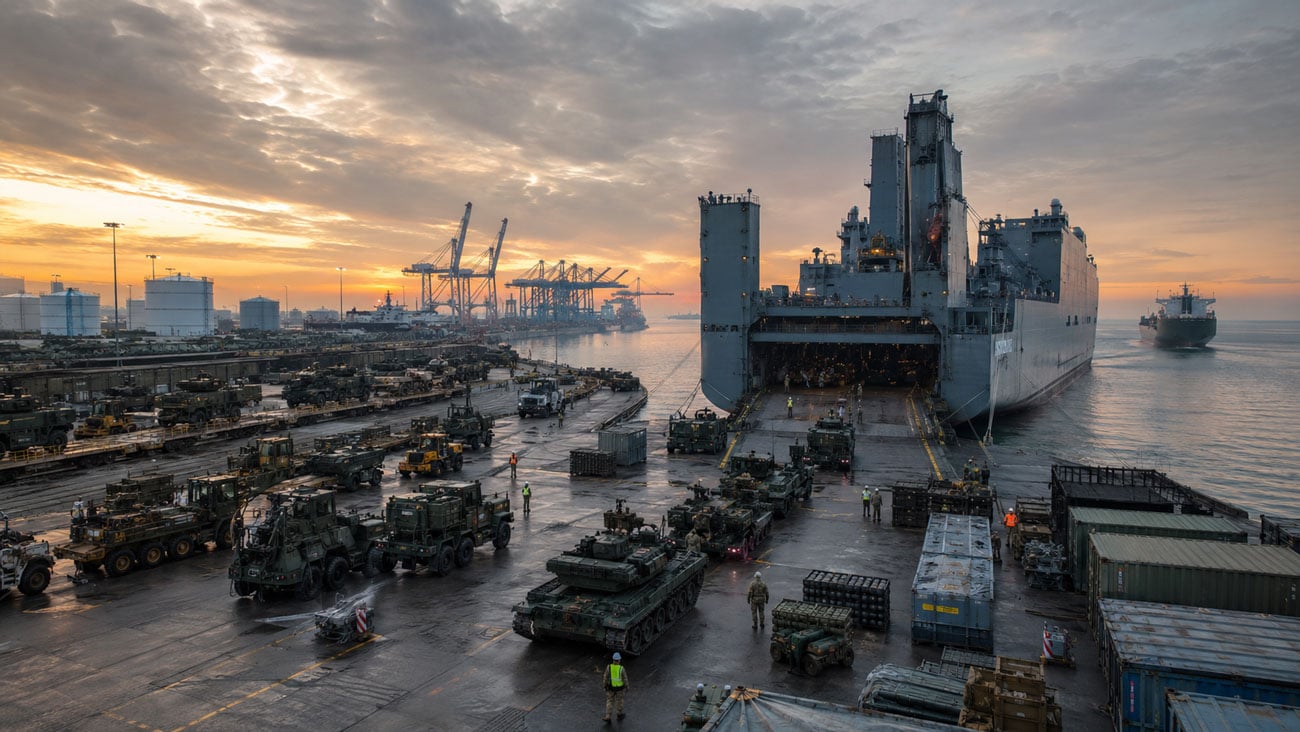
Equipment may begin at an Army installation hundreds or thousands of miles inland. Vehicles and containers must move by rail or highway. Routes have weight, clearance, scheduling, and capacity constraints. Commercial transportation providers may be involved. Ports require staging space, labor, security, and cargo-handling equipment.
A strategic sealift vessel can be perfectly ready and still contribute nothing if the cargo cannot reach its loading berth.
That means strategic mobility begins at the installation and extends through the entire deployment and execution network.
The Ship Is Only One Node in the Chain
To convert a reserve vessel into delivered combat power, a much larger sequence has to work:
- the vessel activates;
- a complete crew is assembled;
- maintenance discrepancies are resolved;
- the vessel reaches its loading port;
- military cargo arrives at the same location;
- equipment is staged and documented;
- the ship is loaded;
- the ocean route remains usable;
- a destination port is available;
- cargo is unloaded;
- and theater distribution moves the equipment to the force.
A failure anywhere changes the outcome.
This is the central strategic-sealift insight: transportation capacity should be measured as an end-to-end system rather than as a collection of ships.
Ports Are Combat Infrastructure in a Mobilization
A deep-water berth, roll-on/roll-off ramp, heavy crane, warehouse, fuel storage site, rail spur, and container-handling system may normally be commercial infrastructure.
During mobilization, those assets become military capacity.
Port throughput can therefore become the limiting constraint even when enough ships exist. A fleet may theoretically carry enormous tonnage, but if only a limited number of vessels can be loaded or unloaded simultaneously, the transportation network cannot realize that capacity on the required timeline.
The same is true at destination ports.
A high-end conflict may threaten fixed maritime infrastructure through long-range strike, cyber operations, undersea threats, sabotage, congestion, or disruption of supporting utilities and transportation.
The logistics architecture has to assume the preferred port may be unavailable.
Alternate ports, commercial terminals, allied infrastructure, distributed reception points, and austere offload options create resilience by providing choices.
The War Can Attack the Network Before the Network Leaves Home
America’s geographic distance from potential theaters is protective, but it also creates a long and observable mobilization process.
An adversary seeking to slow U.S. deployment does not necessarily need to sink a sealift ship in the Pacific or Atlantic.
Cyberattacks on port or rail systems, sabotage, infrastructure failures, disinformation, utility disruption, or attacks on logistics data could create friction while equipment is still moving inside the United States.
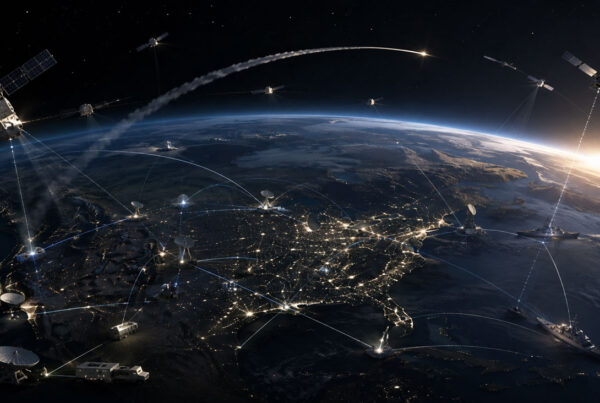
The homeland transportation network should therefore be considered part of contested logistics.
The battlefield does not begin at the shoreline.
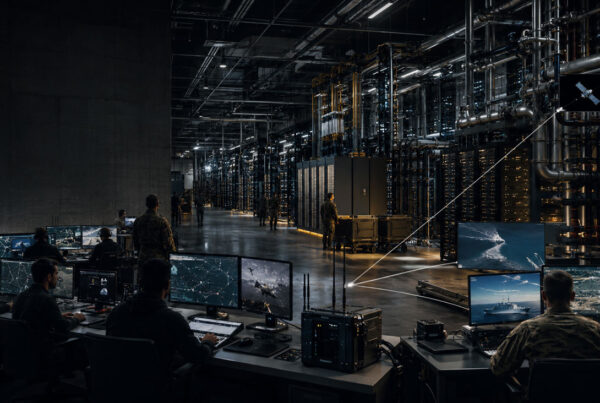
Strategic Mobility Needs a Trusted Operating Picture
The scale of a major deployment creates an enormous information-management challenge.
Leaders need to understand which ships are available, which are activated, whether crews are complete, where cargo is located, which ports have capacity, where congestion is forming, which routes remain usable, what has already moved, and what needs to move next.
Those data may originate in military systems, commercial logistics platforms, port-management tools, maintenance systems, carrier networks, and allied organizations.
If the enterprise cannot reconcile those sources, it does not have an operating picture. It has disconnected databases.
This is where technology enablement and data architecture become strategic mobility capabilities.
Predictive analytics and AI-augmented planning can potentially forecast congestion, identify schedule conflicts, recommend alternate routing, predict maintenance issues, and improve load planning—but only if the underlying data are sufficiently reliable, timely, and interoperable.
Commercial Logistics Networks Create Scale—and Dependencies
The Pentagon could not economically recreate the global logistics networks already operated by commercial carriers.
That is the strategic value of programs such as MSP: DoD gains access not only to ships but to commercial transportation systems that operate globally every day.
But public-private scale introduces questions that should be answered before mobilization:
- Which commercial capacity is contractually committed?
- What happens when civilian demand is also high?
- How quickly can military cargo receive priority?
- What cybersecurity requirements apply to commercial systems?
- What happens if a carrier, terminal, or service provider loses capacity?
- How are data shared between military and commercial systems?
- What alternate providers are available?
A resilient public-private architecture depends on governance, agreements, exercises, and relationships established in advance.
Fuel Is Its Own Strategic Sealift Problem
Aircraft, ships, vehicles, generators, and distributed bases consume enormous quantities of fuel.
That fuel requires specialized vessels, terminals, storage, pipelines, transfer systems, safety procedures, and trained personnel.
The Tanker Security Program exists because petroleum movement cannot simply be treated as ordinary cargo. TSP is designed to provide DoD assured access to 10 commercially operated, U.S.-registered product tankers during conflict or national emergency.
In a geographically expansive theater such as the Indo-Pacific, tanker availability and terminal access can directly affect operational tempo.
A combat aircraft without fuel is potential capability. The logistics architecture that delivers fuel makes it usable.
Recapitalization Has to Improve the System, Not Just the Hulls
The Ready Reserve Force has faced long-standing age and maintenance challenges, which is why MARAD has pursued recapitalization through acquisition and modernization of replacement vessels.
Newer ships matter. Reliability matters. Maintenance burden matters.
But a younger fleet alone does not solve strategic mobility.
A new vessel still needs mariners, ports, maintenance, fuel, cargo-handling infrastructure, cybersecure systems, commercial support, and a functioning deployment architecture.
Recapitalization should therefore be judged by whether it increases the probability that the complete mobility system performs on demand.
That is an enterprise modernization and systems-engineering challenge.
Readiness Has to Be Tested Through Activation
A reserve ship listed as available on paper is not necessarily ready operationally.
MARAD periodically activates RRF vessels for Department of Defense exercises and real-world cargo missions to validate readiness. Those activations matter because reduced-status systems can conceal problems that become visible only when they are placed under sustained operating demand.
The same principle should apply to the wider logistics network.
Exercises should not simply prove that ships can activate under ideal conditions. They should introduce friction:
- make a loading port unavailable;
- disrupt a rail route;
- create a vessel casualty;
- degrade logistics data;
- delay fuel;
- remove commercial capacity;
- create destination-port congestion;
- or introduce a mariner shortfall.
Then evaluate whether the enterprise adapts.
Can cargo reroute? Can another vessel assume the load? Can a commercial terminal substitute? Can an allied port receive the shipment? Can planners maintain visibility while systems are degraded?
A sealift network tested only under ideal conditions is being tested against the wrong war.
Allies Expand the Logistics Architecture—If the Procedures Exist
Strategic mobility is inherently multinational.
Allied ports, repair facilities, fuel infrastructure, commercial terminals, rail networks, and transportation providers can create alternative routes and reception points across Europe and the Indo-Pacific.
But infrastructure does not automatically become military capacity simply because a friendly government owns it.
Customs procedures, access agreements, contracting mechanisms, security requirements, data exchange, cargo-handling standards, communications, and exercises all have to be established.
Interoperability extends to the dock.
Sealift Is Part of Contested Logistics, Not Behind It
Contested logistics assumes the adversary will attack the sustainment network rather than allowing supplies to move through protected rear areas.
Strategic sealift belongs squarely inside that concept.
The contest can include ports, ships, rail, highways, information systems, communications, fuel infrastructure, commercial providers, and destination distribution.
Physical and digital readiness are converging. A port with functioning cranes but unavailable terminal-management systems may be unable to sustain normal throughput. A ship that can cross the ocean but depends on compromised navigation, maintenance, or communications systems is not fully ready.
Cybersecurity, route diversity, alternative ports, communications resilience, workforce readiness, and commercial continuity should therefore be designed into the sealift enterprise rather than treated as supporting issues.
The National Maritime Strategy Has to Connect the Pieces
The CNA study released through MARAD in March 2026 is important because it frames commercial shipping, merchant mariners, domestic shipbuilding, and national-security requirements as one strategic system.
That is the right level of analysis.
Strategic sealift cannot be solved only by buying reserve ships. Mariner shortages cannot be solved only by maritime academies. Commercial shipping policy cannot be separated from defense access. Port resilience cannot be treated only as a local infrastructure concern. Shipbuilding programs draw from overlapping workforce, supplier, and industrial capacity.
The United States needs enterprise governance that connects these pieces through a coherent maritime and mobility strategy.
The Metric Is Delivered Combat Power, Not the Number of Ships
Sealift is naturally measured through inputs:
How many ships? How much square footage? How many tankers? How many mariners?
Those numbers matter, but they are not the mission outcome.
The more useful question is:
How much combat power can the United States deliver to the required theater within the required timeline—and continue delivering after the initial surge?
That measure incorporates the complete chain:
Installation → inland transportation → loading port → vessel → mariner → ocean route → destination port → theater distribution → sustained resupply.
The weakest node can constrain everything behind it.
The First Battle May Be the Deployment
America’s oceans provide strategic protection. They also create strategic distance.
In a major overseas conflict, much of the force required to shape the outcome must cross those oceans while the transportation system itself may be observed, disrupted, congested, or attacked.
The Ready Reserve Force supplies government-owned surge capacity. The Maritime Security Program adds commercially operated ships and global intermodal networks. The Tanker Security Program helps secure fuel transportation. Merchant mariners crew the vessels. Ports, rail, highways, data systems, commercial logistics providers, and allies connect the movement from home station to theater.
That architecture is one of the least visible pillars of American military power.
The strategic question is therefore not merely whether the United States has the best tank, missile, aircraft, radar, or autonomous system.
It is whether those capabilities can reach the place where they matter before the operational window closes.
Military power inside the United States is potential. Military power delivered into theater is capability.
And in a contested conflict, the first battle may be fought across rail yards, highways, ports, shipping lanes, logistics networks, and data systems before much of the combat force ever encounters the enemy.
Primary Sources
- MARAD — Ready Reserve Force
- MARAD — Maritime Security Program
- MARAD — Tanker Security Program
- MARAD — U.S.-Flag Fleet Dashboard
- MARAD / CNA — Independent Study in Support of a National Maritime Strategy
- U.S. GAO — Maritime Administration Workforce Challenges
- U.S. Department of Transportation — FY2027 Evidence Plan