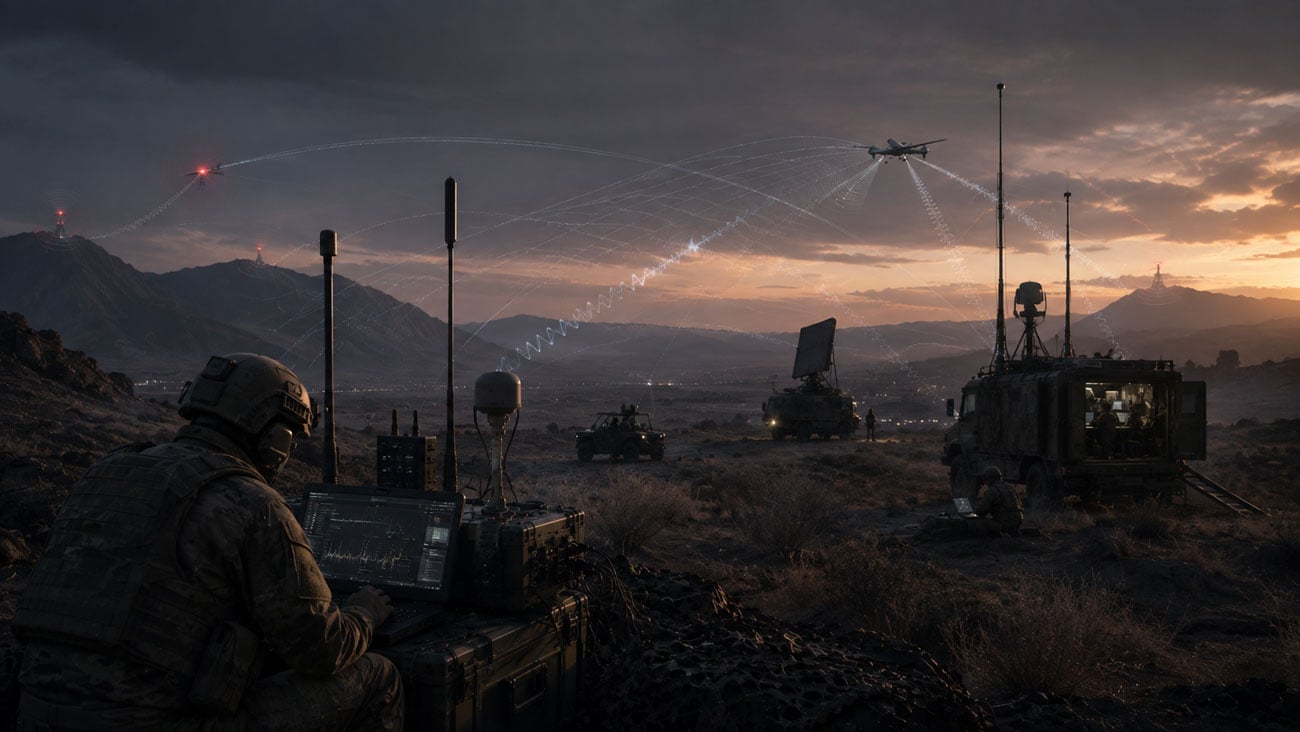
Modern forces cannot communicate, navigate, sense, target, or coordinate without access to the electromagnetic spectrum—and every transmission can also expose them. In 2026, the Army began fielding near-real-time spectrum-awareness tools, prototyping modular electronic-warfare systems, and integrating the electromagnetic operating picture into Next Generation Command and Control. The shift is larger than better jammers: the spectrum is becoming maneuver space that commanders must understand, protect, exploit, and move through as deliberately as physical terrain.
Bottom line: the electromagnetic spectrum is becoming a core combat function because modern forces do not merely use it—they maneuver, sense, communicate, reveal themselves, deceive, and fight through it.
Radios, radars, GPS, drones, datalinks, satellite terminals, sensors, electronic warfare systems, and command networks all depend on electromagnetic energy.
That makes the spectrum both an enabler and a battlespace.
The Army’s 2026 modernization activity reflects that shift. A new $350 million Spectrum Situational Awareness System contract is intended to help commanders see their own electromagnetic signature. The Electromagnetic Warfare Rapid Integration System is testing smaller, modular EW capabilities across ground, airborne, and autonomous platforms. Electronic-warfare command-and-control software is being integrated into NGC2 so spectrum information can reach the commander’s operational picture.
The larger idea is simple:
the force that understands and changes the electromagnetic environment faster can create advantage in the physical fight.
The Battlefield Has Terrain You Cannot See
Commanders study terrain because terrain shapes movement, visibility, protection, and opportunity.
Mountains constrain. Rivers canalize. Urban areas conceal. High ground creates advantage.
The electromagnetic spectrum creates a different kind of terrain.
It is invisible, dynamic, shared, and continuously changing.
Army professional writing published in July 2026 argues that electromagnetic spectrum operations should increasingly be understood through the logic of maneuver warfare: seek positional advantage, exploit weakness, avoid enemy strength, and create temporary windows of opportunity.
The authors explicitly distinguish the spectrum from a formal warfighting domain. Their argument is that it functions as maneuver space that cuts across every domain.
That is an important conceptual change.
Electronic warfare is no longer simply a supporting effect added after the maneuver plan is complete.
It increasingly shapes the maneuver plan itself.
Every Emission Can Become Intelligence
A modern military formation produces an enormous electromagnetic signature.
Command posts transmit. Radars radiate. Drones send video. Tactical radios exchange data. Satellite terminals connect to orbit. Wireless systems move information among sensors and shooters.
Every one of those emissions can potentially reveal something:
- location;
- unit concentration;
- network activity;
- equipment type;
- sensor status;
- operational tempo;
- or command-and-control behavior.
The paradox is unavoidable:
communications create command advantage and electromagnetic exposure at the same time.
That makes signature awareness a survivability requirement.
S2AS Is Designed to Let a Command Post See Itself
On June 1, 2026, the Army announced a $350 million, five-year production contract with 3dB Labs for the Spectrum Situational Awareness System, or S2AS.
S2AS senses, detects, and reports in near real time a command post’s electromagnetic signature and sources of electromagnetic interference.
The system is intended to support:
- emissions-control decisions;
- interference resolution;
- warning of unauthorized or intentional interference;
- and command-post survivability.
The Army says Transformation in Contact engagements accelerated the procurement timeline and that first-unit issue is planned for 2026.
The underlying operational principle is powerful:
before a force can manage its electromagnetic signature, it has to be able to see it.
Command Posts Can Be Targeted Before They Are Seen
A physical command post can be camouflaged.
Its electromagnetic behavior may still reveal it.
Modern command posts contain radios, satellite communications, wireless networks, servers, antennas, and other emitters. Those systems support the commander’s decision cycle, but they also create detectable patterns.
The Army’s own S2AS program explicitly connects spectrum awareness with command-post survivability.
Other Army writing on command-post survivability emphasizes smaller footprints, dispersion, mobility, emissions control, and signature reduction as necessary responses to a battlefield in which sensors and long-range fires can rapidly exploit detection.
The objective is no longer merely:
stay connected.
It is:
stay connected without making the command node easier to find and target.
Emissions Control Is Becoming a Form of Maneuver
Physical maneuver moves forces through terrain.
Spectrum maneuver changes position in electromagnetic space.
A unit may:
- change frequencies;
- reduce transmission power;
- shift to another communications path;
- operate passively;
- activate a jammer briefly;
- create a decoy signature;
- move an emitter;
- or concentrate electronic attack against a specific portion of the spectrum.
These actions can create temporary local advantage without creating permanent control.
That distinction matters.
A sophisticated peer opponent will also sense, jam, deceive, adapt, and reprogram.
Permanent spectrum dominance may be unrealistic.
Temporary spectrum advantage at the right place and time may be enough to enable physical maneuver, fires, or protection.
The Better Mental Model Is Windows of Advantage
Army writing on spectrum maneuver describes electromagnetic effects as temporally bounded—more like precision fires that create an opening than terrain that can be occupied permanently.
That suggests a useful operational model.
An electronic attack suppresses a sensor long enough for aircraft to move.
A communications pathway is protected long enough for a unit to displace.
An emitter is located long enough to generate a target.
A jammer creates a gap in an adversary network long enough for another force to exploit it.
The electromagnetic effect does not need to last forever.
It needs to create the required advantage during the decision window.
Spectrum Awareness Has to Reach the Commander
Electronic-warfare expertise remains specialized for good reason.
But if the spectrum affects whether a formation can communicate, navigate, sense, survive, and target, spectrum information cannot remain isolated inside an EW cell.
Commanders need answers to operational questions:
- Where are friendly systems interfering with one another?
- Which frequencies are being denied?
- What is our current electromagnetic signature?
- Where are threat emitters operating?
- Which communications paths remain usable?
- What traffic should receive priority?
- Can an electromagnetic effect create a maneuver opportunity?
That information has to reach the same decision environment used to understand physical forces.
EWPMT and EWC2 Are Moving the Spectrum Into NGC2
The Army’s Electronic Warfare Planning and Management Tool has long provided the ability to visualize, plan, model, and manage EW spectrum assets.
In 2026, that capability is being integrated into Next Generation Command and Control.
The Army says EWPMT integration with NGC2 is intended to expand electromagnetic awareness, command and control, and understanding across warfighting functions while shortening targeting timelines.
The transition is also producing a newer web-based application called Electromagnetic Warfare Command and Control, or EWC2.
Army officials say EWC2 now provides commanders with a real-time Electromagnetic Operating Picture and decision support and has already been integrated with the 4th Infantry Division’s NGC2 experimentation.
This is a direct example of technology enablement through integrated operational data and command architecture.
The Spectrum Picture Has to Connect to Fires and Intelligence
Electromagnetic sensing has value far beyond interference management.
A detected emitter can contribute to target development.
An electronic attack can create a non-kinetic effect.
Signals can provide indications and warning.
Spectrum information can help determine whether a threat system has changed operating modes or moved.
The Army describes EWPMT and related EW systems as supporting both non-kinetic effects and kinetic targeting across fires and intelligence.
This is where the invisible and visible battlespaces converge.
A signal becomes information.
Information becomes a target.
An electromagnetic effect may shape a physical maneuver.
A kinetic strike may remove an emitter.
Jamming Is Only One Part of Electromagnetic Warfare
Public discussions often use electronic warfare and jamming as though they were synonymous.
The actual mission is broader.
Electromagnetic warfare includes:
- electromagnetic support to detect, identify, and locate signals;
- electromagnetic attack to deny, degrade, disrupt, deceive, or otherwise affect hostile systems;
- electromagnetic protection to preserve friendly capability;
- spectrum management;
- signature control;
- target support;
- and reprogramming as threats change.
The spectrum is simultaneously an intelligence source, communications medium, protection problem, and effects environment.
Friendly Congestion Can Be a Combat Problem Too
Not every spectrum problem comes from the adversary. Radios, radars, drones, datalinks, counter-UAS systems, satellite terminals, sensors, and EW systems can interfere with one another or compete for limited spectrum.
S2AS is valuable partly because it identifies interference from all sources. Spectrum management therefore has to prevent electronic fratricide as well as enemy attack.
The Drone Age Has Accelerated the Spectrum Contest
Unmanned systems make the relationship between spectrum and physical combat easy to see.
Many drones depend on some combination of:
- radio-frequency command links;
- telemetry;
- video transmission;
- satellite navigation;
- and network connectivity.
Electronic warfare can attack those dependencies.
But the target never remains static.
Developers introduce alternative navigation, greater autonomy, frequency agility, new datalinks, and other counter-countermeasures.
That produces the defining characteristic of modern EW:
adaptation speed.
A countermeasure that works exceptionally well today may become less effective after the adversary changes its software, waveform, operating procedure, or hardware configuration.
ERIS Is Built Around Rapid Adaptation and Modular Hardware
On May 1, 2026, the Army selected Pacific Defense Strategies, SRC, and Herrick Technologies Laboratories to prototype the Electromagnetic Warfare Rapid Integration System, or ERIS.
The Army describes ERIS as an effort to counter sophisticated radio-frequency threats using adaptable and scalable technology.
The prototypes are intended to demonstrate that small, modular EW systems can operate from:
- ground platforms;
- airborne platforms;
- and autonomous systems.
The Army also made ERIS its first effort under the Army Open Solicitation and Commercial Solutions Opening approach, using commercial acquisition mechanisms to reach available technology faster.
The architecture matters because the threat evolves faster than traditional multiyear hardware replacement cycles.
This is where modular systems engineering and rapid technology integration become combat requirements.
Electronic Warfare Is Becoming a Software Race
Physical EW hardware may remain in service for years.
The mission software that determines what the system detects, recognizes, prioritizes, and counters may need to change far more frequently.
Threat libraries change.
Signal-processing algorithms change.
Waveforms change.
Countermeasures change.
The Army’s spectrum-maneuver concept specifically identifies agile reprogramming as essential to maintaining advantage against an adaptive adversary.
The useful operating loop becomes:
sense → identify → understand → develop response → test → distribute → observe again.
That closely resembles the continuous-delivery model discussed in Diamondback’s analysis of why the battlefield cannot wait for the next software release.
The Reprogramming Enterprise Is Part of the Weapon System
If an EW system’s effectiveness depends on updated mission software, then the people, laboratories, test environments, threat data, distribution pipelines, and authorization processes producing that software are part of combat capability.
The weapon does not end at the antenna.
It includes the enterprise capable of keeping the antenna relevant.
This changes sustainment.
A contractor or government software team is not simply maintaining a fielded product.
It may be responding to adversary adaptation at operational speed.
Artificial Intelligence Can Reduce the Time From Signal to Understanding
The electromagnetic environment produces enormous amounts of data.
Signals appear and disappear. Frequencies shift. Waveforms overlap. Noise complicates classification. Thousands of emitters can operate simultaneously.
Artificial intelligence and machine learning can assist with:
- signal classification;
- pattern recognition;
- anomaly detection;
- emitter association;
- threat prioritization;
- and automated support to spectrum management.
The Army already fields systems such as the Tactical Electronic Warfare System with machine-learning signal-recognition software, while newer modernization efforts continue exploring AI-enabled analytics.
The objective should not be replacing EW specialists.
It is reducing the interval between emission and understanding.
That is a natural application for AI-augmented analysis with human operational judgment.
GPS Denial Is One Part of the Same Fight
Positioning, navigation, and timing are electromagnetic functions too.
GPS signals can be jammed, spoofed, masked, or degraded.
That makes assured PNT inseparable from the broader spectrum problem.
The Army’s PM EW&C architecture explicitly identifies Assured PNT as an interdependency across S2AS, EWPMT, MEMSS, and other spectrum capabilities.
Diamondback’s analysis of how the Army is preparing for operations without reliable GPS examines that portion of the electromagnetic contest in greater depth.
Satellite Communications Are Spectrum Maneuver Too
Military SATCOM depends on electromagnetic links between users, terminals, satellites, and ground infrastructure.
Those links can be jammed or disrupted.
The Space Force is therefore moving toward hybrid satellite-communications architecture that can shift traffic among providers and pathways when one becomes unavailable.
That is the same resilience principle at a different scale.
Diamondback’s analysis of the Space Force network designed to route around satellite loss shows how spectrum resilience increasingly spans terrestrial and space architecture.
Connectivity Has to Fail Gracefully
The more capability the force places on networks, the more dangerous it becomes to assume networks always work.
A peer adversary will attempt to disrupt them.
Communications may become intermittent. Bandwidth may fall. GPS may disappear. A satellite link may be unavailable. A jammer may deny part of the spectrum.
Resilient communications therefore require:
- multiple pathways;
- alternative waveforms;
- local processing;
- distributed data;
- mission command under reduced connectivity;
- and systems capable of useful disconnected operation.
The goal is not to promise uninterrupted connectivity.
It is to prevent one lost pathway from becoming mission failure.
Training Has to Include Losing the Spectrum
Units should not discover their electromagnetic dependencies during combat.
Exercises should deliberately introduce:
- GPS denial;
- communications jamming;
- friendly interference;
- satellite-link loss;
- deceptive signals;
- bandwidth constraints;
- and emissions-control requirements.
Commanders and staffs then learn which systems are essential, which alternate pathways actually work, which procedures are too slow, and which signatures expose the formation.
This is where readiness testing and operational execution convert spectrum resilience from architecture into demonstrated capability.
The Entire Formation Needs Electromagnetic Discipline
EW specialists cannot manage every emitter on the battlefield. Signal Soldiers, drone operators, fires cells, command posts, intelligence teams, vehicle crews, and aviation units all create and depend on electromagnetic activity.
Personnel increasingly need to understand what their equipment emits, when those emissions are necessary, which alternate pathways exist, and how to respond to jamming or interference. Sensitive threat information must also move among intelligence, acquisition, laboratories, operators, and software teams quickly enough to support adaptation without weakening security.
This makes training, workforce readiness, and mission-support planning part of spectrum operations.
Industry Has to Support a Living Capability
Electronic-warfare contractors increasingly have to deliver more than hardware. The operating model may require continuous software updates, threat analysis, new mission data, rapid testing, field reprogramming, open interfaces, command-and-control integration, and feedback from operational units.
The lifecycle becomes cyclical:
develop → field → observe → update → test → redeploy.
Closed architectures slow that loop. Modular, platform-agnostic designs such as ERIS create more pathways for new software, sensors, processors, effects, and suppliers to enter without replacing the entire system.
The Spectrum Fight Is a Decision-Speed Competition
At the tactical level, electromagnetic warfare often compresses into a race.
Who detects first?
Who identifies the signal correctly?
Who understands what changed?
Who can alter a waveform?
Who can reprogram the system?
Who can distribute the response?
Who can exploit the resulting opening before the opponent adapts again?
The decisive metric may increasingly become:
time from electromagnetic observation to operational response.
That is both a force-design and modernization-planning problem and a battlefield execution problem.
The Invisible Terrain Will Shape the Visible Fight
The electromagnetic spectrum does not appear on a traditional terrain map.
Yet nearly every modern military capability depends on it.
A fighter needs communications and navigation.
A drone needs command, navigation, autonomy, or data transfer.
A missile-defense system needs sensing and networking.
A command post needs communications.
An artillery unit needs targeting.
A ship needs radar and datalinks.
A satellite communicates through radio-frequency links.
Remove reliable access to the spectrum and many of the systems defining modern warfare become less capable at once.
That is why the Army’s investments in S2AS, ERIS, EWC2, EWPMT, MEMSS, and related spectrum capabilities matter beyond the EW community.
They point toward a force that increasingly treats the spectrum as something commanders must actively understand and shape.
The important questions become:
What is the adversary emitting? What are we emitting? What can each side detect? Which pathways still work? Where can we create a temporary advantage—and how quickly can we move when the environment changes?
The next battlefield will still contain roads, cities, mountains, forests, coastlines, and oceans.
Layered across all of them will be another terrain:
invisible, dynamic, congested, contested, and increasingly decisive.
Primary Sources
- U.S. Army CPE ISW — $350 million S2AS production contract and 2026 fielding
- U.S. Army CPE ISW — ERIS modular EW prototyping awards
- U.S. Army Gray Space — Spectrum Maneuver: Integrating EMSO into 21st Century Warfare
- U.S. Army CPE ISW — PM Electromagnetic Warfare & Collection program portfolio, EWPMT, S2AS, MEMSS, and NGC2 integration
- U.S. Army CPE ISW — EWC2 real-time Electromagnetic Operating Picture and NGC2 experimentation
- U.S. Army Military Intelligence Professional Bulletin — command-post signature and survivability considerations