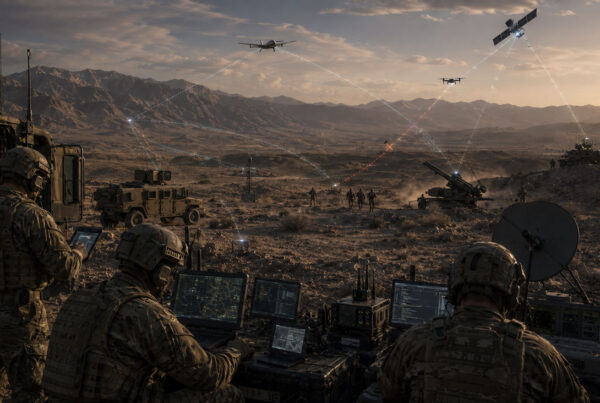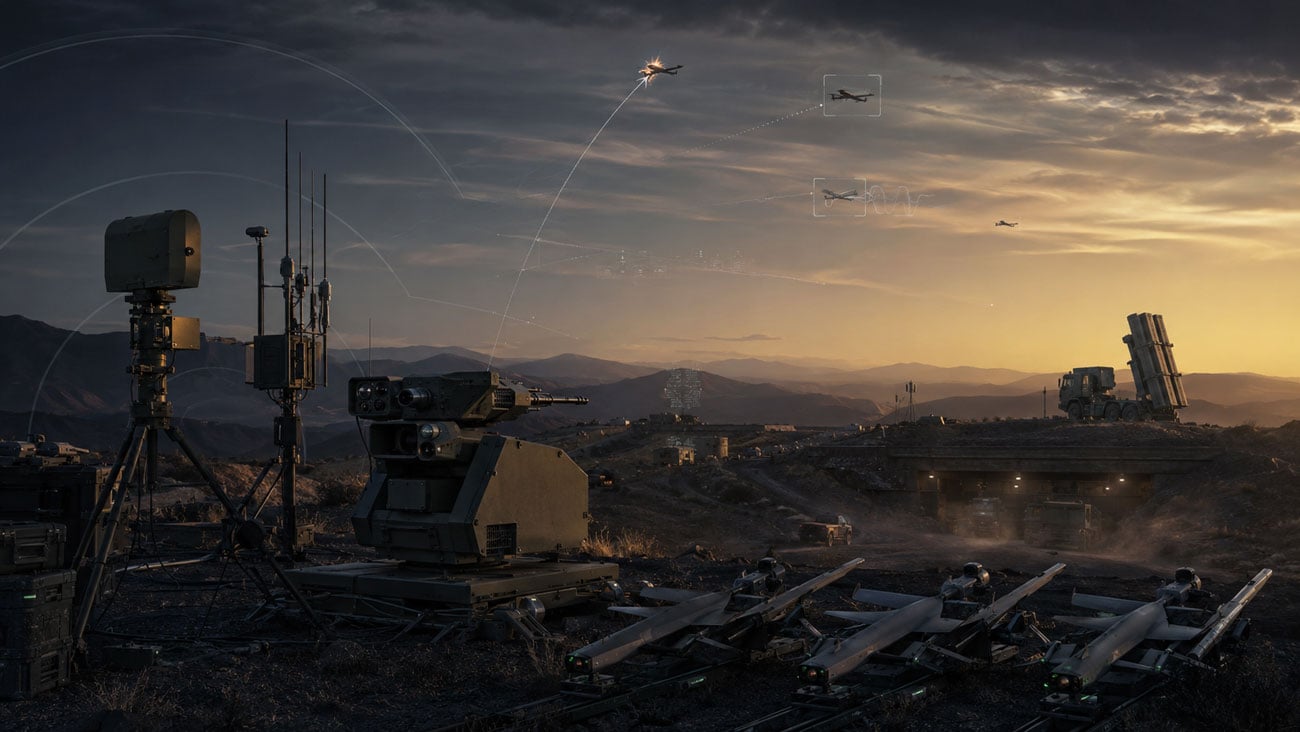
The Space Force is redesigning military satellite communications around a different assumption: some satellites, ground stations, links, and commercial providers will be disrupted in a major conflict. Its emerging Space Data Network combines proliferated constellations, commercial services, protected military SATCOM, hybrid terminals, and software-driven orchestration so the mission can route around damage. The strategic shift is larger than satellite design—resilience is moving from protecting individual assets to preserving connectivity after assets are lost.
Bottom line: the Space Force is moving from an architecture designed to protect a small number of highly capable satellites toward one designed to continue the mission after individual nodes are disrupted or destroyed.
The 2026 Objective Force calls the legacy satellite-communications architecture—built around relatively small numbers of high-value sovereign satellites—no longer fit for purpose in a contested environment.
The replacement concept is the Space Data Network: a hybrid, multi-layered communications architecture spanning government, commercial, allied, and partner capabilities across multiple orbits.
The strategic objective is not invulnerability.
It is graceful degradation, dynamic rerouting, and continued connectivity when the network is under attack.
Resilience Begins With a Different Assumption
For much of the space age, military satellite communications followed rational economics.
Satellites were expensive. Launches were expensive. Payloads were specialized. The United States therefore built relatively small numbers of extremely capable spacecraft designed to provide years of service.
That model delivered extraordinary communications capability.
It also concentrated value.
When a small number of satellites carry a large share of mission traffic, each spacecraft becomes strategically important—and strategically attractive to an adversary.
The Space Force is now changing the assumption underneath the architecture.
Chief of Space Operations Gen. Chance Saltzman described the future SATCOM model at the 2026 Space Symposium as a hybrid, self-healing architecture combining proliferated constellations, leased bandwidth, and commercial services.
The more important principle is simple:
Do not design communications around the assumption that every node survives. Design the network so the mission survives node loss.
Space Is No Longer a Sanctuary
The redesign begins with the threat environment.
Modern military operations depend heavily on space for communications, navigation and timing, missile warning, intelligence, weather, targeting, command and control, and logistics.
The Space Force’s July 2026 threat assessment describes growing Chinese and Russian capabilities intended to track, disrupt, degrade, and threaten U.S. and allied space systems.
Russia continues electronic attacks against satellite communications and GPS. The Space Force also notes Russian statements that commercial satellites supporting military operations may become legitimate targets and highlights continued development of kinetic, cyber, electronic, directed-energy, and other counterspace capabilities.
Future commanders therefore cannot assume space-enabled services remain available simply because they existed at the beginning of the conflict.
Resilience becomes a mission requirement.
The Space Data Network Is the Core of the New Architecture
The Space Force’s Objective Force centers future SATCOM on the Space Data Network, or SDN.
The service describes the SDN as hybrid by design rather than by augmentation. Instead of building a government architecture first and adding commercial services only when needed, the future model deliberately integrates sovereign, allied, partner, and commercial capacity from the beginning.
The network is intended to span multiple orbital regimes and multiple providers while supporting strategic, operational, and tactical users.
That makes the SDN less like one satellite program and more like a mission-scale digital and communications architecture.
The $2.29 Billion SDN Backbone Award Makes the Concept Physical
On May 26, 2026, Space Systems Command awarded a $2.29 billion firm-fixed-price OTA delivery order to SpaceX for the Space Data Network Backbone.
The backbone is intended to provide a resilient, optically interconnected constellation for secure, high-speed global data transport.
That matters because the Space Force is not simply purchasing more communications satellites.
It is creating a transport layer designed to connect sensors, platforms, command nodes, and other satellite systems through a broader data architecture.
The network increasingly becomes the system.
Commercial SATCOM Is Moving From Augmentation to Core Infrastructure
The Objective Force makes the role of commercial space unusually explicit.
Its SATCOM design calls for a commercial-derived layer diversified across low Earth orbit, medium Earth orbit, and geostationary orbit.
The Space Force says these commercial layers will serve as the principal pathway for bulk data transport and general-purpose connectivity.
That is a significant shift.
Commercial networks are no longer viewed only as extra capacity available when government systems become saturated.
They are becoming part of the baseline architecture.
Commercial investment provides scale, rapid technology refresh, constellation proliferation, and capacity that government would struggle to replicate independently.
Sovereign SATCOM Still Protects the Missions That Cannot Be Outsourced
Hybrid architecture does not mean every mission migrates to commercial networks.
The same Objective Force retains a specialized sovereign layer for functions requiring the highest levels of security, government control, survivability, and mission assurance.
That includes missions such as strategic communications and nuclear command and control.
In June 2026, Space Systems Command awarded two contracts totaling $437.7 million to Viasat and Intelsat General Communications for the first two Protected Tactical SATCOM–Global satellites, known as Swarm 1. The system is intended to provide anti-jam tactical communications in denied environments.
On July 27, Space Systems Command separately awarded $287 million to Sphinx Defense for the Evolved Strategic SATCOM Mission Planning application supporting next-generation nuclear command, control, and communications.
The architecture therefore becomes layered:
commercial where appropriate; sovereign where necessary; protected where essential.
Diamondback’s analysis of NC3 as the network behind the nuclear triad examines why strategic communications remain a distinct mission requirement inside that broader ecosystem.
Proliferation Changes the Economics of Attack
Numbers can create resilience.
If a mission depends on four satellites, losing one removes a substantial share of capacity.
If communications are distributed across hundreds or thousands of nodes, multiple providers, different orbital regimes, and alternate pathways, the adversary faces a much harder denial problem.
Proliferation does not make every satellite survivable.
It makes the mission harder to stop by attacking individual satellites.
The objective is graceful degradation.
A node disappears. Traffic reroutes. Another constellation absorbs demand. Another orbit provides a path. Another provider carries the mission.
The architecture adapts around damage.
Resilience Depends on Diversity That Is Actually Usable
Multiple providers create little operational value if the warfighter cannot move among them.
True diversity requires:
- interoperable terminals;
- common or compatible interfaces;
- security accreditation;
- network visibility;
- traffic-management rules;
- and operational procedures for switching providers.
Otherwise, vendor diversity exists on contract documents rather than in combat.
This is a systems-engineering and interoperability problem as much as a procurement strategy.
Hybrid Terminals Become Strategic Infrastructure
The user terminal may become one of the most important components in the entire architecture.
A soldier, ship, aircraft, command post, or sensor cannot benefit from alternate satellite capacity if its terminal is locked to one network.
The Objective Force explicitly includes hybrid SATCOM terminals capable of supporting diverse signals and providers.
The Space Force’s longer-term roadmap calls for prototyping, testing, and fielding hybrid user equipment through 2035.
The strategic requirement is not that every user connect to every network simultaneously.
It is that critical users have practical alternatives when their primary pathway disappears.
Open Standards Are What Keep the Hybrid Network From Becoming Fragmented
Adding more networks can create resilience.
It can also create complexity.
The Objective Force identifies open standards as a foundational characteristic of the Space Data Network and calls for non-proprietary standards across user terminals and management interfaces.
That is critical because the future network may combine government satellites, commercial mega-constellations, tactical SATCOM, strategic SATCOM, allied systems, multiple frequency bands, and evolving commercial technologies.
Without deliberate interface governance, hybrid architecture can become another collection of disconnected systems.
The goal is diversity without fragmentation.
Network Service Orchestration May Be More Important Than Any Single Satellite
A hybrid network creates an enormous orchestration problem.
If one pathway fails, the system has to identify that failure, find alternatives, assess capacity, validate security, authenticate the user, prioritize traffic, and move the mission quickly enough that operations continue.
The Objective Force identifies Network Service Orchestration as a critical component of the SDN.
The service says orchestration has to provide real-time visibility into network health and performance while enabling dynamic service selection.
That is essentially software-defined mission connectivity.
The satellite provides a path.
Software decides how the enterprise uses the paths.
“Self-Healing” Is Really a Decision System
The phrase self-healing network can make the architecture sound automatic.
In practice, every reroute contains decisions.
Which traffic receives priority? Which alternate provider meets the security requirement? How much bandwidth is available? What latency is acceptable? Which mission can tolerate degradation?
Missile warning may outrank administrative synchronization.
Operational command and control may outrank routine logistics data.
Strategic communications may require a protected government pathway unavailable to ordinary traffic.
This turns network orchestration into a real-time resource-allocation and mission-execution problem.
Zero Trust Extends Into Space Communications
The Objective Force states that the Space Data Network is being designed around a Zero Trust security model in which networks are assumed contested and connections, users, and data are continuously verified.
That is necessary because the future architecture expands the cyber boundary dramatically.
It may include:
- government satellites;
- commercial satellites;
- commercial networks;
- military networks;
- ground stations;
- exchange points;
- user terminals;
- network-management software;
- cloud infrastructure;
- and multiple commercial partners.
The space system is no longer only in space.
A resilient constellation can still lose mission effectiveness if authentication, orchestration, ground software, or exchange infrastructure is compromised.
Ground Architecture May Be the Hardest Part
The Objective Force itself identifies the resilient ground architecture as one of the key technical barriers to delivering the SDN.
The Space Force must integrate multiple vendors while maintaining real-time visibility across the network, dynamically selecting services, supporting exchange points, and testing management software at scale.
That is a useful reminder:
building more satellites does not automatically create a resilient communications service.
The ground architecture, software, terminals, standards, cybersecurity, and operational procedures have to mature with them.
Commercial Augmentation Needs to Be Negotiated Before the Crisis
Commercial capacity creates another problem:
What happens when military demand surges during war?
The Space Force’s Commercial Augmentation Space Reserve, or CASR, is intended to address that question.
Modeled conceptually on the Civil Reserve Air Fleet, CASR establishes pre-negotiated agreements giving the government guaranteed access to participating commercial surge capacity during crisis or conflict while compensating providers for readiness.
Space Systems Command has already used pilot contracts and wargames to explore the model.
The logic is straightforward.
Buying commercial bandwidth during peacetime is easy.
Negotiating priority access after a major conflict begins is not.
This is why commercial-space mobilization and capacity planning have to occur before the emergency.
Commercial Space Providers Become Wartime Partners
Deeper commercial integration changes the relationship between the government and satellite operators.
Commercial providers may now support missions directly relevant to military operations during conflict.
That makes questions of resilience, threat warning, cyber defense, ground-station redundancy, spare capacity, contractual obligations, and recovery planning increasingly important.
The Space Force threat assessment highlights Russia’s willingness to conduct cyber and electronic attacks against commercial space-enabled services and its statements that commercial satellites supporting military activity could be viewed as targets.
Commercial integration therefore cannot be treated as an ordinary service purchase.
In a major conflict, it can become a wartime operational partnership.
Bandwidth Becomes a Contested Resource
More commercial capacity can create another form of dependence.
When bandwidth is abundant, applications naturally grow around it.
Full-motion video. Cloud applications. Continuous telemetry. Large intelligence products. Remote analytics. AI-enabled workflows.
Then the environment becomes contested.
Bandwidth falls.
Applications must therefore be designed for:
- full connectivity;
- reduced bandwidth;
- intermittent communications;
- and disconnected operations.
The mission should degrade intelligently rather than collapse.
This is the same software-design principle explored in Diamondback’s analysis of why battlefield software must operate through degraded networks and adapt continuously.
GPS Resilience Is Part of the Same Architectural Shift
The Objective Force applies a similar philosophy to positioning, navigation, and timing.
Rather than assuming GPS remains continuously available, the Space Force is pursuing allied and commercial navigation and timing systems, more resilient operations, and improved receivers across the Joint Force.
The underlying principle is identical:
do not let the mission depend on one pathway remaining continuously available.
Diamondback’s analysis of assured PNT and operations without GPS examines that resilience problem in greater depth.
Acquisition Has to Move at Commercial Space Speed
Commercial space technology changes faster than traditional military satellite programs.
Providers introduce new spacecraft, terminals, network features, software, and business models continuously.
A requirement written around one commercial configuration can become outdated before the contract finishes.
That shifts acquisition toward service outcomes:
- availability;
- capacity;
- coverage;
- security;
- resilience;
- interoperability;
- and performance.
The government increasingly has to define the mission outcome while allowing the commercial implementation underneath it to evolve.
The Government Still Has to Own the Mission Architecture
Industry can build and operate enormous portions of the future communications environment.
The government still has to understand how the complete system behaves.
That means maintaining visibility into:
- interfaces;
- dependencies;
- failure modes;
- security boundaries;
- network performance;
- traffic priorities;
- alternative routes;
- and transition plans.
Without government technical ownership, resilience becomes dependent on supplier assurances rather than demonstrated enterprise understanding.
The network may be commercially enabled.
The mission remains governmental.
Testing Has to Remove Satellites on Purpose
A resilient network cannot be validated only by proving the preferred pathway works.
Exercises should deliberately:
- remove a constellation;
- jam another link;
- disable a ground station;
- constrain bandwidth;
- simulate cyber compromise;
- force provider transitions;
- and prioritize competing mission traffic.
Then planners can ask:
Did the terminal switch? Did the alternate route satisfy security requirements? Did traffic move automatically? Which mission degraded first? Did operators understand what happened?
This is where training, readiness, operational support, and continuity planning become part of SATCOM resilience.
Redundancy Is Not Resilience Until the Mission Can Use It
Two available satellites do not create resilience if the user terminal reaches only one.
Two providers do not create resilience if accreditation prevents switching.
Two ground stations do not create resilience if one software service remains a single point of failure.
Additional capacity therefore has to be evaluated against mission usability.
The relevant question is not:
How many alternate systems exist?
It is:
Can the mission actually move to them under stress?
The Future SATCOM Force Is Also a Workforce Problem
A communications architecture built around multiple providers, dynamic service selection, software-defined networking, zero-trust security, and hybrid terminals changes the work Guardians and Joint Force operators perform.
The Objective Force explicitly identifies manpower, training, sustainment, infrastructure, and testing implications as the service transitions away from legacy architectures.
Operators increasingly need to understand service portfolios, commercial capabilities, network health, cyber conditions, and cross-provider mission continuity.
The future SATCOM operator is not simply operating a satellite.
The operator is helping orchestrate a communications ecosystem.
The Strategic Asset May Be the Network, Not the Satellite
The Space Force will continue buying satellites.
Commercial constellations will continue expanding. Protected military systems will continue entering service. New terminals and software will continue appearing.
But the enduring advantage may sit one layer above the individual asset.
A network capable of combining them dynamically.
A soldier should not need to know which spacecraft carries the message.
A commander should not need to redesign an operation because one provider becomes unavailable.
A ship should be able to move to another pathway.
A command post should remain connected after individual nodes are jammed or lost.
The network should route around disruption.
The Future Network Must Expect Damage
The most important characteristic of the Space Force’s emerging SATCOM architecture may be the assumption underneath its design.
Something will fail.
A satellite may disappear.
A commercial provider may lose capacity.
A ground site may become unavailable.
A cyber incident may disrupt network management.
Bandwidth may become constrained.
Instead of treating those conditions as exceptions, the Objective Force attempts to make them normal planning assumptions.
That is a larger shift in how military resilience is defined.
For decades, resilience often meant making individual assets extraordinarily difficult to destroy.
The next generation increasingly means making the mission extraordinarily difficult to stop.
The Space Force is not building a network because it believes satellites will survive the next conflict untouched. It is building the network because it assumes some of them will not.
That may be the more resilient architecture—and the more realistic one.
Primary Sources
- U.S. Space Force — Objective Force 2040 Baseline, including the SATCOM Objective Force and Space Data Network
- U.S. Space Force — Gen. Chance Saltzman remarks at the 2026 Space Symposium
- Space Systems Command — $2.29 billion Space Data Network Backbone award
- Space Systems Command — $437.7 million Protected Tactical SATCOM–Global Swarm 1 awards
- Space Systems Command — $287 million Evolved Strategic SATCOM Mission Planning award
- U.S. Space Force — Space Threat Fact Sheet, current July 2026
- Space Systems Command — Commercial Augmentation Space Reserve