America’s submarine shortfall is not simply a problem at Electric Boat or Newport News. The Navy must reach one Columbia-class and two Virginia-class submarines per year while sustaining the existing fleet and supporting AUKUS, but current Virginia production remains well below the required rate. Closing that gap depends on a national industrial system of suppliers, skilled workers, outsourced fabrication, advanced manufacturing, maintenance capacity, data, and disciplined investment management—not just more space inside the two nuclear shipyards.
Bottom line: America’s submarine gap is not fundamentally a shortage of shipyard space. It is a shortage of synchronized industrial throughput.
The Navy needs one Columbia-class ballistic missile submarine and two Virginia-class attack submarines delivered each year while sustaining the existing fleet and meeting future AUKUS commitments. Yet Virginia-class production has remained far below two boats annually, creating a growing backlog of submarines already purchased but not yet delivered.
Closing that gap requires more than asking Electric Boat and Newport News Shipbuilding to work faster.
It requires the entire submarine enterprise to produce faster:
suppliers → workforce → materials → fabrication → modules → shipyards → maintenance → fleet availability.
Undersea Superiority Starts Long Before a Submarine Reaches the Water
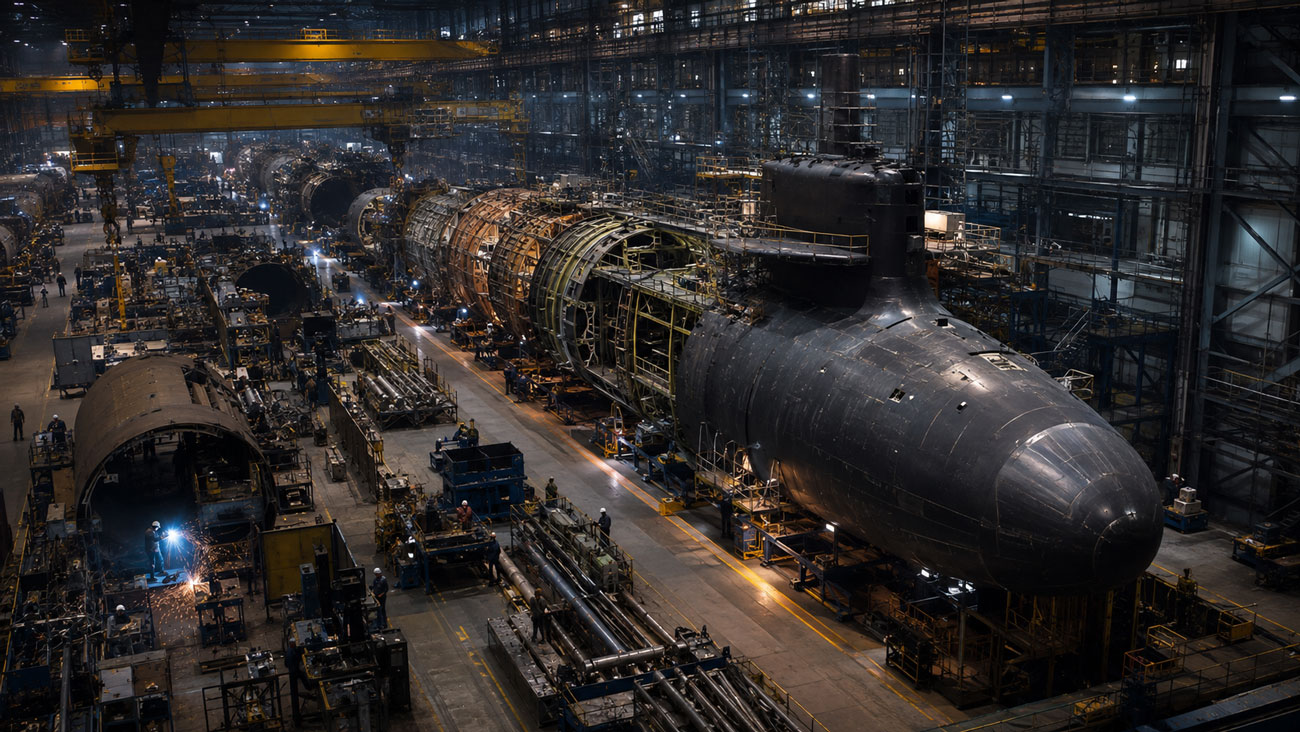
A nuclear-powered submarine is one of the most complex industrial products the United States builds.
It combines nuclear propulsion, precision manufacturing, advanced metallurgy, sonar, weapons, electronics, software, communications, specialized materials, and thousands of tightly controlled components inside a platform expected to operate safely in one of the most unforgiving environments on earth.
The engineering achievement is extraordinary.
The strategic question is increasingly simpler:
Can the United States build and sustain enough of them at the rate strategy requires?
The Navy describes the current effort as its largest submarine recapitalization in nearly 50 years.
Beginning in 2028, the submarine industrial base is expected to support delivery of one Columbia-class and two Virginia-class submarines every year while maintaining the existing fleet and supporting AUKUS.
The Navy says that represents a workload roughly five times the build rate sustained in 2015.
That is not merely shipbuilding.
It is national industrial transformation.
The Virginia-Class Gap Shows the Scale of the Problem
The gap between procurement and production is already visible.
Virginia-class submarines have generally been procured at two per year since 2011, but Congressional Research Service analysis reports that the actual production rate has never reached two annually and has remained around 1.1 to 1.2 boats per year since 2022.
The result is a growing backlog of submarines that Congress and the Navy have bought faster than industry can build them.
For AUKUS, the long-term requirement becomes even harder. The Navy is working toward a Virginia production rate of roughly 2.33 boats per year so it can support normal U.S. procurement, replace submarines transferred to Australia, and reduce accumulated backlog.
The challenge therefore is not simply reaching two boats.
It is creating an industrial system capable of sustaining rates above today’s demonstrated output.
Two Shipyards Cannot Solve the Problem Alone
General Dynamics Electric Boat and Huntington Ingalls Industries’ Newport News Shipbuilding perform final assembly of America’s nuclear submarines.
They receive most of the attention when schedules slip.
But the Navy’s Submarine Industrial Base Program Office describes a much larger national network beneath them.
Thousands of suppliers provide:
- castings and forgings;
- valves and pumps;
- electrical systems;
- piping;
- machined components;
- propulsion equipment;
- sonar and mission systems;
- specialty materials;
- electronics;
- and other sequence-critical parts.
A late component can interrupt work far downstream.
A first-pass quality problem at a small supplier can delay assembly at a multibillion-dollar shipyard.
A single-source vendor experiencing workforce, equipment, financial, cyber, or quality problems can become a Navy-wide schedule constraint.
The submarine is assembled at two shipyards. The capability is produced across the country.
The Industrial Base Shrunk Before Demand Returned
The current challenge reflects decades of industrial contraction.
The Navy says primary nuclear shipbuilding suppliers declined from roughly 17,000 to about 5,000 after the Cold War and that overall manufacturing capacity supporting the submarine enterprise fell by more than 60 percent.
Those reductions reflected a period of lower demand.
The strategic requirement has now changed faster than the industrial ecosystem can regenerate.
The United States simultaneously has to support:
- Columbia-class serial production;
- Virginia-class production;
- maintenance of the current submarine fleet;
- industrial-base recapitalization;
- and AUKUS.
Industrial capacity that took decades to contract cannot be rebuilt instantly because strategy changes.
1+2 Is Really a National Throughput Target
The Navy often summarizes the future production requirement as:
1 + 2.
One Columbia.
Two Virginias.
Every year.
But the meaningful unit is not simply three hulls.
The target represents millions of manufacturing hours, thousands of suppliers, complex modules, precision components, quality inspections, shipyard infrastructure, trained workers, technical data, logistics, and maintenance capacity arriving in sequence.
The Navy’s own planning emphasizes that the Columbia and newer Virginia variants impose substantially greater workload than a simple hull count suggests.
The requirement is therefore industrial throughput across the entire value stream.
This is a capacity-planning and industrial-portfolio problem as much as a ship-acquisition problem.
The Navy Is Deliberately Moving Work Away From the Final Shipyards
One of the most consequential changes is strategic sourcing.
The logic is straightforward:
do not use the most constrained shipyard capacity for work that can be performed somewhere else.
The Navy says Electric Boat is expanding its Focus Factory outsourcing model and plans to outsource more than 4 million manufacturing hours of fabrication work in 2026.
Across the broader submarine enterprise, shipbuilders reached approximately 3.8 million outsourced manufacturing hours in 2025, with a target approaching 14 million hours annually by 2030.
This is more than subcontracting.
It is a redesign of the production architecture.
Distributed Shipbuilding Is Becoming a National Manufacturing Model
The goal is to reserve Electric Boat and Newport News for the work that truly must occur at the nuclear shipyards while moving fabrication, outfitting, components, and modules to qualified partners elsewhere.
A supplier hundreds of miles away may be able to produce piping assemblies, structural components, foundations, machined parts, or modules and deliver them closer to installation-ready condition.
The better those products arrive—tested, documented, dimensionally correct, qualified, and complete—the less scarce shipyard labor is consumed on lower-level fabrication.
That turns submarine production into a more distributed national manufacturing network.
The approach can increase capacity.
It also increases the need for systems integration, configuration control, and production engineering across organizational boundaries.
The Hadrian Factory Makes Distributed Production Concrete
On March 20, 2026, the Navy and Hadrian opened a new advanced manufacturing facility in Cherokee, Alabama.
The site covers approximately 2.2 million square feet and is designed to mass-produce components for Virginia- and Columbia-class submarines using highly automated manufacturing.
The financial structure is notable:
- $900 million in Navy investment;
- $1.5 billion in private capital;
- more than $2.4 billion in total investment.
The Navy says the facility is intended to remove work from constrained submarine yards and identifies distributed shipbuilding as a key element of its plan to achieve required production rates.
The factory is therefore more than another supplier.
It is a physical example of a different production architecture.
Distribution Creates Capacity—But Also Coordination Risk
Moving work outward introduces another challenge.
The more suppliers and facilities involved, the harder the production system becomes to understand.
Decision-makers need to know:
- which supplier is behind;
- which component is sequence-critical;
- where quality is deteriorating;
- which production line lacks capacity;
- which investment is removing a bottleneck;
- which workforce shortage is limiting new equipment;
- and where the next delay is likely to emerge.
This is why the submarine gap is also a data problem.
GAO Found an Industrial-Base Management Problem
In April 2026, GAO reported that DoD had invested more than $10 billion since FY2018 in the submarine industrial base but still had not established a comprehensive understanding of the total cost and schedule required to reach the Navy’s production goals.
GAO also found inconsistent performance metrics and oversight across individual investments.
In its review of 15 high-dollar projects, only a few contained complete documentation covering baseline performance, expected outcomes, and tracking of those outcomes over time.
The Navy and DoD also used disparate information systems for industrial-base investment data, complicating leadership visibility.
Officials told GAO they were developing a centralized dashboard covering more than 1,300 submarine industrial-base investment projects.
The finding is fundamental:
You cannot manage a distributed industrial system effectively if you cannot see how its investments and constraints connect.
Investment Does Not Equal Capacity
The submarine industrial base is receiving billions of dollars.
Factories are expanding. Equipment is being purchased. Suppliers are receiving capital. Training capacity is increasing. Automation and additive manufacturing are entering production.
But dollars obligated are not the same thing as capacity delivered.
Every investment should eventually answer:
- What bottleneck did this remove?
- Did output increase?
- Did lead time decline?
- Did first-pass yield improve?
- Did a second source become available?
- Did component deliveries become more predictable?
- Did maintenance availability improve?
- Did submarine construction accelerate?
This is where execution governance and outcome measurement become part of industrial policy.
The Navy Needs an Industrial Operating Picture
Military commanders expect visibility into force readiness.
The submarine industrial base increasingly needs a similar operating concept.
Leadership needs sufficiently current information on:
- supplier health;
- available capacity;
- sequence-critical material;
- production rates;
- workforce gaps;
- lead times;
- quality trends;
- equipment availability;
- investment performance;
- and schedule risk.
The objective is not a giant government database containing every proprietary detail.
It is a decision architecture capable of identifying where risk is accumulating and where intervention produces the greatest throughput benefit.
That makes industrial data visibility and technology enablement a submarine-readiness issue.
Supplier Resilience Has to Reach Below Tier 1
The Navy’s current supply-chain strategy increasingly targets fragile sub-tier suppliers and single-source dependencies.
The SIB Program Office reports active efforts to qualify additional sources, reduce lead times, and address suppliers that affect mission systems and sustainment.
Examples include adding suppliers for sonar-system hull penetrators, qualifying an additional oxygen-candle supplier, and replacing a sole-source hull-tile producer that exited the market.
These examples matter because the strategic value of a supplier is not proportional to its revenue.
A small company can become the production ceiling for a multibillion-dollar submarine program.
That is the same upstream vulnerability explored in Diamondback’s analysis of why defense supply-chain risk often begins before final assembly.
Second Sources Are Industrial Insurance
When only one company can produce a critical item, its problem becomes the Navy’s problem.
A cyberattack, workforce loss, equipment failure, natural disaster, financial crisis, or quality defect can immediately affect submarine schedules.
Qualifying alternate suppliers may cost more during peacetime.
But a second source creates:
- surge capacity;
- competition;
- geographic resilience;
- and a fallback when the primary supplier fails.
Redundancy is therefore not automatically waste.
In a constrained industrial system, it can be strategic insurance.
The Workforce May Be the Hardest Capacity to Build
Factories can be financed.
Machines can be purchased.
Experienced workers take longer.
The Navy estimates the submarine enterprise needs approximately 140,000 skilled workers: roughly 100,000 for new construction and 40,000 for maintenance and sustainment.
The requirement spans welders, pipefitters, machinists, electricians, engineers, quality specialists, nuclear-qualified personnel, designers, production planners, and advanced-manufacturing technicians.
Many of those roles require substantial time before a new hire becomes fully productive.
The workforce pipeline therefore has to be built before production reaches its peak.
The Talent Pipeline Is Becoming National Industrial Infrastructure
The Navy’s Talent Pipeline Program demonstrates the scale of that effort.
By June 2026, the program had expanded to 618 employer partners across 39 states.
Participating employers had hired more than 20,655 workers, with an average first-year retention rate of 72 percent. The most recent program year added 7,709 hires.
The important word is employers.
The solution is not simply staffing Electric Boat and Newport News.
Machine shops, equipment manufacturers, component suppliers, repair organizations, and distributed fabrication partners all need workers.
The workforce strategy has to follow the production network.
Diamondback’s analysis of defense workforce capacity as a readiness constraint addresses this larger national problem.
Retention Matters More Than Headcount Alone
Hiring statistics can hide a critical variable.
A new employee is not immediately equivalent to an experienced shipbuilder.
Productivity, quality judgment, process knowledge, and mentoring capacity accumulate over time.
If trained employees leave rapidly, the industrial base loses both labor and learning.
This makes retention, supervision, working conditions, regional housing costs, compensation, scheduling, and career pathways part of the production problem.
Industrial capacity is embodied in people—not merely payroll positions.
Advanced Manufacturing Can Compress Logistics Time
Technology cannot replace the entire skilled workforce, but it can remove specific constraints.
The Navy’s USS Pennsylvania valve-body case is a useful example.
After inspectors found critical damage to a valve body in the submarine’s emergency diesel system, the original manufacturer quoted a nine-month lead time and no spare was available.
The Navy instead used advanced scanning, digital design, and additive manufacturing to produce, test, and install replacements in approximately eight weeks.
The Navy says the effort saved about 32 weeks and avoided approximately $500,000 in cost.
The important capability was not simply 3D printing.
It was compressing the time between identifying a material problem and returning a submarine to service.
Digital Technical Data Can Become Part of the Spare-Parts Inventory
Additive manufacturing also points toward a different logistics model.
Traditional sustainment depends heavily on physical inventory.
A part is manufactured, stored, cataloged, transported, and eventually installed.
For selected components, future inventory may also include:
- qualified digital technical data;
- approved materials;
- validated manufacturing processes;
- inspection requirements;
- and qualified production sites.
The part can then exist as controlled manufacturing capability until demand appears.
That will not apply to every nuclear-submarine component.
But where qualification permits it, digital manufacturing can reduce dependence on obsolete vendors and long physical supply chains.
Quality Is Throughput
Submarine production cannot trade nuclear-quality standards for schedule.
Pressure boundaries, structural integrity, metallurgy, welds, valves, electrical systems, and nuclear systems demand rigorous control.
The correct objective is not lower standards.
It is eliminating wasted time around those standards.
Automation can increase repeatability.
Digital inspection can identify defects earlier.
Supplier-development teams can improve first-pass yield.
Better technical data can reduce rework.
Production planning can reduce out-of-sequence work.
Faster because the system became better—not faster because the standard became lower.
Maintenance Is Part of the Same Industrial Equation
Construction gets most of the attention, but submarine availability depends equally on sustainment.
A new submarine delivered late and an existing submarine trapped in extended maintenance create the same operational result:
neither is available to the fleet.
Production and maintenance draw from overlapping pools of:
- workers;
- suppliers;
- components;
- technical data;
- industrial facilities;
- and specialized skills.
The Navy therefore cannot optimize new construction while treating maintenance as a separate industrial problem.
Fleet capacity is ultimately measured in submarines available for operations.
AUKUS Raises the Required Production Ceiling
AUKUS makes submarine industrial performance an alliance issue.
The current plan anticipates Australia eventually acquiring three to five Virginia-class submarines before operating future SSN-AUKUS boats.
CRS notes that the U.S. industrial base would ultimately need to sustain roughly 2.33 Virginia-class submarines per year to support normal Navy demand, replace submarines transferred to Australia, and reduce backlog.
That means the industrial base has to create not merely enough capacity for today’s U.S. procurement rate.
It needs headroom.
If strategy requires capacity the industrial system cannot deliver, strategy and production begin competing with each other.
Predictable Demand Is Part of the Production Architecture
Many submarine suppliers operate in narrow markets with little commercial demand for their specialized products.
Expanding capacity can require expensive equipment, facilities, training, and qualification.
Companies will make those investments more confidently when future demand is visible.
Stable procurement signals allow suppliers to:
- purchase machinery;
- expand factories;
- hire apprentices;
- add shifts;
- automate processes;
- and qualify alternate production sources.
Demand visibility therefore becomes a form of industrial policy.
Shipbuilding Is Becoming Portfolio Management
The Navy formally established the Submarine Industrial Base Program Office under the Direct Reporting Portfolio Manager for Submarines in April 2026.
The organizational change reflects the connected nature of the problem.
Supply chain affects workforce.
Workforce affects advanced manufacturing.
Advanced manufacturing affects sustainment.
Infrastructure affects strategic outsourcing.
Data affects investment decisions.
All of those factors affect delivery.
The submarine enterprise therefore has to be managed as a portfolio of interdependent constraints rather than as a collection of isolated improvement projects.
This is where supplier, workforce, sustainment, and mission-support coordination become inseparable from acquisition.
America Does Not Simply Need More Shipyard
Additional shipyard infrastructure is necessary.
It is not sufficient.
America needs:
- more supplier capacity;
- more skilled labor;
- more alternate sources;
- more distributed manufacturing;
- better technical data;
- faster qualification;
- stronger first-pass quality;
- better investment visibility;
- more maintenance throughput;
- and clearer understanding of where the industrial network will constrain next.
A new factory does not solve those problems by itself.
Neither does a dry dock.
Neither does another appropriation.
The advantage appears when the parts of the enterprise reinforce one another.
Undersea Deterrence Has an Industrial Architecture
Virginia-class submarines provide some of America’s most capable conventional undersea combat power.
Columbia-class submarines will carry an essential portion of the nation’s strategic nuclear deterrent.
The platforms are visible.
The industrial architecture behind them is less so.
A machinist in Ohio. A valve manufacturer in Pennsylvania. An automated factory in Alabama. A welder in Virginia. A community college training new technicians. A supplier adding a second shift. An engineer qualifying an additively manufactured component.
Each is part of the same mission.
That is why America’s submarine gap should not be understood merely as a shipyard problem.
It is a national industrial-system problem.
The United States knows how to design extraordinary submarines.
The harder test is whether it can build the synchronized industrial enterprise needed to produce and sustain them at the rate strategy now demands.
Undersea superiority begins years before a submarine reaches the water—inside the supplier network, workforce, factories, data systems, and maintenance enterprise that turn strategy into deployable hulls.
Primary Sources
- U.S. Navy Submarine Industrial Base Program Office — mission, 1+2 requirement, workforce need, and industrial-base contraction
- U.S. Navy Submarine Industrial Base Program Office — supply chain, strategic sourcing, Focus Factory, and supplier-resilience initiatives
- U.S. Navy — 2026 Talent Pipeline National Signing Day and workforce metrics
- U.S. Navy — Hadrian Factory of the Future in Cherokee, Alabama
- U.S. Navy — USS Pennsylvania additive-manufacturing valve replacement and advanced manufacturing execution
- U.S. GAO — submarine industrial-base investment management and shipbuilding challenges, April 2026
- Congressional Research Service — Virginia-class submarine production, backlog, and AUKUS industrial-base requirements
- U.S. Navy — establishment of the Submarine Industrial Base Program Office, April 2026