The Indo-Pacific turns logistics into a combat function. Distance, dispersion, limited infrastructure, contested communications, and vulnerable ports and airfields mean deterrence depends not only on what the United States can deploy on day one, but on what a joint and allied force can keep fueled, armed, repaired, connected, and moving after weeks of disruption. Recent 2026 exercises show the logistics architecture is increasingly being rehearsed before crisis begins.
Bottom line: Pacific deterrence depends on mission endurance.
The United States can deploy extraordinary combat power across the Indo-Pacific.
The harder question is whether a distributed joint and allied force can remain effective after fuel is consumed, munitions are expended, equipment breaks, ports are disrupted, networks are attacked, and transportation routes become contested.
The sustainment chain therefore becomes:
preposition → move → distribute → refuel → rearm → repair → replenish → continue.
Every step has to work across enormous distance and under pressure.
The Pacific Changes the Logistics Equation
The Indo-Pacific imposes a geography problem before an adversary fires a shot.
The theater spans enormous ocean distances, dispersed islands, uneven infrastructure, and long supply lines stretching back toward the continental United States.
Everything a military force consumes has to move:
- fuel;
- munitions;
- food and water;
- spare parts;
- batteries;
- medical supplies;
- replacement systems;
- communications equipment;
- and maintenance materiel.
Distance creates time.
Time creates exposure.
A spare part in California does not repair a disabled launcher on a Pacific island.
A weapons stockpile is useful only when the weapon can reach the unit that needs it.
Inventory and availability are not the same thing.
Logistics Is Moving From Support Function to Deterrence Function
Army sustainment leaders increasingly describe logistics itself as a component of deterrence.
In July 2026, 8th Theater Sustainment Command emphasized that the theater must be set before crisis begins through forward-positioned capabilities, regional partnerships, rehearsed logistics networks, and repair capacity located closer to operating forces.
The command’s underlying logic is simple:
a force that cannot be sustained cannot create durable combat power.
That makes logistics architecture part of the deterrent signal.
Exercises Are Becoming Rehearsals for the Supply Network
Some of the most consequential experimentation across the Pacific is focused not on firing weapons but on sustaining the forces that fire them.
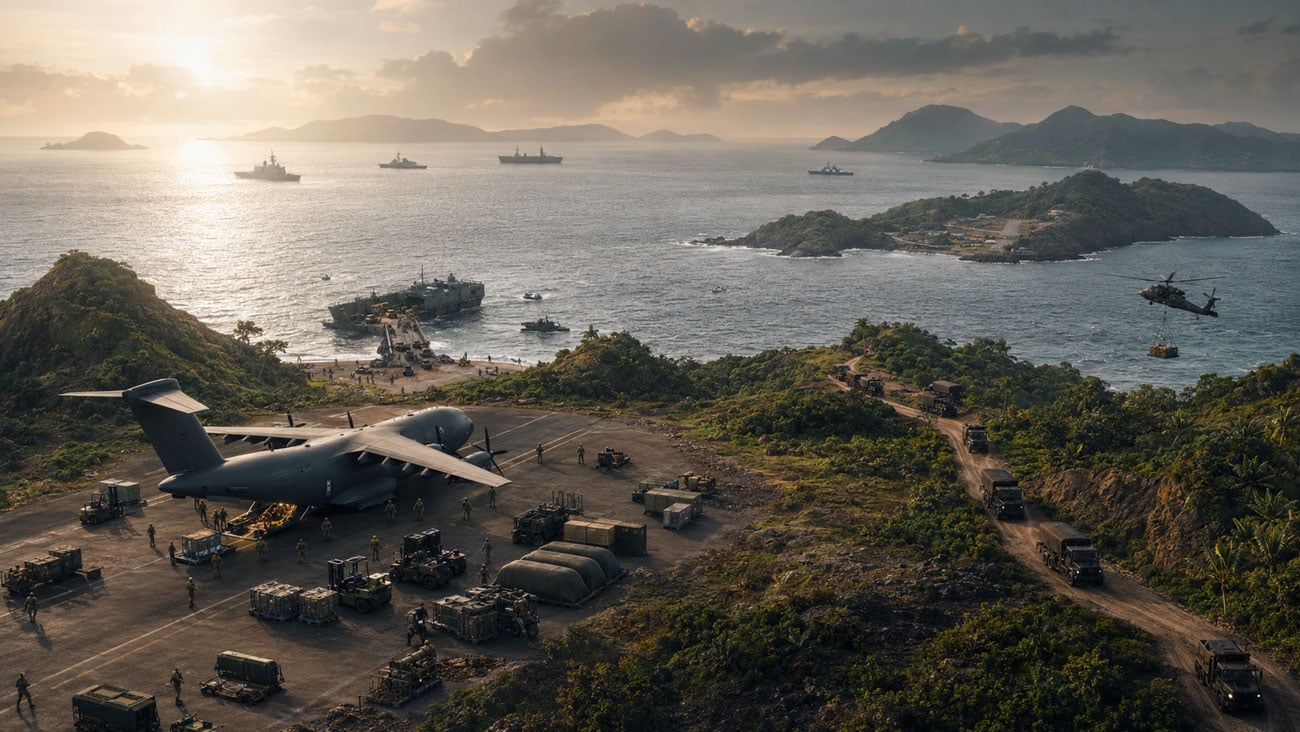
During Balikatan 2026, U.S. Marines, Sailors, Philippine forces, port authorities, and commercial transportation partners conducted distributed maritime logistics through the Philippines.
The effort moved prepositioned equipment through:
afloat platforms → ports → shore nodes → barges → follow-on distribution.
The operation included the first Marine Maritime Prepositioning Force offload in Mindanao, expanding the number of locations through which future sustainment could flow.
The military value is not the novelty of the port call.
It is another usable node in the logistics network.
Pacific Atlas Tests Allied Logistics, Not Just Allied Presence
In June 2026, U.S. and Japanese maritime forces conducted the first Pacific Atlas 26-1 off Japan.
U.S. 7th Fleet described the event as a demonstration of allied logistics interoperability intended to strengthen the ability to sustain distributed maritime operations.
That distinction matters.
Alliances are often measured through combined exercises, common strategy, and interoperable weapons.
In a long conflict, another question becomes just as important:
Can allied forces sustain one another?
Distribution Creates Survivability—and Logistics Complexity
Dispersed operations reduce the risk of concentrating combat power at a handful of large bases.
Aircraft can move.
Command nodes can relocate.
Missiles can disperse.
Supplies can be distributed.
Maintenance can move closer to the force.
The adversary faces a harder targeting problem.
But distribution transfers complexity into sustainment.
Instead of one major logistics hub, the force may need to support dozens of smaller locations.
Each may require:
- fuel;
- transportation;
- communications;
- security;
- maintenance;
- parts;
- power;
- and inventory visibility.
That transforms logistics from transportation into an enterprise coordination and execution problem.
Setting the Theater Means Moving Capability Before the Crisis
One of the most effective ways to reduce wartime transportation demand is to move critical capability forward during peacetime.
Prepositioning can include:
- vehicles;
- engineering equipment;
- munitions;
- maintenance stocks;
- fuel systems;
- medical capability;
- communications equipment;
- and repair infrastructure.
The more material already inside the theater, the less the force has to push across long trans-Pacific routes after conflict begins.
This is why the Army’s current sustainment strategy emphasizes forward-positioned equipment and repair capacity rather than depending entirely on reachback to the United States.
Australia Is Becoming a Deeper Sustainment Node
The allied logistics architecture is also becoming more physical.
In May 2026, U.S. and Australian defense leaders agreed to accelerate infrastructure projects at Australian bases, including additional maintenance, storage, and distribution facilities supporting combined logistics.
The same meeting reinforced broader defense-industrial and AUKUS cooperation.
Australia therefore matters not only as a location for rotational forces.
It increasingly functions as a logistics, maintenance, industrial, and force-posture node in the broader Pacific architecture.
Allies Are Part of the Supply Chain
The future Pacific sustainment network cannot realistically be American-only.
Allies and partners possess:
- ports;
- airfields;
- shipyards;
- warehouses;
- repair facilities;
- commercial transportation;
- fuel infrastructure;
- manufacturing;
- telecommunications;
- and local suppliers.
The operational opportunity is enormous.
So is the integration problem.
Different nations may use different logistics systems, contracting mechanisms, maintenance standards, customs processes, authorities, and information-sharing rules.
A coalition can be strategically aligned and still be logistically fragmented.
Logistics interoperability therefore has to be engineered and rehearsed, not assumed.
Joint Theater Distribution Centers Turn Geography Into a Network
The Army has been expanding Joint Theater Distribution Centers as forward logistics nodes capable of combining storage, transportation, receiving, shipping, and maintenance functions.
During Balikatan 2026, Army sustainment organizations operated through the Subic Bay port while exercising reception, staging, onward movement, warehouse operations, and theater opening.
The importance is architectural.
Distributed nodes can create interior logistics lines across the theater rather than forcing every requirement to return to one distant hub.
The network becomes more resilient when multiple nodes can absorb demand.
Maintenance Has to Move Forward
Wars consume equipment as well as ammunition.
Aircraft break.
Vehicles fail.
Electronics degrade.
Drones are lost.
Ships require repair.
In July, 8th Theater Sustainment Command described a deliberate effort to move maintenance capability closer to operating units so equipment does not always have to travel back to the continental United States.
That changes the readiness equation.
Instead of asking only:
Can the part reach the platform?
planners also ask:
Can the repair capability reach the platform?
This is a mission-support, maintenance, and sustainment-planning problem.
Maintainability Is Becoming a Combat Characteristic
The logistics environment should influence how equipment is designed.
A platform with extraordinary performance but maintenance requirements available at only a few specialized locations creates an operational dependency.
Future systems increasingly benefit from:
- modular components;
- line-replaceable units;
- common parts;
- built-in diagnostics;
- predictive maintenance;
- remote technical support;
- digital technical data;
- and additive manufacturing where qualification allows.
The question becomes not only what the platform can do.
It is how easily the force can keep it doing it.
That makes design-for-sustainment and systems engineering part of Pacific operational planning.
Data Is Becoming a Logistics Capability
Distributed sustainment creates an enormous information problem.
Commanders need to understand:
- what inventory exists;
- where it is located;
- how quickly it is being consumed;
- what transportation is available;
- which routes remain usable;
- which facilities have capacity;
- what equipment is damaged;
- where replacement parts exist;
- and what will become critical several days from now.
That requires logistics, maintenance, transportation, inventory, operational, and intelligence data to connect.
The objective is not perfect information.
It is decision-grade logistics visibility.
This is where data integration and technology enablement become sustainment capabilities.
AI Can Optimize Logistics Only If the Data Exists
Artificial intelligence can help forecast demand, identify bottlenecks, optimize routing, prioritize repair, and model inventory consumption.
But AI cannot locate a spare part that does not exist in the data.
It cannot accurately predict fuel demand from fragmented records.
It cannot route supplies through infrastructure the enterprise does not know is available.
The fundamental requirement remains trustworthy data architecture.
AI can accelerate a visible logistics network.
It cannot compensate indefinitely for an invisible one.
The Logistics Network Has to Assume It Will Be Attacked
Contested logistics begins with a different planning assumption:
the adversary understands that sustainment is a target.
Ports can be attacked.
Airfields can be damaged.
Fuel depots can be targeted.
Networks can be disrupted.
Satellite links can be degraded.
Transportation can be monitored.
Commercial infrastructure can be affected.
Cyberattack can interrupt logistics without destroying any physical equipment.
The network therefore has to be resilient under deliberate disruption—not merely efficient during normal operations.
Peacetime Efficiency and Wartime Resilience Pull in Different Directions
Commercial supply chains often minimize excess inventory, unused capacity, and redundant routes.
Military logistics sometimes needs the opposite.
Resilience may require:
- multiple routes;
- distributed inventories;
- alternate ports;
- extra transportation capacity;
- backup communications;
- multiple suppliers;
- and reserve infrastructure.
Those features can appear inefficient during peacetime.
They become valuable when the primary pathway disappears.
Installation Resilience Is Part of Theater Logistics
Forward logistics nodes still depend on infrastructure.
Warehouses need power.
Fuel systems need electricity.
Maintenance facilities require utilities.
Communications and data systems need resilient energy.
A distributed logistics network therefore inherits the resilience of the installations and commercial infrastructure supporting it.
Diamondback’s analysis of why installation energy is becoming mission assurance examines that dependency from the infrastructure side.
Munitions Production and Pacific Logistics Are One Continuum
A missile factory in the United States and a launcher in the western Pacific are part of the same sustainment chain.
The factory has to produce the weapon.
The logistics enterprise has to move it.
The theater has to store it.
The unit has to receive it.
The launcher has to remain operational.
Diamondback’s analysis of why U.S. munitions production is ultimately a throughput problem addresses the industrial end of that same chain.
Production throughput without distribution throughput still leaves combat power unavailable.
Strategic Sealift Is the Bridge Into the Theater
Not every Pacific logistics requirement can be satisfied through prepositioning.
Large quantities of equipment, fuel, ammunition, vehicles, and sustainment materiel still have to cross oceans.
That makes strategic sealift, commercial shipping, ports, and merchant mariners part of the Pacific logistics architecture.
Diamondback’s analysis of America’s strategic sealift vulnerability examines the transportation network connecting the domestic industrial base to overseas combat power.
Commercial Capacity Will Be Part of the Fight
Pacific sustainment already depends on commercial actors.
Balikatan 2026 used Philippine port authorities and local transportation contractors.
Future contested logistics may involve:
- commercial shipping;
- air cargo;
- ports;
- fuel providers;
- telecommunications;
- maintenance firms;
- construction companies;
- cloud providers;
- and local suppliers.
The important question is not whether commercial capacity participates.
It is whether the government has already planned how that capacity remains accessible, secure, and useful during crisis.
Contractors Need to Design for Disruption
A contractor supporting Pacific operations should increasingly be able to answer:
- What happens when connectivity fails?
- Which function depends on reachback to the United States?
- Where are critical suppliers located?
- Can support shift to another site?
- Can personnel operate across multiple dispersed locations?
- What data is required to continue?
- Which dependencies create single points of failure?
Contract performance in normal conditions is not the same thing as mission performance during disruption.
Logistics Has to Be Designed Into the Operational Concept
One of the most dangerous planning habits is treating sustainment as something solved after the maneuver concept is complete.
Logistics constrains what operations are possible.
A force requiring enormous fuel volumes has a fuel problem.
A dispersed force without enough transportation has a distribution problem.
A missile strategy without adequate inventory has a production problem.
A networked formation that cannot function while disconnected has a resilience problem.
Operational design therefore needs logisticians, engineers, acquisition professionals, allies, commercial partners, and industry involved from the beginning.
This is a mission-design and strategic-planning requirement.
Exercises Need to Break the Logistics System on Purpose
The value of Balikatan, Pacific Atlas, and other regional events is not simply proving that planned procedures work.
The greater value is discovering how they fail.
Exercises should deliberately remove:
- a primary port;
- a major airfield;
- a communications pathway;
- a fuel source;
- a supplier;
- or a transportation asset.
Then planners can ask:
Can another node take the load?
Can an ally provide the capability?
Does the data system know what changed?
Can the unit keep operating?
Resilience that has never been exercised remains an assumption.
Operation Pathways Is Turning Rehearsal Into Campaigning
In July 2026, more than 200 planners from more than 70 commands, joint organizations, allied nations, and partner organizations gathered to coordinate future Operation Pathways activity.
U.S. Army Pacific says the framework connects exercises, experimentation, forward positioning, and mission rehearsals into persistent campaigning.
8th Theater Sustainment Command says Operation Pathways currently connects 49 exercises across the Pacific, allowing sustainment formations to validate networks and practice key mission sets before they are required during crisis.
That is important because logistics competence is cumulative.
Ports become familiar.
Authorities become understood.
Partners learn one another’s systems.
Routes are tested.
Equipment is positioned.
The theater is being prepared before demand arrives.
The Pacific Is a Systems Problem
No single capability solves contested logistics.
Not another transport ship.
Not another warehouse.
Not another software platform.
Not another allied agreement.
The mission requires an integrated enterprise connecting:
infrastructure + transportation + inventory + maintenance + production + data + allies + commercial capacity + communications + energy + operational planning.
The components may already exist in many places.
The difficult work is making them function as a resilient network.
Deterrence Has a Supply Chain
Combat power on day one matters.
Combat power on day thirty matters more than it often receives credit for.
Behind every aircraft is fuel, munitions, parts, maintainers, transportation, data, and infrastructure.
Behind every ship is replenishment, repair capacity, ports, communications, and supply.
Behind every distributed unit is a network that must reach it while the adversary is actively trying to prevent exactly that.
The strategic question is therefore not simply:
Can the United States deploy combat power into the Pacific?
It can.
The harder question is:
Can a distributed joint and allied force keep generating combat power after weeks or months of contested operations?
That is why logistics cannot be treated as activity behind the battle.
In a contested Pacific, logistics is part of the battle.
Primary Sources
- U.S. Marine Corps — Balikatan 2026 distributed maritime logistics and first MPF offload in Mindanao
- U.S. 7th Fleet — Pacific Atlas 26-1 allied logistics interoperability
- U.S. Army Pacific — 8th Theater Sustainment Command sustainment transformation and Operation Pathways logistics rehearsals
- U.S. Army — Balikatan 2026 theater opening, Subic Bay, and Joint Theater Distribution Center operations
- Department — U.S.-Australia acceleration of maintenance, storage, and distribution infrastructure
- U.S. Army Pacific — July 2026 Operation Pathways planning across more than 70 organizations
- U.S. Army Pacific — Indo-Pacific sustainment, prepositioned stocks, and Army Materiel Enterprise support