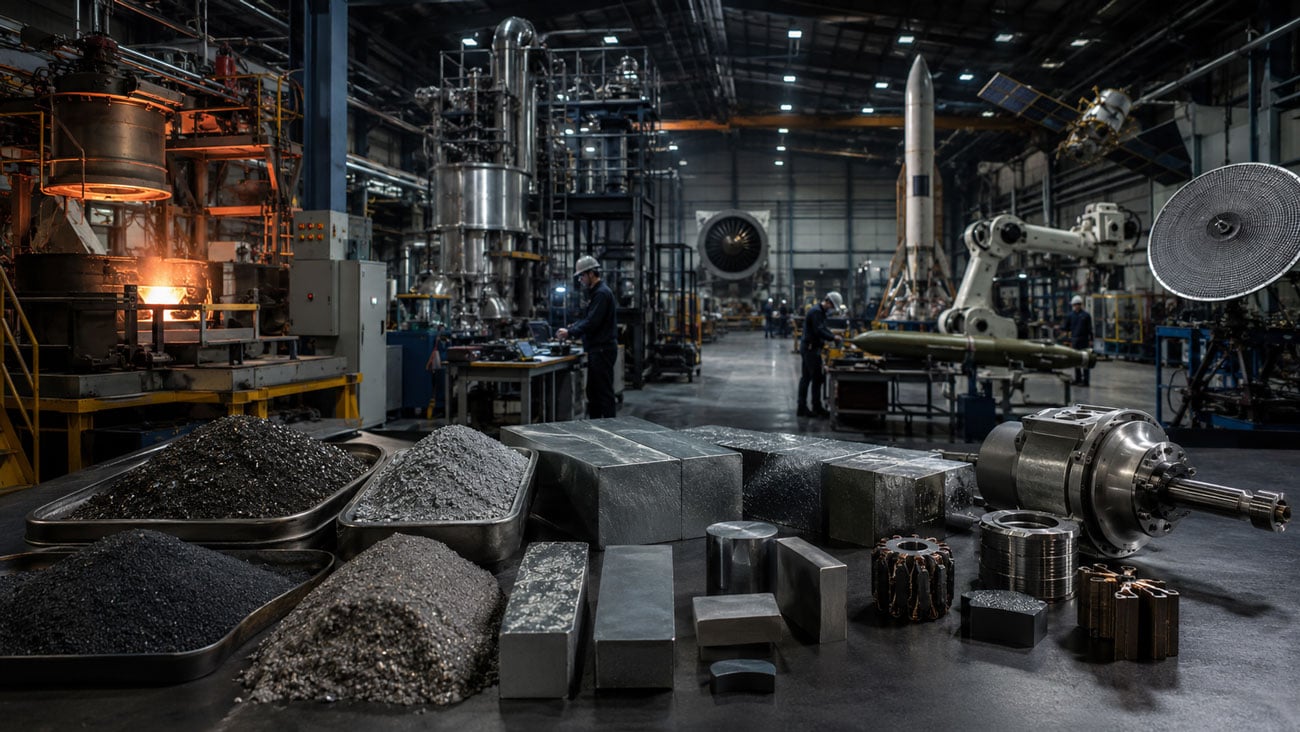
America’s most advanced weapons depend on materials and processing steps that sit far upstream from final assembly. In 2026, Washington accelerated investments in rare-earth separation, refining, strategic stockpiles, recycling, and deeper supply-chain mapping while directing defense contractors to trace critical dependencies back toward raw-material origin. The lesson is increasingly clear: defense production begins long before the factory—and resilience depends on whether the entire chain can be seen, substituted, qualified, and scaled.
Bottom line: the next defense supply-chain crisis may begin several tiers before a prime contractor ever sees the problem.
A missile manufacturer can have assembly capacity. A radar company can have orders. A shipyard can have labor. Yet production can still stop because one specialty metal, magnet alloy, optical material, semiconductor input, or refining process becomes unavailable.
That is why defense supply-chain resilience increasingly has to reach all the way from:
raw material → processing → refining → metallization → component → qualification → weapon system.
The Pentagon’s 2026 critical-material initiatives show that the problem is no longer being treated primarily as a mining issue. It is becoming an end-to-end industrial architecture problem.
The Most Advanced Weapon Can Be Constrained by Its Smallest Material Dependency
Defense readiness is usually measured at the finished-system level.
How many missiles can industry produce? How quickly can aircraft be delivered? Can submarine construction accelerate? Can drone output surge?
Every one of those questions eventually leads upstream.
Past the prime.
Past the subsystem supplier.
Past the electronics manufacturer.
Eventually, the chain reaches materials such as:
- rare earth elements;
- gallium;
- germanium;
- antimony;
- tungsten;
- graphite;
- scandium;
- tantalum;
- and other specialty metals and alloys.
Defense budget documents identify these materials across applications including permanent magnets, jet engines, missile guidance, missile defense, satellites, communications, batteries, optics, autonomous systems, and other advanced military technology.
The finished weapon may be extraordinarily sophisticated.
Its production can still depend on a commodity or processing step that receives almost no public attention.
Critical Minerals Are a Readiness Issue, Not Just a Resource Issue
The central vulnerability is concentration.
Department officials have repeatedly warned that portions of the rare-earth and critical-material supply chain remain heavily dependent on foreign processing, including supply chains exposed to Chinese export controls.
Materials such as gallium, germanium, and antimony have already demonstrated how geopolitical decisions can affect industrial availability.
The risk may remain invisible during normal production. Materials arrive. Suppliers deliver components. Programs meet schedule.
The vulnerability becomes visible during disruption:
- an export restriction;
- a geopolitical crisis;
- a processor going offline;
- rapid wartime demand;
- transportation disruption;
- or another customer competing for the same limited output.
At that point, possessing mineral reserves somewhere underground is not enough.
The question becomes whether the industrial system can transform those materials into qualified defense components quickly enough to sustain production.
Mining Is Only the First Node in the Chain
Critical-mineral discussions often begin with mines.
Domestic extraction matters.
But mining solves only the first step.
A high-performance rare-earth magnet may require material to move through:
extraction → concentration → separation → refining → metallization → alloying → magnet production → machining → coating → qualification.
A nation can mine the material domestically while remaining dependent on foreign industry for one or more steps in the middle.
This is why the Department has described its objective as building a mine-to-magnet supply chain rather than simply increasing mineral extraction.
The more useful readiness question is therefore not:
Where was the mineral mined?
It is:
Can every critical transformation required to turn that mineral into a defense component be performed through trusted domestic or allied capacity?
The Midstream May Be the Hardest Part to Rebuild
The middle of the supply chain is less visible than either mines or final factories.
It may also be where some of the most important constraints exist.
Rare-earth separation, purification, metallization, specialty alloying, chemical processing, and other midstream capabilities require specialized equipment, technical knowledge, environmental controls, and qualified operators.
In June 2026, the Office of Strategic Capital announced a $500 million conditional loan commitment to Phoenix Tailings to expand domestic rare-earth processing. The project is intended to support approximately $1 billion in total public and private investment, including a new U.S. rare-earth separation and metallization facility.
Two days later, OSC announced a $725 million conditional loan commitment to Energy Fuels focused on expanding domestic rare-earth midstream processing.
In July, the Department announced another $25 million investment in ReElement Technologies to expand refining capacity at its Marion, Indiana facility.
The pattern is clear.
Washington is increasingly investing in the industrial steps between the mine and the component.
The Supply Chain Is Only as Domestic as Its Most Dependent Step
A product assembled in the United States can still contain strategic foreign dependencies.
A guidance unit may contain a domestically manufactured magnet whose alloy relies on imported separated oxides. An optical system may be assembled domestically while depending on a specialty material refined overseas. A semiconductor component may rely on high-purity inputs produced by only a small number of facilities worldwide.
That is why labeling a product “domestic” does not fully describe industrial resilience.
Useful questions include:
- Where was the feedstock sourced?
- Where was it separated?
- Where was it refined?
- Where was it converted into metal or alloy?
- Where was the component produced?
- How many qualified suppliers exist?
- What other programs depend on the same capacity?
- How quickly can output increase?
This is a strategic supply-chain mapping and portfolio-planning problem.
The July Executive Order Makes Deep Supply-Chain Visibility a Policy Requirement
On July 20, 2026, the White House issued Executive Order 14415, Securing America’s Defense Supply Chains and Ensuring Domestic Acquisition of Critical Materials.
The order directs the Department to strengthen restrictions involving covered foreign sources, accelerate qualification of domestic and partner-nation alternatives, and pursue much deeper mapping of designated critical defense supply chains.
Most importantly, the order defines a critical supply chain as extending across all tiers of suppliers and subcontractors supporting mission assurance, security, or resilience.
It also defines an indentured Bill of Materials as the parts, components, software, equipment, and materials traced back toward the origin of raw materials.
That represents a major shift in the information requirement placed around defense production.
Supply-chain visibility is moving from Tier 1 management toward material-level provenance.
A Bill of Materials Is Becoming a Strategic Intelligence Product
A conventional bill of materials tells a manufacturer what is inside a product.
A defense supply-chain map can answer a different question:
Where can the industrial system break?
Deep mapping can expose:
- single-source components;
- foreign processing dependencies;
- concentrated materials;
- shared suppliers across weapon systems;
- fragile sub-tier companies;
- long-lead processes;
- and dependencies that are invisible at the prime-contractor level.
Three missile programs can appear industrially independent while all relying on one specialty processor several tiers down.
Operationally, those programs share a common vulnerability.
That makes supply-chain data a form of industrial intelligence.
This is where data integration and technology-enabled supply-chain visibility can materially improve defense planning.
Visibility Without Action Does Not Create Resilience
Mapping is valuable only if leaders can do something with what it reveals.
If a program discovers that a critical component depends on one foreign processor, the enterprise needs options:
- qualify a second source;
- fund domestic processing;
- establish allied production;
- redesign the component;
- substitute another material;
- increase inventory;
- or reduce dependence through improved manufacturing yield.
Supply-chain intelligence therefore needs to connect directly to engineering, procurement, investment, and production decisions.
Otherwise, the government has a better map of the risk without reducing it.
Qualification Can Become the Next Bottleneck
A new domestic supplier does not automatically become an operational supplier.
Defense materials and components may require extensive testing for composition, purity, durability, reliability, repeatability, environmental performance, and compatibility with existing systems.
Engineering authorities may have to approve changes. Drawings can require revision. Manufacturing processes may need adjustment. Subcontractors may need to change their own qualification baselines.
The July executive order explicitly directs the Department to develop a strategy for accelerating testing and qualification of new sources and materials across prime contractors and subcontractors at any tier.
That could become one of the most consequential parts of the policy.
A resilient source that requires years to qualify may not arrive in time to solve the disruption.
Designing for Substitution Is a Systems-Engineering Requirement
Material availability increasingly belongs inside system design.
If one component depends on a highly concentrated material with no practical substitute or second source, that dependency is technical risk.
Future systems can reduce that risk through:
- multiple qualified suppliers;
- alternative materials;
- modular components;
- standard interfaces;
- approved substitution pathways;
- and qualification of secondary sources before a disruption occurs.
The principle resembles open architecture elsewhere in defense modernization:
avoid building mission capability around a dependency that cannot be changed.
That is a transformational-engineering and design-for-resilience challenge.
Stockpiles Buy Time—They Do Not Remove Dependency
Strategic reserves are another important part of the resilience architecture.
In February 2026, the Export-Import Bank approved a direct loan of up to $10 billion for Project Vault, a public-private initiative establishing the U.S. Strategic Critical Minerals Reserve. EXIM says the structure is intended to provide manufacturers stable access to essential raw materials during supply disruptions.
That is strategically valuable.
Stockpiles create time.
They can keep factories operating while another supplier comes online, a disrupted market recovers, or substitution is completed.
But reserves do not eliminate structural dependence.
If domestic and allied industry still lacks separation, refining, metallization, or component-manufacturing capacity, the stockpile eventually becomes another finite inventory.
The strongest architecture therefore combines:
production + trusted allies + reserves + recycling + substitution + visibility.
The August Investment Package Shows the Scale of the Policy Shift
On August 7, the administration announced roughly $3 billion in new financing and investment commitments spanning critical-mineral and battery projects.
The package included support across mining, processing, battery materials, magnets, and allied mineral projects.
The significance is not any one project.
It is the growing use of financing tools beyond conventional defense procurement.
Loans, equity-style investments, stockpiles, grants, long-term purchasing commitments, and public-private capital are increasingly being used to preserve industrial capabilities the government may need during crisis.
The government is not merely purchasing material.
It is attempting to shape the industrial capacity that determines whether material will exist later.
Price Can Become a National-Security Variable
A strategically important domestic facility can be technically successful and commercially vulnerable at the same time.
Mining and processing projects often require large upfront investment. Global prices can then fall enough that a domestic operator struggles to remain economic.
If the plant closes, national-security capacity disappears even though the technical capability worked.
That is one reason government increasingly uses:
- loans;
- loan guarantees;
- long-term offtake agreements;
- direct investment;
- strategic reserves;
- and other demand-support mechanisms.
Industrial resilience sometimes requires preserving capacity that ordinary spot-market economics would not maintain on its own.
Allies Are Part of the Material Architecture
Complete national self-sufficiency across every critical material would be difficult and, in many cases, economically inefficient.
The more realistic objective is trusted and diversified supply.
Allies and partners can contribute mining, processing, refining, specialty metals, and manufacturing capacity.
Australia and Canada are especially important mineral partners, while other allied industrial bases provide processing and component capabilities the United States can integrate into resilient supply chains.
Supply-chain sovereignty therefore does not have to mean isolation.
It means avoiding dependencies that can be denied when the mission requires them most.
Recycling Creates Another Source of Strategic Material
Not every critical mineral has to originate from newly mined ore.
Rare earths and other valuable materials exist in:
- electronic waste;
- retired equipment;
- manufacturing scrap;
- used magnets;
- batteries;
- mine tailings;
- and other secondary feedstocks.
In June 2026, the Department of Energy announced $134 million for two rare-earth demonstration projects intended to recover and refine materials from unconventional sources including mine tailings, electronic waste, and other waste streams.
The projects include work by Colorado School of Mines and Phoenix Tailings to demonstrate integrated domestic recovery, separation, refining, and metal production.
The strategic value goes beyond waste reduction.
Recycling converts material already inside the domestic economy into another potential supply source.
Material Efficiency Can Create Supply Without Opening a Mine
Supply resilience also has a demand side.
Engineers can improve manufacturing yield, reduce material intensity, recover scrap, design for recycling, and substitute more available materials when mission requirements permit.
If a production process wastes a significant share of a constrained input, increasing yield effectively increases usable supply without adding new extraction.
That means critical-mineral strategy belongs partly on the factory floor.
Mining engineers can expand supply upstream.
Manufacturing engineers can reduce unnecessary demand downstream.
The Workforce Constraint Exists From Mine to Magnet
Rebuilding the material ecosystem requires specialized people:
- mining engineers;
- geologists;
- metallurgists;
- chemical engineers;
- materials scientists;
- process engineers;
- equipment operators;
- qualification specialists;
- and environmental and permitting professionals.
Facilities cannot scale without qualified workers.
This is the same industrial constraint examined in Diamondback’s analysis of why the defense workforce is becoming a readiness variable.
A billion-dollar processing facility without the people capable of operating it is not industrial capacity.
Critical-Mineral Timelines Are Longer Than Political Timelines
New supply chains can take years.
Exploration, financing, environmental review, permitting, construction, equipment installation, startup, process stabilization, customer qualification, and production ramp all consume time.
That makes critical-mineral policy partly a question of readiness for conflicts that have not happened yet.
There is no switch that converts appropriated money into high-purity material next month.
This is why industrial resilience has to precede military demand.
The same time-to-capacity problem appears across NATO rearmament and munitions production. Diamondback’s analysis of why NATO needs factories as well as funding addresses the broader production version of the same challenge.
Small Suppliers Can Carry Strategic Risk
Supply-chain importance does not correlate neatly with corporate size.
A small company can own a unique processing technique, specialty alloy, chemical capability, optical material, or precision-manufacturing process that a multibillion-dollar platform depends on.
The supplier’s revenue may be small.
Its strategic significance may be enormous.
This is why supplier-risk, resource, and industrial-base planning cannot stop at prime contractors or large Tier 1 suppliers.
The useful question is not merely how much the government spends with the supplier.
It is:
What stops working if the supplier disappears?
Hypersonic Production Makes the Material Problem Concrete
The importance of sub-tier materials becomes especially visible in advanced weapons.
Hypersonic systems depend on high-temperature structures, thermal-protection materials, propulsion, electronics, specialized manufacturing, and quality processes that can be difficult to scale.
Diamondback’s analysis of the industrialization challenge facing hypersonic weapons examines how one constrained component or process can determine the production rate of an entire missile.
The same principle applies across the defense industrial base:
final assembly cannot outrun the slowest critical input.
Mission Assurance Has to Reach the Raw Material
Mission assurance usually focuses on fielded capability.
Can the network survive attack? Can the command post continue operating? Can the aircraft remain mission-capable?
Critical materials push the same question upstream.
Can the factory keep producing?
Can the component supplier obtain the input?
Can the refiner obtain feedstock?
Can another source be qualified?
Can the supply chain survive geopolitical disruption?
If not, the mission vulnerability existed long before the weapon entered service.
Defense Contractors Will Need Deeper Supply-Chain Intelligence
The July executive order points toward a contracting environment in which prime contractors and subcontractors may need substantially deeper visibility into origin, processing, and supplier concentration.
Procurement organizations will increasingly need to answer:
- Where did the material originate?
- Which country processed it?
- How concentrated is the source?
- Is a second source qualified?
- How long would substitution take?
- Which other programs depend on the same supplier?
- What inventory exists?
- How quickly can output surge?
That turns procurement information into strategic intelligence.
Managing it will require enterprise governance and execution discipline across engineering, acquisition, suppliers, data, and production.
The Objective Is Optionality
No supply chain can eliminate every disruption.
Mines close. Companies fail. Governments change policy. Demand spikes. Natural disasters occur. Technologies create new material requirements.
The more realistic objective is optionality:
- multiple suppliers;
- multiple countries;
- alternative materials;
- stockpiles;
- recycling;
- substitution pathways;
- distributed processing;
- transparent supply maps;
- and faster qualification.
Resilience is the ability to change when one assumption stops being true.
The Arsenal Begins Before the Factory
America’s most advanced weapons are the visible end of industrial chains extending through mines, chemical plants, processing facilities, refineries, metal producers, magnet manufacturers, electronics companies, machine shops, and small specialty suppliers.
Those upstream dependencies are easy to overlook when the finished missile is sitting inside a launcher or the aircraft is on the flight line.
They become impossible to ignore when supply stops.
Washington’s 2026 actions—from Phoenix Tailings, Energy Fuels, and ReElement investments to Project Vault, recycling initiatives, and Executive Order 14415—show that critical materials are moving deeper into the defense-readiness conversation.
The challenge will not be solved by mines alone.
It requires:
extraction + processing + refining + metallization + manufacturing + qualification + workforce + data + stockpiles + allies + substitution.
Defense production does not begin when the prime contractor starts assembling the weapon.
It begins years earlier, several tiers upstream, with the industrial capabilities required to make every critical input replaceable, visible, and available at scale.
A defense industrial base is only as resilient as the dependency it cannot replace.
Primary Sources
- White House — Executive Order 14415 on defense supply chains and critical materials, July 20, 2026
- Department — $500 million Phoenix Tailings conditional loan commitment
- Department — $725 million Energy Fuels conditional loan commitment
- Department — $25 million ReElement refining investment
- Export-Import Bank of the United States — Project Vault and U.S. Strategic Critical Minerals Reserve
- U.S. Department of Energy — $134 million rare-earth recovery and refining projects
- Department — Rare-earth supply-chain concentration and national-security risk
- Reuters — August 7, 2026 critical-minerals investment package