America can appropriate money for shipyards, munitions plants, AI infrastructure, cyber programs, and advanced manufacturing faster than it can create the experienced people required to operate them. Across the defense enterprise, workforce capacity is becoming a readiness variable: skilled trades, engineering, cyber, data, acquisition, logistics, and institutional knowledge increasingly determine whether physical and digital investments translate into usable military capability.
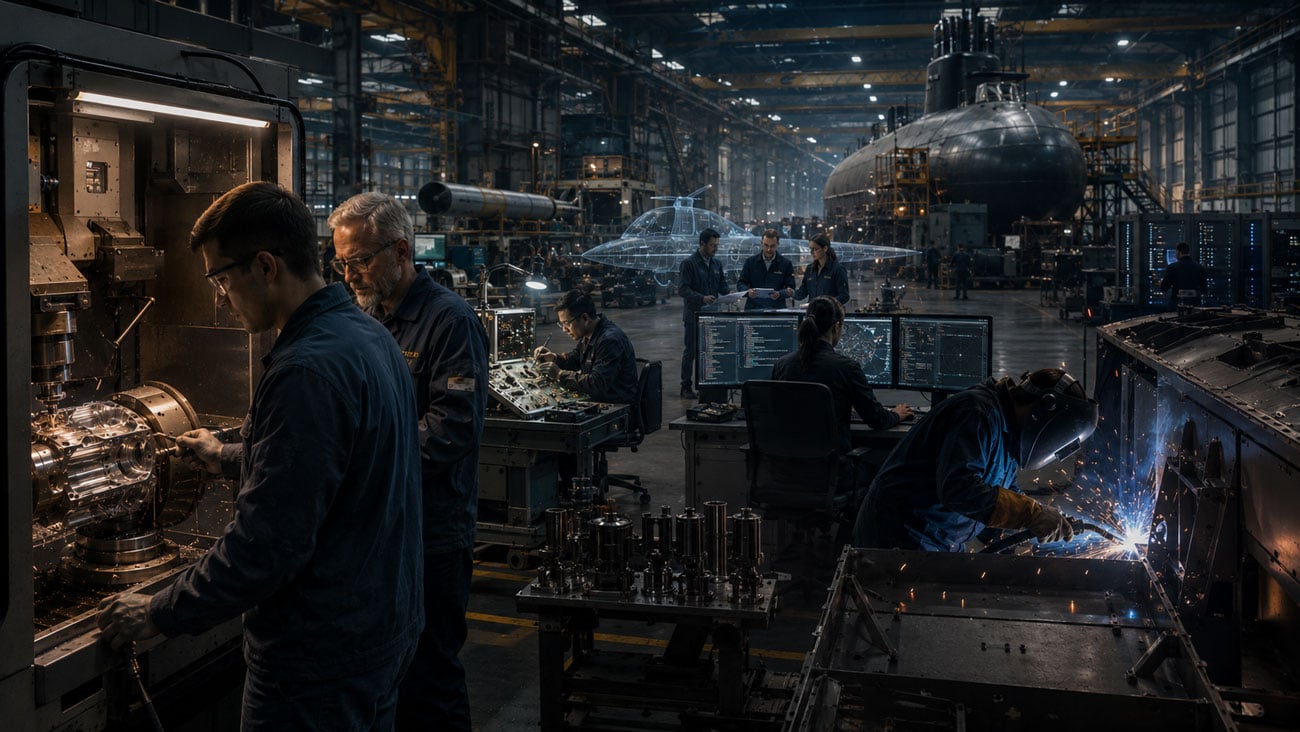
Bottom line: the defense workforce is no longer just a personnel issue. In many parts of the enterprise, it is a production constraint, a modernization constraint, and a readiness constraint. A shipyard without enough qualified tradespeople cannot accelerate submarine output. A cyber organization without experienced operators cannot defend networks simply because new tools were purchased. A factory without machinists, technicians, inspectors, and production engineers cannot convert capital investment into sustained throughput.
That is why workforce planning increasingly belongs in the same strategic conversation as munitions capacity, shipyard infrastructure, supply-chain resilience, compute, and energy. The people who design, build, integrate, secure, maintain, and operate military systems are themselves part of the capability.
The Next Defense Bottleneck May Be Human
Defense modernization is usually described through physical assets: factories, ships, missiles, autonomous systems, data centers, machine tools, and production lines.
But almost every one of those assets shares a dependency that cannot be ordered from a catalog: competent people with the right experience at the right time.
A billion-dollar facility without qualified operators is underused capacity. A sophisticated maintenance system without technicians is software. A nuclear shipyard without welders, pipefitters, electricians, machinists, engineers, and inspectors cannot increase delivery rates simply because Congress funds more work.
The Navy’s maritime industrial-base effort makes the scale visible. NAVSEA has said the submarine enterprise must recruit and train more than 140,000 skilled workers over the coming decade to support submarine production and sustainment. The challenge spans prime shipyards, public shipyards, suppliers, foundries, machine shops, fabricators, engineering organizations, and maintenance activities across the country.
This is not simply an industrial-base problem. It is a workforce-capacity and mission-support problem.
Capital Can Scale Faster Than Expertise
Money can move relatively quickly. Congress appropriates funding. Contracts are awarded. A company purchases another machine. A facility expansion begins.
Expertise operates on a different timeline.
A nuclear-qualified welder, precision machinist, experienced contracting professional, senior cyber operator, data scientist, systems engineer, or maintenance technician represents accumulated capability: training, judgment, certification, institutional knowledge, and years of exposure to problems that cannot be recreated instantly.
That creates an important distinction between industrial capacity and workforce capacity.
Industrial capacity can often be purchased. Workforce capacity has to be recruited, trained, qualified, retained, and developed.
For highly specialized roles, the most important readiness metric may not be headcount. It may be time to competence: how long it takes from identifying a requirement until someone can perform the mission independently and reliably.
Advanced Manufacturing Changes Which People Become Critical
Automation, robotics, additive manufacturing, digital inspection, AI-assisted production planning, and modern machine tools can increase productivity dramatically. But they do not eliminate workforce requirements. They change them.
Someone has to program the robot, maintain it, diagnose process drift, interpret quality data, validate the output, integrate software, and understand how the automated cell fits into the larger production system.
This is why the Navy’s maritime industrial-base strategy links workforce development, supply-chain resilience, infrastructure, and advanced manufacturing rather than treating them as independent initiatives.
The Accelerated Training in Defense Manufacturing program illustrates the effort to compress workforce-development timelines. Its intensive 16-week model provides 600 hours of hands-on training in welding, CNC machining, additive manufacturing, quality assurance, or nondestructive testing—trades directly tied to maritime manufacturing demand.
The larger lesson is straightforward: modernization succeeds when technology and workforce design evolve together.
Shipbuilding Makes the Workforce Equation Impossible to Ignore
Few defense sectors expose the relationship between labor and military capacity as clearly as shipbuilding.
Submarine production depends on a national network of suppliers and specialized trades, not only the workforce inside the major shipyards. The Navy’s Talent Pipeline Program has therefore expanded as an employer-centered model designed to improve recruiting, hiring, onboarding, training, and retention across the maritime industrial base.
NAVSEA reported 452 employer partners participating in the program for the 2025 Signing Day season, with regional pipelines spanning major maritime centers and an Enterprise Plus pathway intended to reach suppliers outside those hubs.
The significance is larger than the hiring events themselves. The Navy is building a national human-capital network around the production system.
That is industrial mobilization through workforce architecture.
Hiring Is Only the First Step
Recruiting numbers are easy to count. They are not the same as capability.
A new hire may require months or years of training, qualification, mentorship, and supervised experience before reaching full productivity. If that person leaves early, the organization loses both current capacity and part of its investment in future expertise.
A useful defense workforce model therefore looks less like:
Hire more people.
And more like:
Forecast → Recruit → Train → Qualify → Retain → Develop → Transfer knowledge.
Every stage matters. Hiring without retention creates churn. Training without career development loses talent after the organization has paid to create it. Retirement without knowledge transfer can remove years of institutional memory at once.
Cyber Shows That the Problem Is Often Pathway Design
The digital workforce has a different problem from the skilled trades. Interest can be abundant while access to the mission remains difficult.
The Pentagon’s 2026 Cyber Registered Apprenticeship Program offers a useful signal. After an initial preview, the program generated more than 70,000 inquiries. The 12-month paid apprenticeship combines competency-based education, hands-on labs, on-the-job training, mentorship, and industry-recognized certifications. One technical pathway does not require a four-year degree or prior professional cyber experience.
That does not prove every cyber vacancy can be filled easily. It does show that alternative pathways can reveal talent pools traditional recruiting may miss.
The strategic question becomes less about credentials in the abstract and more about which capabilities the mission actually requires and how the organization can identify them reliably.
The Army Is Applying the Same Logic to Specialized Officers
The Army’s modernized Direct Commissioning Program is another example of workforce architecture adapting to mission demand.
Historically associated with fields such as medicine, law, and chaplain services, the program now reaches high-demand technical areas including cyber operations, data science, artificial intelligence, robotics, advanced logistics, engineering, military intelligence, and information warfare.
The Army reported in July 2026 that reforms had increased the number of selection boards and reduced some application-to-commission timelines to fewer than six months.
The logic is important. A civilian AI engineer, data scientist, robotics specialist, or supply-chain expert may already possess years of expertise the Army needs. Requiring every specialist to enter through a career architecture designed for a different talent profile can create avoidable delay.
Defense organizations increasingly recognize that different technologies require different acquisition models. The same principle applies to people.
The Workforce Architecture Should Match the Mission Architecture
A nuclear welder, cyber analyst, logistics planner, AI engineer, contracting specialist, machinist, and military commander all contribute to national defense. They do not need identical talent pipelines.
Some expertise should be developed internally over decades. Some can be recruited laterally. Some can come through apprenticeships. Some can be commissioned directly. Some can remain in industry while supporting government through contracts and partnerships.
The objective should be a portfolio of talent pathways aligned to mission requirements.
That is fundamentally a strategic planning problem. Leaders need to know which capabilities must exist internally, which can be sourced externally, where surge capacity is required, which roles have long training lead times, and where workforce risk threatens future mission performance.
Workforce Reductions Should Be Evaluated Against Capability, Not Headcount Alone
Workforce modernization also includes deciding where organizations can become leaner.
GAO reported in May 2026 that DoD’s civilian workforce declined by about 78,000 employees during 2025, roughly a 10 percent reduction. GAO found that DoD components did not consistently analyze the impacts of workforce reductions and recommended a formal lessons-learned process.
The implication should not be that every position must be preserved. Organizations should eliminate unnecessary work, automate where appropriate, and restructure around changing mission needs.
But efficiency has to be measured against capability.
A smaller organization is not necessarily more effective if critical work moves into backlogs, oversight capacity disappears, contractor dependence grows, or specialized expertise takes years to rebuild.
A June 2026 GAO review of DoD’s operational-test organization provided a concrete example: significant staffing reductions left remaining personnel responsible for more programs, including some outside their areas of expertise, reducing oversight capacity.
That is why workforce rationalization should begin with the question:
What capabilities must this organization be able to perform?
Then leaders can determine which roles should grow, shrink, change, automate, outsource, or remain sovereign.
Institutional Knowledge Is a Strategic Asset
Experienced personnel carry information that often does not exist in formal documentation.
A mechanic knows which component tends to fail first. A program analyst remembers why a requirement exists. A machinist knows how a difficult part behaves in production. A cyber engineer understands the undocumented dependency inside a legacy network. A contracting officer knows which acquisition approach repeatedly creates delay.
Organizations often discover the value of this knowledge only after it leaves.
That makes succession planning, documentation, mentorship, communities of practice, and deliberate knowledge transfer part of mission continuity—not simply human-resources administration.
This is especially important where replacement timelines are measured in years.
AI Will Change Defense Jobs Before It Eliminates Them
Artificial intelligence and automation will reshape the workforce, but the most immediate effect is likely to be a redistribution of work.
A maintenance planner may spend less time assembling reports and more time interpreting readiness trends. A cyber analyst may rely on automation for triage while focusing on sophisticated incidents. A software engineer may produce code faster while spending more time validating architecture, integration, and security. A machinist may operate increasingly automated equipment while requiring stronger digital skills.
The useful question is not simply Which jobs will AI remove?
It is which human capabilities become more valuable when routine work is automated?
That is where AI-augmented delivery becomes a workforce strategy as much as a technology strategy: automate repetitive work while concentrating human judgment on the decisions, exceptions, and risks that matter most.
Training Has to Move at Technology Speed
Traditional education pathways can take years. Some technologies change in months.
Cyber techniques evolve. AI tools change. Advanced manufacturing equipment improves. Autonomous systems mature rapidly. A one-time qualification completed at the beginning of a career is not enough for many modern defense roles.
Training therefore has to become continuous:
- apprenticeships;
- microcredentials;
- vendor and government training;
- simulation;
- on-the-job learning;
- mentorship;
- rotational assignments;
- and recurring technical requalification.
The workforce has to modernize while it is employed.
Rotations Can Build Enterprise Talent—If the Program Actually Moves People
Modern defense problems cross organizational boundaries. Cyber intersects with weapons systems. Logistics intersects with data. AI intersects with intelligence. Manufacturing intersects with supply chains. Acquisition intersects with engineering and operations.
Rotational programs can build personnel who understand those connections, but implementation matters.
GAO reported in July 2026 that the Federal Rotational Cyber Workforce Program attracted 634 applicants over its life, yet only eight employees were approved to serve rotational assignments. OPM effectively suspended the program after low participation.
The lesson is not that rotations lack value. It is that talent-development mechanisms have to be operationally usable. If managers cannot release employees, eligibility rules block applicants, or administrative friction overwhelms the benefit, a theoretically sound program does not create capability.
Contractors Are Part of the Workforce Architecture
Defense missions rely heavily on contractors for engineering, software, cybersecurity, program management, logistics, maintenance, systems integration, analytics, and specialized technical support.
That access to industry talent is a major strategic advantage. It also creates design questions.
Which knowledge must remain inside government? Which mission functions can depend heavily on one contractor? Can government remain an intelligent customer if too much technical understanding migrates outside the organization? What happens when a contract transitions to a new provider?
The strongest model uses industry to expand and accelerate specialized capacity while preserving enough government expertise to define requirements, evaluate performance, make decisions, and maintain continuity.
That balance is central to effective operations management and mission execution.
Small Defense Companies Face the Same Talent Constraint
The workforce problem does not stop with the government or major primes.
A 50-person defense technology company may compete against large commercial firms for the same software engineer. A small machine shop may need skilled machinists while competing with larger manufacturers. A supplier may suddenly require cyber expertise simply to remain eligible for defense work.
Smaller firms often cannot build the internal academies, recruiting organizations, or rotational pipelines available to major enterprises.
That is why regional and sector-wide workforce networks matter. Shared pipelines can connect employers, schools, community colleges, trade programs, workforce boards, and government demand signals rather than asking every supplier to solve the same problem independently.
Workforce Data Should Be Managed Like Readiness Data
Defense organizations track aircraft readiness, inventory, ship maintenance, program schedules, and supply-chain risk with increasing sophistication. Workforce capacity deserves similar rigor.
Leaders should be able to answer:
- Which skills are actually scarce?
- Where are the shortages?
- Which occupations have the longest time to competence?
- Where is retirement risk concentrated?
- Which positions take longest to fill?
- Where does attrition occur?
- Which training programs produce sustained retention?
- Where is automation changing demand?
- Which roles represent single points of failure?
Those are not HR metrics in isolation. They are mission-risk indicators.
A data-informed workforce planning model allows leadership to connect hiring, training, resource allocation, succession, and contractor strategy directly to mission demand.
The Defense Workforce Is Strategic Infrastructure
The Pentagon already plans around constrained resources: munitions, strategic materials, fuel, compute, bandwidth, shipyard capacity, industrial tooling, and critical suppliers.
Workforce capacity belongs on the same map.
Where are the single points of failure? Which skills exist in only a handful of people? Where is demand likely to surge? Which pipelines take years to produce competent workers? Which roles can be automated? Where should government preserve sovereign expertise? Which supplier regions lack enough skilled labor to absorb new capital investment?
This is workforce planning as mission assurance.
The Navy’s maritime workforce effort, the Pentagon’s cyber apprenticeship, the Army’s direct-commissioning reforms, and GAO’s recent warnings about workforce reductions all point toward the same conclusion from different directions:
Technology does not generate military advantage by itself.
People design it. Build it. Integrate it. Secure it. Maintain it. Operate it. Improve it. And when systems fail, experienced people often determine whether the mission recovers.
For years, workforce was often treated as an input supporting platforms and programs. In the most constrained parts of the defense enterprise, that relationship is reversing.
The workforce is itself a strategic capability—and where expertise takes years to build, it may be one of the least replaceable capabilities the defense enterprise possesses.
Primary Sources
- Naval Sea Systems Command — Submarine workforce revitalization and 140,000-worker requirement
- Naval Sea Systems Command — Maritime Talent Pipeline Program
- Naval Sea Systems Command — Accelerated Training in Defense Manufacturing
- DoD Chief Information Officer — Cyber Registered Apprenticeship Program
- U.S. Army — Modernized Direct Commissioning Program
- U.S. GAO — DoD civilian workforce reductions and mission-impact analysis
- U.S. GAO — Federal Rotational Cyber Workforce Program