Artificial intelligence may be software, but military AI advantage increasingly depends on physical infrastructure: GPUs, hardened data centers, trusted data, secure networks, power, cooling, classified environments, and compute at the tactical edge. The Pentagon’s emerging AI Arsenal proposal makes that shift explicit. The next phase of defense AI is not only a model race—it is a race to build, secure, allocate, refresh, and distribute the computing infrastructure that turns algorithms into operational capability.
Bottom line: the Pentagon’s AI race is becoming a compute race because models do not create military advantage by themselves.
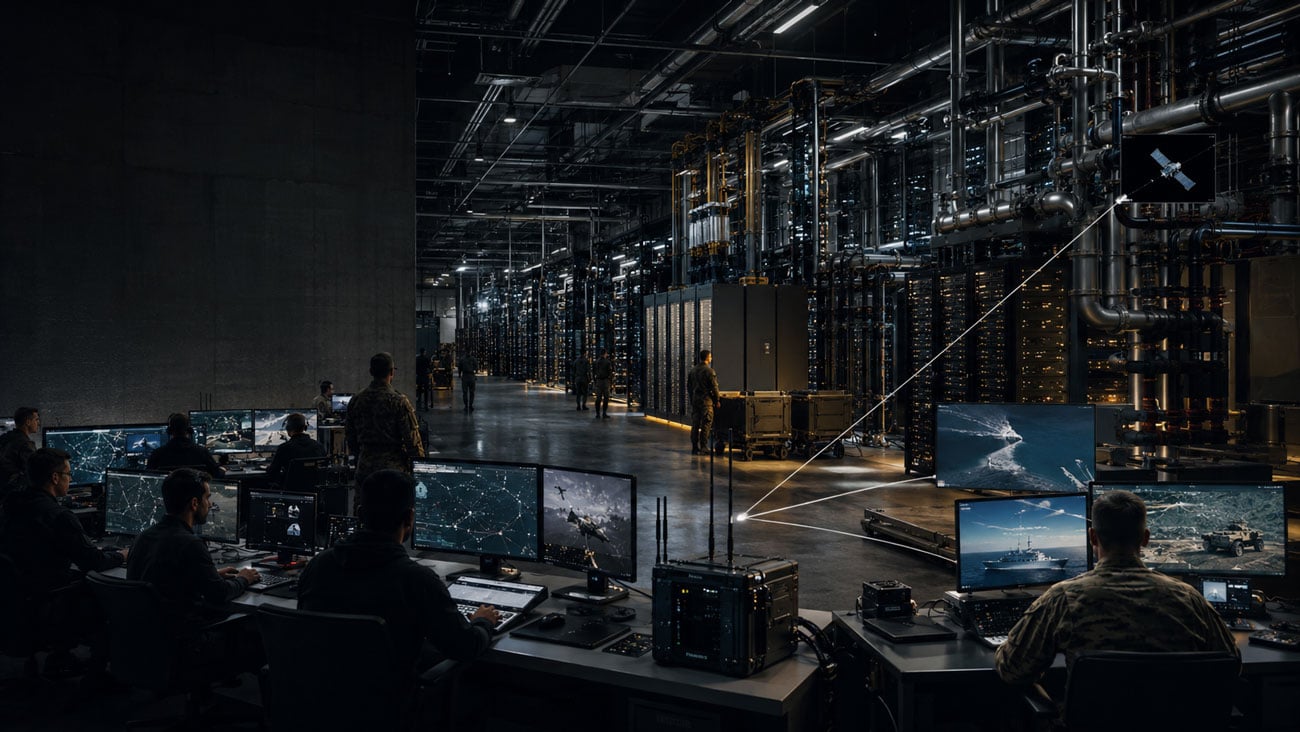
Artificial intelligence depends on a complete physical and digital stack: processors, servers, data centers, power, cooling, storage, networking, classified infrastructure, data pipelines, cyber defense, and increasingly tactical edge hardware capable of functioning when the cloud is unavailable.
The strategic question is therefore changing.
It is no longer simply:
Which military has the best AI model?
It is:
Which military can make trusted AI available wherever the mission requires it, at sufficient scale, under the conditions in which it must actually operate?
Artificial Intelligence Has a Physical Supply Chain
AI feels intangible because the visible interaction is software.
A user submits a request. A model processes data. An answer appears.
Behind that interaction sits industrial infrastructure:
- advanced semiconductors;
- high-bandwidth memory;
- GPU servers;
- high-speed networking;
- storage;
- data centers;
- electrical substations;
- backup generation;
- cooling systems;
- fiber connectivity;
- cloud platforms;
- cybersecurity;
- and trained technical personnel.
For national-security workloads, another layer appears: secure facilities, classified networks, controlled access, cross-domain data movement, configuration management, and trusted supply chains.
The AI model may be software.
The capability that allows the military to use it is an industrial system.
The Pentagon Is Beginning to Treat Compute as Strategic Infrastructure
The Department’s FY2026–2030 Strategic Plan identifies a $4 billion investment through FY2027 to modernize its AI ecosystem and enabling infrastructure, with the objective of expanding secure and accessible enterprise AI while reducing data silos and cyber vulnerabilities.
The FY2027 procurement request goes considerably further.
Budget justification documents propose $29.5 billion in mandatory funding for the AI Arsenal initiative. The initiative is designed to move the Department away from scattered GPU clusters and toward an organized infrastructure portfolio spanning strategic through tactical AI compute requirements.
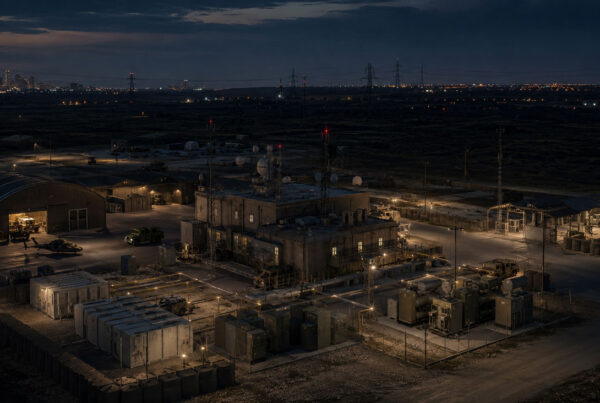
The plan includes hardened, Sensitive Compartmented Information Facility-accredited data centers across multiple sites, along with state-of-the-art GPUs and AI supercomputers.
That is not merely a larger IT budget.
It represents a shift toward treating compute as a managed mission technology resource.
The AI Race Is Also an Infrastructure Race
Defense AI discussions have often focused on algorithms:
Which model performs best? Which task can be automated? Can AI accelerate intelligence analysis, targeting, logistics, maintenance, cyber defense, or command decisions?
Those questions remain important.
But operational scale introduces another set:
- Where does the model run?
- How much compute does it require?
- Where does its data reside?
- What classification environment is required?
- How much power and cooling does the workload consume?
- What happens when connectivity disappears?
- How quickly can capacity expand?
- How is scarce compute prioritized?
A military can possess sophisticated models and still fail to operationalize them broadly if the compute architecture underneath them is insufficient.
Fuel enables mobility.
Munitions enable fires.
Bandwidth enables connectivity.
Compute increasingly enables AI.
Scattered GPU Islands Can Recreate the Pentagon’s Legacy IT Problem
The AI Arsenal budget language is notable because it explicitly targets scattered clusters of GPUs.
Without enterprise coordination, local infrastructure proliferates naturally.
One command buys GPUs. Another organization builds a separate cluster. A research laboratory creates another environment. A program office procures its own hardware around a specific requirement.
Each purchase may be rational individually.
Collectively, the Department can create another fragmented enterprise:
- different hardware generations;
- different software stacks;
- different security configurations;
- different utilization rates;
- different procurement agreements;
- different data environments;
- and different support models.
The result would be the compute equivalent of application sprawl.
That is exactly the pattern Diamondback examined in the Pentagon’s fight against legacy systems: individually reasonable technology decisions can accumulate into enterprise complexity when architecture and portfolio governance are weak.
Compute Needs a Portfolio, Not a Single Cloud
The core architecture question is deceptively simple:
Which workload should run where?
Not every AI mission needs the same infrastructure.
Training a very large model may require enormous centralized compute. Fine-tuning a specialized model may require far less. Intelligence analysis may demand high-side classified infrastructure. An autonomous aircraft or vessel may need local inference. A tactical command post may need useful AI while disconnected. An administrative assistant may be served efficiently through a commercial environment.
The Department therefore needs layers of compute:
- strategic compute;
- enterprise compute;
- mission compute;
- edge compute;
- embedded compute;
- and commercial compute.
The correct architecture places workloads according to mission need, security, latency, cost, connectivity, power, classification, and resilience.
That is a technology portfolio and resource-allocation problem, not simply a data-center procurement.
Centralization Creates Efficiency. Distribution Creates Resilience.
Large centralized AI facilities provide enormous advantages.
They concentrate compute, storage, high-speed networking, technical staff, cooling, security controls, and specialized infrastructure.
Concentration also creates dependency.
A data center can lose power. Network access can be disrupted. A cyber incident can affect availability. A regional infrastructure event can affect access. In a major conflict, concentrated digital infrastructure should not automatically be assumed to remain untouched.
The same architectural tension appears repeatedly across modern defense:
concentration improves efficiency; distribution improves resilience.
The strongest defense AI architecture will deliberately use both.
Hardened SCIF Data Centers Signal a Different Threat Model
The AI Arsenal proposal specifically calls for multiple hardened, SCIF-accredited data-center facilities.
That language matters.
A classified military AI facility has requirements beyond commercial hyperscale infrastructure:
- physical protection;
- personnel security;
- classified information handling;
- cross-domain architecture;
- trusted maintenance;
- cyber defense;
- supply-chain assurance;
- availability during crisis;
- and resilient power and communications.
The facility becomes part of the mission architecture.
Its value is not simply measured in GPUs.
It is measured by whether compute remains available, secure, trusted, and usable when the mission depends on it.
The Army Is Testing a Different Commercial Infrastructure Model
Government-owned infrastructure is only one part of the emerging compute architecture.
On March 26, 2026, the Army announced conditional selections for privately financed hyperscale data-center projects on roughly 1,384 acres at Fort Bliss, Texas, and 1,201 acres at Dugway Proving Ground, Utah.
Under the proposed Enhanced Use Lease model, private partners would finance, construct, operate, maintain, and eventually decommission the commercial facilities on Army land without upfront taxpayer funding.
The model reflects an important reality: the private sector is investing on a scale in AI infrastructure that government does not need to duplicate everywhere.
Defense organizations therefore need to decide which infrastructure benefits from commercial scale and which capabilities require stronger government control.
The Future Defense Compute Architecture Will Be Hybrid
An entirely government-owned AI infrastructure would sacrifice much of the commercial sector’s scale, hardware refresh rate, capital, and innovation.
An entirely commercial architecture could create unacceptable dependencies for highly classified, highly sensitive, or uniquely resilient missions.
The likely answer is hybrid.
Commercial infrastructure can provide enormous elasticity and rapid technology refresh. Government-controlled infrastructure can preserve sovereign capability, specialized security, classified operations, and resilience for missions the Department cannot afford to make dependent on ordinary commercial assumptions.
The challenge is interoperability.
If commercial, sovereign, enterprise, and tactical environments cannot exchange approved data and workloads coherently, hybrid compute becomes another form of fragmentation.
The Tactical Edge Is Where Commercial Cloud Assumptions Break
Defense AI diverges most sharply from commercial AI at the tactical edge.
Commercial applications can often assume reliable power, persistent internet access, high bandwidth, and centralized data centers.
A military system may operate from a vehicle, aircraft, ship, island, command post, or remote sensor while those assumptions fail.
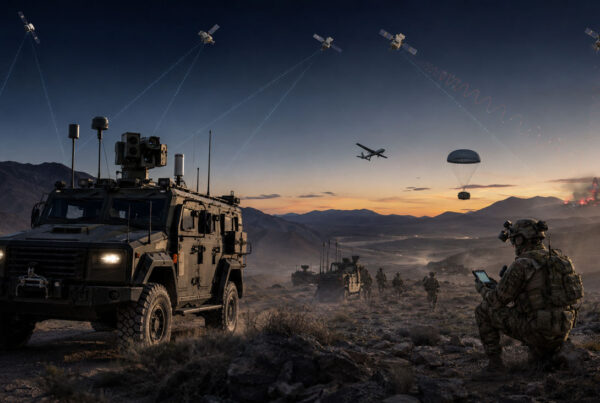
Communications may be jammed. Satellite links can disappear. Bandwidth can collapse. Power is limited. Heat matters. Size and weight matter. Electromagnetic signature matters.
That requires edge AI.
But edge AI is not simply a smaller copy of cloud AI.
The Best Tactical Model May Not Be the Most Powerful Model
Tactical compute forces tradeoffs.
A large model may deliver excellent performance when connected to centralized infrastructure but become unavailable during communications disruption.
A smaller local model may provide lower raw capability but continue operating under degraded conditions.
For a warfighter, the second system may provide greater mission value.
The correct measure is therefore not benchmark performance alone.
It is:
useful performance under the conditions where the mission actually occurs.
This is where AI-augmented delivery has to integrate model performance with operational constraints and human decision requirements.
Connected, Degraded, and Disconnected Should Be Normal AI States
Future military AI should be designed around at least three connectivity conditions:
- Connected: enterprise compute, large models, cloud services, and broad datasets are available.
- Degraded: bandwidth is constrained, synchronization is intermittent, and centralized services may be partially available.
- Disconnected: local models and locally available data sustain essential mission functions.
Graceful degradation should become a standard design requirement.
The system should not move from extraordinary capability to complete uselessness because one network path disappears.
This directly connects defense AI infrastructure with the same resilience challenge discussed in Diamondback’s analysis of why battlefield software must survive contested networks and evolve continuously.
NGC2 Shows Why AI Requires a Full Stack
The Army’s Next Generation Command and Control experimentation provides an operational example.
The Army describes NGC2 as a full-stack capability ecosystem consisting of applications, data and AI, infrastructure, network, and transport.
That is the right framing.
AI cannot be operationalized as an isolated application layer.
The model depends on data.
The data depend on infrastructure.
Infrastructure depends on networking and transport.
Every layer depends on cybersecurity.
The mission depends on the entire stack.
That makes AI implementation a systems-integration and architecture challenge as much as a model-development challenge.
Data May Still Be Harder Than Compute
GPUs attract attention because they are scarce, expensive, and measurable.
Data remains the more difficult institutional problem.
Defense information is distributed across logistics, intelligence, readiness, maintenance, personnel, targeting, acquisition, operations, and sensor systems built by different organizations over decades.
The data may use different formats, permissions, classifications, ownership models, interfaces, and definitions.
Adding more compute does not automatically make inaccessible or inconsistent data useful.
A multibillion-dollar compute environment sitting above poorly governed information will underperform regardless of processor performance.
The Army Data Operations Center Is Infrastructure for the Information Layer
The Army’s new Data Operations Center reached initial operating capability on April 3, 2026.
Army leaders describe it as a centralized data service—and effectively a “911 for data”—designed to help operational organizations identify authoritative sources, establish secure connections, and move information to where it is needed.
As the center matures, the Army says it will support AI and machine learning, manage the Army’s AI model garden, and help shorten sensor-to-shooter timelines.
This is the less glamorous side of AI modernization.
It may also be one of the most important.
Compute without usable data is stranded capacity.
AI Infrastructure Is Becoming Energy Infrastructure
Every large-scale compute discussion eventually becomes an energy discussion.
High-performance GPUs consume significant electricity. Cooling consumes energy. Networking, storage, and supporting systems add additional load.
At hyperscale, electrical infrastructure becomes part of the AI architecture.
Defense planners therefore have to ask:
- Can the local grid support the load?
- Are new substations required?
- What backup generation is necessary?
- How resilient is the power source?
- What cooling architecture is required?
- What water dependencies exist?
- Can the facility continue through grid disruption?
AI modernization therefore reaches beyond CIO organizations into facilities, utilities, installation management, energy resilience, and infrastructure planning.
The data center becomes a cyber-physical mission system.
The Semiconductor Supply Chain Is Part of Defense AI
Advanced AI processors depend on specialized semiconductor fabrication, advanced packaging, high-bandwidth memory, networking, substrates, server manufacturing, and global supply chains.
The Pentagon competes for portions of the same ecosystem serving the world’s largest commercial AI companies.
Funding a data center does not guarantee that the desired processors, memory, networking equipment, or replacement components will be available when needed.
As compute becomes more central to military capability, the commercial semiconductor and data-center supply chain increasingly becomes part of the defense industrial base.
That creates a supply-chain, capacity, workforce, and sustainment challenge around technologies historically considered commercial infrastructure.
Hardware Refresh Will Be Relentless
Traditional military facilities may serve for decades.
AI hardware changes much faster.
Processors, power density, networking, storage, cooling, accelerators, and model architectures all evolve rapidly.
A data center cannot be treated as technologically complete when construction ends.
It needs a lifecycle architecture that allows repeated hardware replacement without rebuilding the entire secure environment.
Designing for refresh may be as important as designing for initial performance.
Otherwise, today’s AI infrastructure program becomes tomorrow’s legacy modernization program.
Cybersecurity Has to Protect the Entire AI Stack
AI infrastructure expands attack surface across:
- models;
- APIs;
- software libraries;
- data pipelines;
- training environments;
- GPU orchestration;
- storage;
- identity systems;
- cloud connections;
- management networks;
- and physical infrastructure.
The Department’s FY2026–2030 Strategic Plan explicitly identifies reducing vulnerabilities in AI systems arising from unpatched software, data pipelines, and infrastructure as a strategic objective.
The implication is important.
AI cybersecurity cannot begin and end with the model.
A sophisticated model operating on compromised infrastructure is still a compromised mission capability.
Classification Makes Scaling AI Harder
Defense organizations operate across unclassified, controlled, Secret, Top Secret, and compartmented environments.
Information cannot simply move freely among them.
A model may be authorized in one domain but unavailable in another. Training data may sit behind classification boundaries. Outputs can require different handling. Infrastructure may require physical separation.
This produces a scaling challenge commercial AI companies largely do not face.
The answer is not weakening classification controls.
It is building architecture that can deliver useful AI inside them while moving approved information and insight across boundaries safely.
Compute Allocation Could Become an Operational Decision
As AI use expands, demand for compute may eventually exceed available capacity during crisis.
Intelligence workloads increase. Cyber teams need processing. Planning expands. Autonomous systems consume inference capacity. Simulations run more frequently. Logistics models compete with other workloads.
What receives priority?
Model training?
Sensor processing?
Missile defense?
Operational planning?
Administrative AI?
Compute allocation then becomes more than an infrastructure-management function.
It becomes a command-resource question.
The Department may eventually need to manage scarce compute with the same discipline used for bandwidth, fuel, lift, or munitions.
Sovereign Compute Is Strategic Insurance
Commercial AI infrastructure offers extraordinary advantages.
Dependence without alternatives creates risk.
The Department needs sufficient government-controlled or sovereign compute to ensure critical missions can continue if commercial capacity becomes constrained, networks fail, contracts change, providers suffer outages, or wartime demand exceeds normal assumptions.
That does not require government to recreate the entire commercial AI ecosystem.
It means preserving enough control over essential capability that the highest-priority missions do not depend entirely on conditions the government cannot guarantee.
Sovereign compute is strategic insurance.
More GPUs Do Not Automatically Create More Military Advantage
Raw infrastructure is easy to count:
GPUs, data centers, model parameters, petabytes, megawatts, and dollars.
Mission outcomes are harder.
Did intelligence analysis accelerate? Did logistics forecasts improve? Did maintenance availability increase? Did commanders receive better options? Did software development move faster? Did operators reduce administrative workload? Did the force become more resilient?
Defense AI should ultimately be measured by how effectively the full stack converts infrastructure into mission performance.
The Pentagon can build extraordinary compute capacity and still fail if workflows, data, governance, training, and operational integration do not change with it.
Contractors Have to Design Beyond the Application
An AI contractor can no longer treat infrastructure as somebody else’s problem.
Solution design increasingly has to answer:
- Where will the model execute?
- What hardware does it require?
- Can it run at the edge?
- What happens without connectivity?
- What classification environment is required?
- How is model provenance tracked?
- How is it patched and updated?
- How does it connect to existing data architecture?
- How much power does deployed hardware require?
- How is performance monitored?
The era of demonstrating an AI capability on commercial infrastructure and assuming operational deployment is merely a procurement step is ending.
The AI Race Will Be Won Across the Entire Stack
The Pentagon’s emerging compute investments signal a more mature phase of defense AI.
The conversation is moving beyond whether artificial intelligence is useful and toward whether it can be operationalized at scale.
That requires:
models + data + compute + networks + power + cooling + facilities + semiconductors + cybersecurity + software + workforce + architecture.
No single layer creates AI advantage.
The advantage emerges when the layers function together.
The Department’s move away from scattered GPU clusters toward an organized compute portfolio recognizes that reality. So do Army investments in full-stack NGC2 architecture, data operations, edge capability, and commercial hyperscale infrastructure.
The defining defense-AI question is therefore changing.
It is no longer simply whether the military can use artificial intelligence.
The harder question is whether it can provide trusted AI at the point of need, at the required scale, through disruption, across security domains, and on infrastructure capable of evolving as quickly as the technology itself.
In an increasingly software-defined military, compute is becoming part of combat power.
And the AI race may ultimately be won as much in data centers, electrical systems, semiconductor supply chains, networks, and tactical compute nodes as in the models themselves.
Primary Sources
- Department FY2026–2030 Strategic Plan — enterprise AI accessibility, $4 billion infrastructure investment, and AI cybersecurity
- FY2027 Procurement, Defense-Wide Budget Justification — AI Arsenal compute and data-center infrastructure
- U.S. Army — Fort Bliss and Dugway hyperscale data-center projects, March 26, 2026
- U.S. Army — NGC2 full-stack applications, data/AI, infrastructure, and transport architecture
- U.S. Army — Army Data Operations Center and operational data support
- U.S. Army — NGC2 common data baseline and edge-compute integration