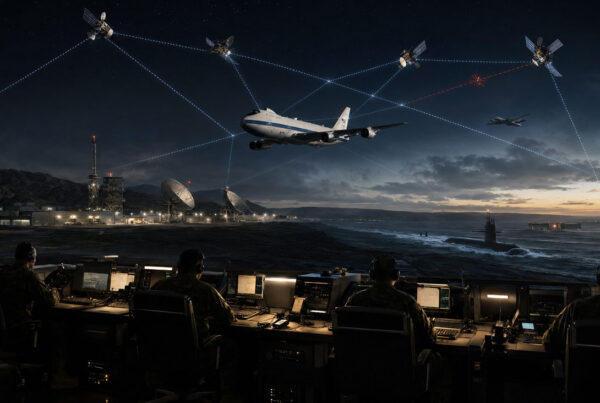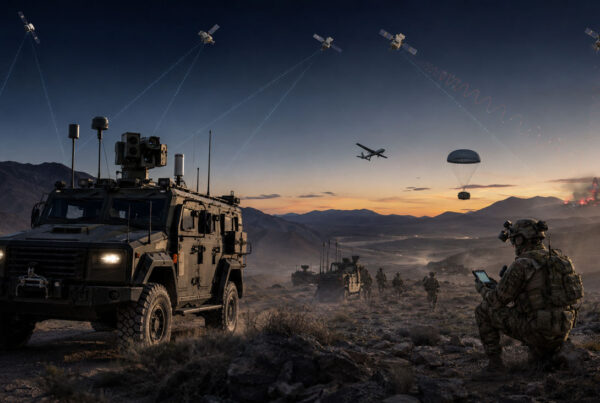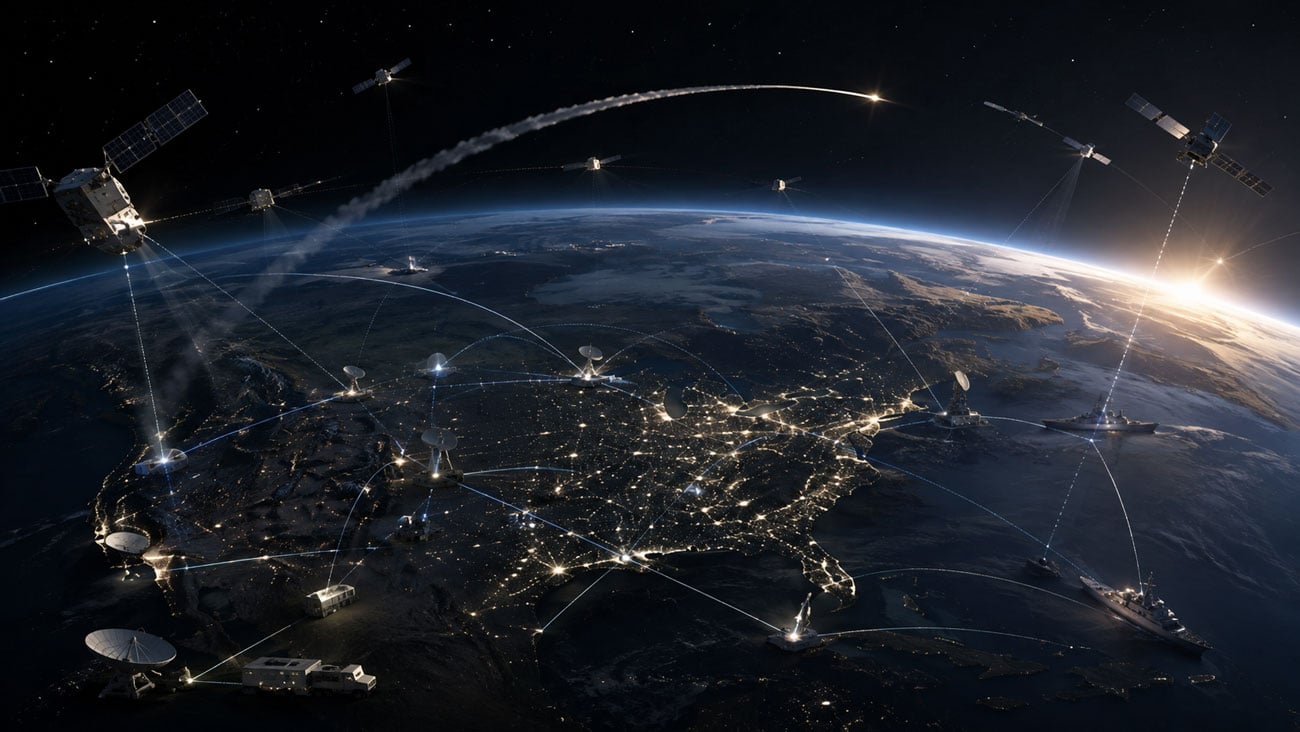
Golden Dome is accelerating investment in missile tracking, space sensors, interceptors, and command-and-control. But its hardest problem may be architectural rather than kinetic: combining legacy and new sensors, networks, decision systems, and effectors into one trusted kill chain that can operate at missile-defense speed. The decisive capability may be the integration layer that allows the United States to use what it already has while continuously adding what comes next.
Bottom line: Golden Dome’s hardest problem may not be building the next sensor or interceptor. It may be making existing and future systems behave like one weapon.
The Department has already said Golden Dome will build on current air and missile-defense capabilities while adding new space-based sensing, interceptors, and command-and-control. In April 2026, program leaders described the emerging architecture as layered, integrated, automated, and built around machine-speed threat management.
That makes the central challenge:
sensor → track → correlate → decide → assign → engage → assess.
Every arrow has to work across systems developed by different organizations, contractors, services, and generations of technology.
Missile Defense Is Becoming a Systems-Integration Problem
The visible elements of missile defense are easy to understand.
A radar detects.
A satellite tracks.
A command system decides.
An interceptor engages.
Real operations are more complicated.
Golden Dome is intended to defend against ballistic missiles, hypersonic threats, cruise missiles, and other advanced aerial threats that differ in signature, speed, altitude, trajectory, and engagement geometry.
That demands a system of systems rather than a collection of standalone weapons.
The Department said in April that Golden Dome now has an initial architecture blueprint, an established Command-and-Control Consortium, and active contracts for critical components.
The architecture itself is becoming the capability.
The United States Is Adding More Sensors—But More Sensors Create More Integration
In July 2026, the Space Development Agency awarded approximately $1.75 billion for 36 additional Accelerated Missile Defense Tranche 3 satellites.
The award includes:
- 18 missile-defense variant spacecraft from L3Harris;
- 18 missile-warning and missile-tracking variant spacecraft from Sierra Space;
- deployment across four orbital planes;
- and planned availability for launch by the end of 2028.
SDA says the spacecraft will be interoperable with Tranche 1, Tranche 2, and Tranche 3 vehicles and operate through a common ground system.
That is important.
Proliferation creates coverage and resilience.
It also creates more data, more interfaces, more communications paths, more software, and more opportunities for disagreement.
Physical resilience increases the need for digital coherence.
The Architecture Has to Maintain Custody, Not Merely Detect Launch
Missile warning is not the same as missile defense.
Detection answers:
Something is there.
Engagement requires much more:
- What is it?
- Where exactly is it?
- Which observations belong to the same object?
- Where is it going?
- Is it maneuvering?
- Which defended asset is at risk?
- Which interceptor can engage?
- When is the engagement window?
- Was the intercept successful?
That is why persistent tracking matters so much for maneuvering hypersonic threats.
The architecture must maintain custody while continuously updating the engagement picture.
Golden Dome Is a Brownfield Integration Problem
Golden Dome is not being built on an empty technology landscape.
The United States already operates substantial missile-defense capability, including:
- Ground-based Midcourse Defense;
- Aegis ballistic missile defense;
- THAAD;
- Patriot;
- Long Range Discrimination Radar;
- Upgraded Early Warning Radars;
- AN/TPY-2 radars;
- Sea-Based X-Band Radar;
- space-based missile-warning systems;
- and existing command-and-control networks.
Congressional Research Service analysis notes that Golden Dome may incorporate, update, or augment some or all of these existing systems.
That makes Golden Dome a classic brownfield modernization problem:
build the future without waiting to replace the past.
This is exactly where systems integration and transformational engineering become central to mission delivery.
Legacy Systems Are Valuable—and Architecturally Expensive
Existing systems bring enormous operational value.
They also arrive with history.
Different interfaces.
Different data structures.
Different classification boundaries.
Different software baselines.
Different cyber requirements.
Different ownership.
Different sustainment contracts.
Some were designed decades before today’s threat environment or current concepts of modular open systems.
The difficulty is not proving those systems work individually.
It is making them participate in a larger architecture without forcing every modernization effort into a custom one-off integration project.
The Command-and-Control Layer Is the Integration Engine
Golden Dome leadership has repeatedly prioritized C2 before broader interceptor integration.
In early 2026, Gen. Michael Guetlein described the emerging integrated C2 capability as the “glue layer” connecting the tactical command systems that will contribute to Golden Dome.
By March, an industry consortium had already conducted a live C2 demonstration.
And in April, the Department described Golden Dome as an architecture intended to combine persistent space-based sensing, advanced interceptors, and integrated command and control capable of managing threats at machine speed.
The sequencing is revealing.
Golden Dome does not become more capable simply because another sensor or interceptor exists.
It becomes more capable when the architecture can use that sensor or interceptor.
Data Fusion Is the Real-Time Problem Underneath C2
Multiple sensors may observe the same threat differently.
One can detect launch.
Another may provide a better angle.
A third may contribute discrimination.
A fourth may maintain custody after the threat maneuvers.
The command architecture has to determine:
- which observations represent the same object;
- which source is trusted;
- how confidence changes;
- whether the track is precise enough for engagement;
- and how that track should be distributed.
This is a data architecture and technology-enablement problem as much as a sensor problem.
The Data Cannot Move at Organizational Speed
Missile-defense engagements operate on timelines that do not permit manual coordination across organizational stovepipes.
Software has to move information, correlate tracks, manage state, and present engagement options fast enough that human authorities can make consequential decisions in time.
This does not mean removing human authority.
It means automating the machine-scale work required to support human decision-making.
The architecture therefore has to exchange trusted information at machine speed even when the organizations behind the systems still move at human speed.
The Ground Segment Is Part of the Weapon
Space-based sensors attract more attention than ground infrastructure.
But the ground layer determines whether satellite observations become operationally useful.
In March 2026, Space Systems Command awarded a $446.8 million Ground Management and Integration agreement supporting resilient missile-warning and tracking spacecraft in medium Earth orbit.
The agreement covers launch support, operations, integration, and real-time information delivery to decision-makers.
SSC explicitly says the MEO architecture is designed to detect threats ranging from bright ICBM launches to dim maneuvering hypersonic missiles and integrate with the broader national missile-defense architecture.
The satellite is one node.
The mission also requires:
- ground stations;
- mission software;
- data processing;
- networks;
- cloud and compute;
- cybersecurity;
- operators;
- and integration.
Open Architecture Is Strategic Because the Threat Will Keep Changing
The Department’s April Golden Dome update emphasized a modular, open-systems approach.
That is not simply an acquisition preference.
It is a requirement for long-term survival of the architecture.
A future sensor should be able to join without redesigning the entire network.
A new interceptor should be able to receive targeting data through known interfaces.
A new algorithm should be introduced without replacing the hardware that generated its data.
A vendor should be replaceable without losing control of the mission architecture.
Open interfaces create modernization speed.
That is also why open architecture has become so important in other fast-moving defense portfolios. Diamondback’s analysis of how the Air Force is separating mission autonomy from the fighter airframe examines the same relationship between architecture, competition, and adaptation.
The Government Has to Own the Mission Architecture
Industry will build enormous portions of Golden Dome.
That does not remove the government’s responsibility to understand and govern the complete system.
Government architecture ownership requires visibility into:
- interfaces;
- dependencies;
- data rights;
- performance;
- security boundaries;
- configuration;
- latency;
- and transition plans.
Without that ownership, the government risks creating a network of contractor-controlled technological islands connected through custom interfaces that become harder to modernize over time.
This is a portfolio-governance and architecture-strategy problem.
Golden Dome Cannot Become Integration Debt at National Scale
Rapid acquisition creates a specific risk.
Programs can successfully buy many new systems and still make the enterprise more complex.
Every new sensor, network, software service, interceptor, and commercial provider can introduce another integration burden.
That is the acquisition problem discussed in Diamondback’s analysis of whether the Pentagon can absorb innovation as quickly as it buys it.
Golden Dome may become one of the largest tests of that question.
The objective is not to accumulate systems quickly.
It is to integrate capability quickly.
Artificial Intelligence Can Accelerate Decisions—but It Cannot Repair Architecture
Golden Dome’s scale will likely require increasingly sophisticated automation and AI.
Potential uses include:
- correlating sensor observations;
- classifying threats;
- detecting anomalies;
- predicting trajectories;
- prioritizing targets;
- optimizing sensor tasking;
- and recommending engagement options.
But AI does not remove foundational integration requirements.
It still needs:
- trusted data;
- known provenance;
- timely transport;
- consistent interfaces;
- compute;
- security;
- and operational context.
AI can accelerate a functioning architecture.
It cannot compensate indefinitely for a fragmented one.
This is where AI-augmented decision support with human authority can add value without confusing automation with command responsibility.
Cybersecurity Is Embedded in the Engagement Chain
Connectivity expands capability and attack surface at the same time.
A missile-defense architecture may depend on:
- sensors;
- ground stations;
- networks;
- cloud infrastructure;
- APIs;
- mission software;
- identity systems;
- commercial services;
- and supplier software.
An adversary does not necessarily need to destroy a sensor if it can prevent the data from reaching the engagement network.
It does not need to defeat an interceptor physically if it can corrupt or delay the information needed to employ it.
Data integrity, authentication, segmentation, resilient communications, degraded-mode operations, rapid patching, and configuration control are therefore missile-defense requirements.
Resilience Has to Include Losing Nodes
Golden Dome cannot assume every sensor, satellite, communications pathway, or ground station remains available.
The same resilience principle is already driving the Space Force toward hybrid, proliferated communications architectures designed to reroute around loss.
Diamondback’s analysis of the Pentagon’s space network designed to continue after satellites are lost addresses that architecture directly.
For Golden Dome, resilience means the kill chain has alternate ways to:
- detect;
- track;
- communicate;
- decide;
- and engage.
Redundancy is only useful when the mission can actually switch to it.
Testing Has to Validate the Entire Kill Chain
Component-level success is not enough.
The real test is:
Detect → Track → Correlate → Decide → Assign → Engage → Assess.
Testing should ask:
- How much latency exists across the complete chain?
- What happens when a sensor disappears?
- Can another source assume custody?
- What happens when communications degrade?
- Can old and new systems exchange usable tracks?
- Can an interceptor consume data from a sensor it was not originally designed around?
- Can the architecture operate through cyber disruption?
- Can software fail over without breaking the mission?
This is where operational testing, readiness governance, and execution discipline become part of systems integration.
Integration Should Be Measured as a Performance Parameter
Traditional performance measures focus naturally on individual components:
sensor sensitivity, interceptor range, radar precision, satellite coverage, latency, and probability of kill.
Golden Dome needs architecture-level measures too:
- sensor-to-track latency;
- track-to-engagement latency;
- number of interoperable sensor-effector pairings;
- time required to integrate a new sensor;
- time required to integrate a new interceptor;
- mission performance after node loss;
- data-quality confidence;
- and recovery time after disruption.
Those measures answer a more important question:
How quickly can the architecture turn available capability into defensive effect?
Golden Dome Will Never Have a Final Configuration
Threats will continue changing.
Hypersonic weapons will evolve.
Cruise missiles will evolve.
Decoys will improve.
Electronic warfare will change.
Cyber threats will change.
New sensors and interceptors will enter.
Commercial space will evolve.
Software and AI will improve.
A system frozen into one final architecture would begin aging immediately.
The better model is continuous integration:
field → test → learn → add → replace → retire → improve.
That requires a government architecture stable enough to provide coherence but modular enough to accept change.
Golden Dome May Be the Ultimate Test of Modern Defense Acquisition
The Pentagon is trying to do several difficult things at the same time:
- integrate legacy systems;
- field new space sensors;
- develop new interceptors;
- use commercial technology;
- preserve competition;
- move at accelerated acquisition timelines;
- and maintain a coherent mission architecture.
Those goals can reinforce one another.
They can also collide.
Speed can create integration debt.
Competition can create incompatible systems.
Commercial technology can introduce security and sustainment dependencies.
Legacy systems can slow modernization.
The answer is not less innovation.
It is stronger architecture.
The Most Important Golden Dome Weapon May Be the Architecture
The July investment in 36 additional tracking satellites matters.
Future interceptors matter.
Ground radars matter.
Artificial intelligence matters.
But no individual component is Golden Dome.
Golden Dome exists only when those capabilities function as one defensive mission.
A sensor detects.
Another maintains custody.
A network moves the data.
Software creates a trusted track.
Command and control produces a timely decision.
An interceptor receives the right information.
The architecture assesses the outcome and prepares for the next threat.
The United States already possesses extraordinary missile-defense technologies. The next competitive advantage may come from how quickly and reliably those technologies can be connected.
That makes integration less visible than a launch or an intercept test.
It also makes it one of Golden Dome’s most consequential capabilities.
Primary Sources
- Department — Golden Dome progress update, initial architecture blueprint, C2 consortium, open architecture, and machine-speed battle management
- Department — Golden Dome system-of-systems concept and integration with existing defense architecture
- Space Development Agency — $1.75 billion Accelerated Missile Defense Tranche 3 awards for 36 tracking satellites
- Space Systems Command — $446.8 million Ground Management and Integration agreement for MEO missile warning and tracking
- Congressional Research Service — Golden Dome current capabilities, sensors, interceptors, and command-and-control architecture