Diamondback Solutions geometric shell icon in white on a black background

Diamondback

Military personnel monitoring satellite, maritime, air, and ground operations from a secure industrial command center with advanced network infrastructure
The Pentagon’s AI Race Is Becoming a Compute Race Technology & Innovation
August 13, 2026

The Pentagon’s AI Race Is Becoming a Compute Race

Artificial intelligence may be software, but military AI advantage increasingly depends on physical infrastructure: GPUs, hardened data centers, trusted data, secure networks, power, cooling, classified environments, and compute at the tactical edge. The Pentagon’s emerging AI Arsenal proposal makes that shift explicit. The next phase of defense AI is not only a model race—it is a race to build, secure,…
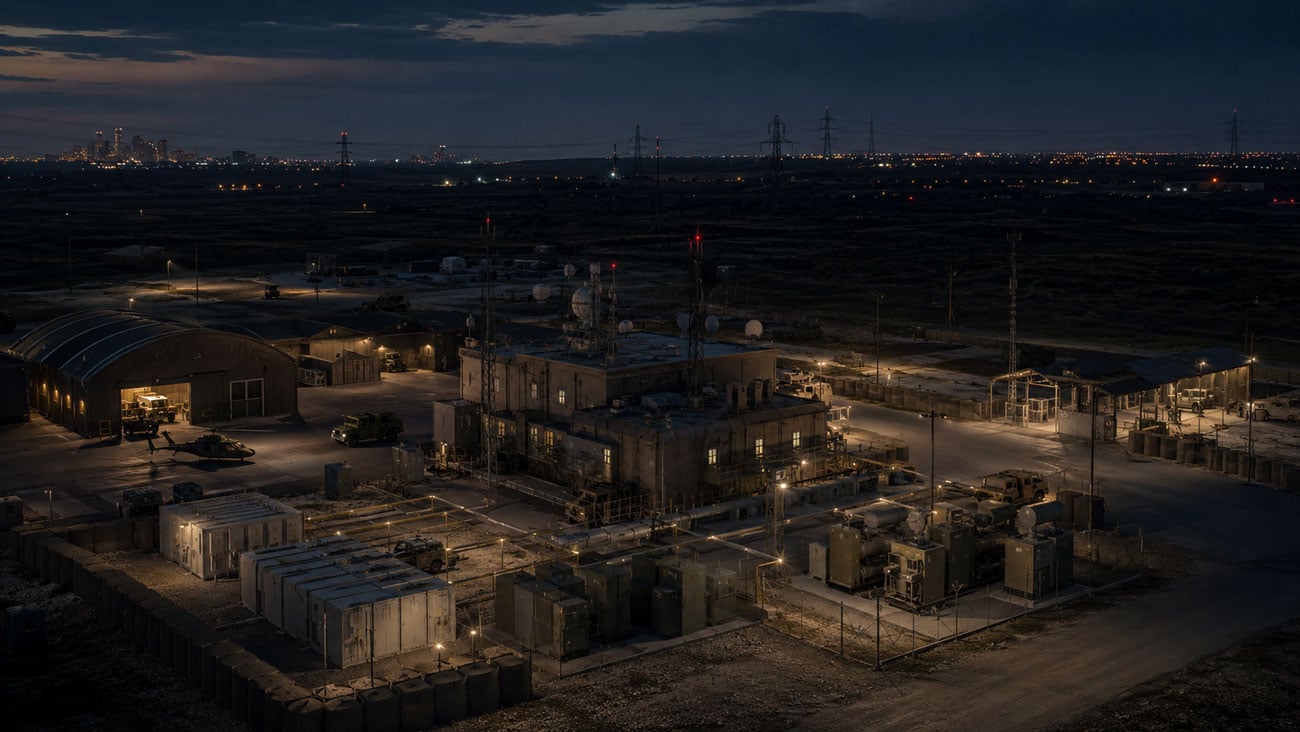
Nighttime military compound overlooking city lights with secure facilities, communications infrastructure, and personnel supporting defense operations
Power Is a Weapon System: Why Installation Energy Resilience Is Becoming Mission Assurance Mission Perspectives
August 13, 2026

Power Is a Weapon System: Why Installation Energy Resilience Is Becoming Mission Assurance

Military installations are operational systems, and nearly every mission they host depends on electricity. In 2026, the Army moved installation energy resilience deeper into the readiness architecture through 14-day islanding requirements, microgrids, long-duration storage, advanced nuclear programs, and private-sector power partnerships. The strategic shift is clear: resilient power is no longer simply a facilities function. It is becoming mission assurance.…
Engineers working inside an advanced aerospace manufacturing hangar with precision components, raw materials, robotic equipment, and missile and satellite systems
The Next Defense Supply-Chain Crisis Starts Before the Factory Industry News
August 13, 2026

The Next Defense Supply-Chain Crisis Starts Before the Factory

America’s most advanced weapons depend on materials and processing steps that sit far upstream from final assembly. In 2026, Washington accelerated investments in rare-earth separation, refining, strategic stockpiles, recycling, and deeper supply-chain mapping while directing defense contractors to trace critical dependencies back toward raw-material origin. The lesson is increasingly clear: defense production begins long before the factory—and resilience depends on…
Counter-drone defense system detecting and engaging low-cost unmanned aircraft with radar, electronic sensors, and layered interceptors
The Pentagon Is Building a Space Network Designed to Lose Satellites Industry News
August 13, 2026

The Pentagon Is Building a Space Network Designed to Lose Satellites

The Space Force is redesigning military satellite communications around a different assumption: some satellites, ground stations, links, and commercial providers will be disrupted in a major conflict. Its emerging Space Data Network combines proliferated constellations, commercial services, protected military SATCOM, hybrid terminals, and software-driven orchestration so the mission can route around damage. The strategic shift is larger than satellite design—resilience…
Technicians assembling a U.S. Navy submarine inside a large shipbuilding facility with cranes, scaffolding, and advanced manufacturing equipment
America’s Submarine Gap Is Not Just a Shipyard Problem Industry News
August 13, 2026

America’s Submarine Gap Is Not Just a Shipyard Problem

America’s submarine shortfall is not simply a problem at Electric Boat or Newport News. The Navy must reach one Columbia-class and two Virginia-class submarines per year while sustaining the existing fleet and supporting AUKUS, but current Virginia production remains well below the required rate. Closing that gap depends on a national industrial system of suppliers, skilled workers, outsourced fabrication, advanced…
U.S. military communications outpost in a desert battlefield with tactical antennas, satellite systems, vehicles, and networked command equipment
The Invisible Battlespace: Why Spectrum Maneuver Is Becoming a Core Combat Function Mission Perspectives
August 13, 2026

The Invisible Battlespace: Why Spectrum Maneuver Is Becoming a Core Combat Function

Modern forces cannot communicate, navigate, sense, target, or coordinate without access to the electromagnetic spectrum—and every transmission can also expose them. In 2026, the Army began fielding near-real-time spectrum-awareness tools, prototyping modular electronic-warfare systems, and integrating the electromagnetic operating picture into Next Generation Command and Control. The shift is larger than better jammers: the spectrum is becoming maneuver space that…
Industrial assembly line producing precision steel components with automated machinery, robotic systems, and manufacturing personnel
America Is Rebuilding the Arsenal. The Bottleneck Is Throughput. Industry News
August 13, 2026

America Is Rebuilding the Arsenal. The Bottleneck Is Throughput.

The United States is investing heavily in ammunition plants, energetics, missile components, and industrial modernization. But a July 2026 Pentagon watchdog review found finished 155mm artillery output at roughly 36,000 rounds per month—well below the Army’s 100,000-round target—and highlighted how one failed metal-parts expansion could constrain the entire production chain. The lesson is larger than artillery: deterrence depends on throughput,…
Engineers testing military technology at a mountain range facility with sensors, autonomous systems, communications equipment, and field prototypes
The Pentagon Can Buy Faster. Can It Absorb Innovation Faster? Thought Leadership
August 13, 2026

The Pentagon Can Buy Faster. Can It Absorb Innovation Faster?

The Pentagon is accelerating acquisition through portfolio-based decision structures, commercial pathways, nontraditional suppliers, and lower barriers to entry. But a faster contract award does not automatically create faster military capability. The harder challenge is absorption: integrating new technology with existing architectures, cybersecurity, data, networks, logistics, training, and operational workflows quickly enough that the innovation reaches users before the technology—or the…
Integrated U.S. missile defense network connecting satellites, radars, command systems, and interceptors across air, space, and ground domains
Golden Dome’s Hardest Problem May Be Connecting What Already Exists Technology & Innovation
August 13, 2026

Golden Dome’s Hardest Problem May Be Connecting What Already Exists

Golden Dome is accelerating investment in missile tracking, space sensors, interceptors, and command-and-control. But its hardest problem may be architectural rather than kinetic: combining legacy and new sensors, networks, decision systems, and effectors into one trusted kill chain that can operate at missile-defense speed. The decisive capability may be the integration layer that allows the United States to use what…
U.S. military logistics operations across the Indo-Pacific with cargo aircraft, naval vessels, tactical vehicles, and distributed island supply hubs
The Pacific Logistics Problem: Deterrence Depends on What Can Be Sustained After Day One Mission Perspectives
August 13, 2026

The Pacific Logistics Problem: Deterrence Depends on What Can Be Sustained After Day One

The Indo-Pacific turns logistics into a combat function. Distance, dispersion, limited infrastructure, contested communications, and vulnerable ports and airfields mean deterrence depends not only on what the United States can deploy on day one, but on what a joint and allied force can keep fueled, armed, repaired, connected, and moving after weeks of disruption. Recent 2026 exercises show the logistics…